Section 1 - Mississippi Commission on Proprietary School & College Registration: Purpose, Organization, & Powers
- 1.1 Commission Purpose
The Commission on Proprietary School and College Registration is responsible for the administration of the Mississippi Proprietary School and College Registration Law, Title 75, Chapter 60, Mississippi Code of 1972, as amended. The purpose of the Commission is to establish and implement the process for obtaining and maintaining certificates of registration and agent permits for schools offering vocational training for a fee. This administration is enacted via licensure.
- 1.2 Commission Membership
The Commission on Proprietary School and College Registration is composed of five (5) members appointed by the Mississippi Community College Board. One (1) member is appointed from each of the five (5) Mississippi Congressional districts as existed at the establishment of the commission. All commission members have held teaching, managerial, or similar positions with the public, private, trade, technical, or other institutions. Additionally, one (1) member shall be actively engaged in some capacity or retired from a privately owned trade, technical, or other institution. Initial terms of service on the commission are for three (3) to five (5) years as provided by the enabling legislation; subsequent terms are for five (5) years.
- 1.3 Commission Staff
The Mississippi Community College Board appoints such staff as is required for the performance of the commission's duties and provides necessary facilities for the commission’s operation. The administrator for the commission is the Director for Proprietary School and College Registration (henceforth “the Director.”) The Director is located at:
Mississippi Community College Board
Commission on Proprietary School and College Registration
3825 Ridgewood Road, Sixth Floor
Jackson, MS 39211
Telephone: (601) 432-6518- 1.4 Powers & Duties of the Commission
- To adopt rules and regulations for implementing institution and agent registration processes [Mississippi Code 1972, as amended§75-60-4(3).]
- To develop application forms for collecting data pertinent to the institution and agent registration processes [Mississippi Code 1972, as amended §75-60-4(3).]
- To interpret which courses and institutions are exempt from registering with the commission [Mississippi Code 1972, as amended §75-60-5.]
- To issue certificates of registration for qualifying institutions [Mississippi Code 1972, as amended §75-60-11.]
- To assign registration numbers to registered institutions [Mississippi Code, 1972 as amended [Mississippi Code 1972, as amended §75-60-11.]
- To suspend, revoke or cancel certificates of registration for cause in accordance with Mississippi Code 1972, as amended §75-60-19.
- To prescribe the conditions of the surety bond requirement for registered institutions in accordance with Mississippi Code 1972, as amended §75-60-17.
- To petition for injunctive relief in instances of advertising or other activity by unapproved institutions [Mississippi Code 1972, as amended §75-60-21.]
- To issue Agent Permits to qualifying applicants [Mississippi Code 1972, as amended §75-60-23]
- To assign Agent Permit numbers to registered agents [Mississippi Code 1972, as amended §75-60-25.]
- To suspend, revoke or cancel agent permits for cause in accordance with Mississippi Code 1972, as amended §75-60-33.
- To prescribe the conditions of the surety bond requirement for agents in accordance with Mississippi Code 1972, as amended §75-60-29.
- To approve all new programs of study and individual courses offered by registered institutions [Mississippi Code 1972, as amended §75-60-15(4).]
- To investigate complaints made against registered institutions in accordance with Mississippi Code 1972, as amended §75-60-19.
- To investigate complaints made against registered agents in accordance with Mississippi Code 1972, as amended §75-60-33.
- To maintain a written record of all complaints.
- When necessary, to conduct hearings to determine if violations of Mississippi Code 1972, as amended, §75-60-19, have been committed by registered institutions or agents.
- To appoint a duly authorized officer to preside over all hearings involving registration controversies [Mississippi Code, 1972 as amended §75-60-4(2).]
- To act through a hearing officer to issue subpoenas in accordance with Mississippi Code 1972, as amended §75-60-19(4).
- To impose civil penalties and administrative sanctions in accordance with Mississippi Code 1972, as amended §75-60-19(6), for any violations prescribed in §75-60-19.
- To collect approved fees necessary for the administration of the commission [Mississippi Code 1972, as amended §75-60-4(3).]
Section 2 - Policies Governing Activity of the Mississippi Commission on Proprietary School & College Registration
- 2.1 2.2 Commission Meeting Schedule
2.1.1 Actions of the Commission
The commission may take action only when in official session and as reflected in the commission's official meeting minutes. Opinions and personal comments of individual commission members are non-binding and do not constitute an official position of the commission.
2.1.2 Location of Meetings
Regularly scheduled meetings and called meetings of the commission shall take place in Room 507, 3825 Ridgewood Road, Jackson, MS 39211.
2.1.3 Regular Scheduled Meetings
The commission shall meet bimonthly on the third Thursday at 1:00 p.m.
2.1.4 Called Meetings
The commission shall meet for called meetings when necessary. Meeting times and locations may be changed by official action of the commission and after appropriate notification of such changes to members, the media, and registered institutions.
- 2.2 Commission Meeting Agenda
- The commission Chair and Director shall confer and prepare the agenda for commission meetings.
- Any commission member may place items on the agenda.
- All requests for items to be placed on the agenda must be received by the Director at least twelve (12) calendar days prior to the scheduled bimonthly meeting.
- The commission will only consider matters not on the agenda when a majority of the commission is present, and voting concurs that an additional item be included.
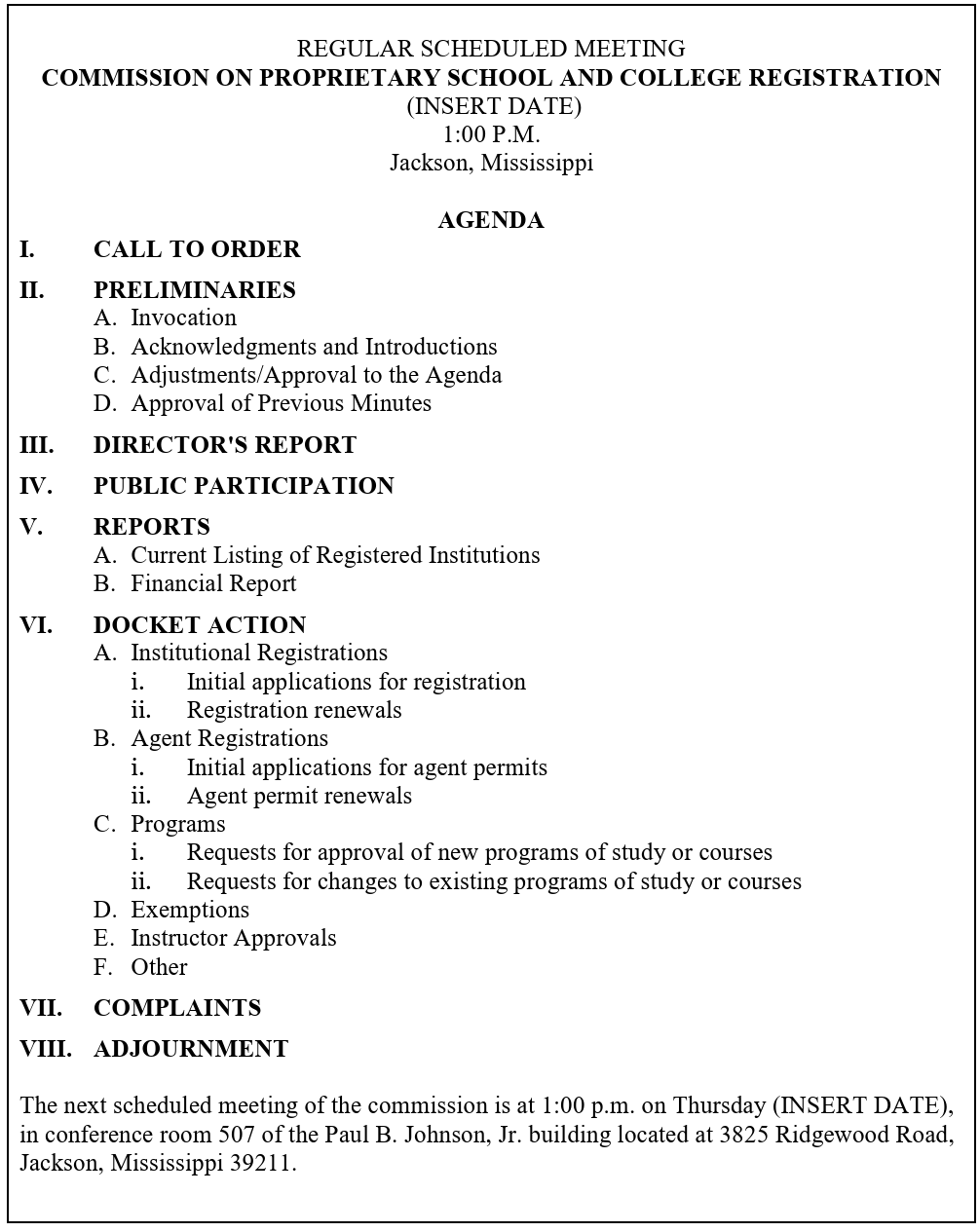
The standard format for the agenda will be as follows:
- 2.3 Notices to Commission Members
- All notices to commission members shall be mailed postage prepaid or emailed to the official mailing address as recorded at the office of the Mississippi Community College Board.
- Each commission member shall submit in writing to the Director any change in official mailing address.
- 2.4 Member Voting
- A quorum of at least three (3) commission members must be present for the commission to conduct its business.
- A commission member present may vote for or against any motion, or the member may abstain. Voting by proxy is not permitted.
- Minutes of commission meetings shall reflect the vote of each member on each matter. A unanimous vote may be reflected.
- Any commission member who may obtain pecuniary benefit from action on any application, either for himself/herself, a relative, or for any business for which he/she is associated, must recuse himself/herself from consideration of the said application.
- 2.5 Minutes of Commission Meetings
- Minutes of all commission meetings shall be the responsibility of the Director.
- The Director may secure such assistance as is necessary for the preparation of the minutes or may designate staff to prepare the minutes.
- In instances when the commission excuses the Director (or designee) from the meeting, the commission Chair shall appoint a member to record the minutes.
- Proposed meeting minutes shall become the official minutes upon approval by the commission.
- Approved minutes will be on file in the office of the Director.
- 2.6 Commission Officers & Their Selection
- There shall be the following officer for the commission: Chair. The Chair shall be elected annually at the June meeting, for a term of one year, with terms to commence on July 1st of each year.
- The Chair position may not be filled by the commission member who is actively engaged in some capacity with a privately owned trade, technical, or other institution.
- 2.7 Commission Administrative Procedures
- When the commission adopts, amends, or repeals any of its policies or procedures, the Director shall file with the Secretary of State notice of such intended action and provide notice as required.
- Notice of such action shall be filed at least thirty (30) days prior to the adoption of the rule, amendment, or repeal except when imminent peril to the public health, safety, or welfare requires adoption of a rule upon fewer than thirty (30) day notice. Thereafter, when the commission adopts a rule, amendment, or repeal, the Director shall file with the Secretary of State a certified copy of the rule, amendment, or repeal. The action shall become final thirty (30) days after the filing of the certified copy with the Secretary of State.
- 2.8 Compensation for & Reimbursement of Commission Members
- Commission members shall receive no annual salary but may receive per diem compensation as authorized by Section 25-3-69, Mississippi code of 1972, as amended, for each day or fraction thereof devoted to the discharge of commission duties or official commission meetings.
- Commission members shall be entitled to reimbursement for expenses such as meals, lodging, and other necessary expenses incurred in the discharge of their duties, including the current state rate per mile actually and necessarily traveled as authorized by Section 25-3-41, Mississippi Code of 1972, as amended.
- The discharge of official commission duties shall consist of attending regular and called meetings of the commission and attending official meetings at which the attendance of the commission member(s) is required as an official assignment by the Mississippi Community College Board.
- 2.9 Distribution of Regulations
Hard copies of the regulations for the commission are available to the public for a nominal fee. Copies are available from:
Mississippi Community College Board
Commission on Proprietary School and College Registration
3825 Ridgewood Road, Sixth Floor
Jackson, MS 39211
Telephone: (601) 432-6518Electronic copies of the regulations are available for download free of charge from the Mississippi Community College Board website at www.mccb.edu.
- 2.10 Public Access to Commission Records
- Except where prohibited by law, any person shall have the right to inspect or obtain reproductions of any public record of the commission.
- The right to inspect public records shall be invoked by a written request. Written notification of the time, place, and method of access shall be provided in accordance with section 25-61-5 of the Mississippi code.
- The right to obtain a reproduction of a public record shall be acquired by written request. The request must specify which record(s) are to be reproduced and whether the reproductions are to be mailed or received in person. Copies of public records will be available for a nominal fee.
- Denial of a request for access to, or copies of, public records of the commission will be in writing and will contain a statement of the specific reasons for the denial.
- The provisions of section 2.10 do not apply to government officials, state legislators, or state agencies.
- 2.11 Listing of Registered Institutions
The commission will maintain a list of institutions holding a valid certificate of registration. The list will be available for download from www.mccb.edu. Hard copies of this list will be available to the public for a nominal fee. Copies are available from:
Mississippi Community College Board
Commission on Proprietary School and College Registration
3825 Ridgewood Road, Sixth Floor
Jackson, Mississippi 39211The provisions of section 2.11 do not apply to government officials, state legislators, or state agencies.
- 2.12 Replacement Certificates of Registration& Agent Permits
If for any reason, a Certificate of Registration or Agent Permit must be replaced, the institution owner or agent must submit an appropriate affidavit form (Certificate of Registration Affidavit Form or Agent’s Permit Affidavit Form) and replacement fee to the Commission on Proprietary School and College Registration. The fee for a duplicate Certificate of Registration or a duplicate Agent Permit is stipulated in the current Schedule of Fees (Appendix A).
- 2.13 Disclosure of Information
Any commission member who may obtain pecuniary benefit from action on any application either for himself/herself, a relative, or for any business for which he/she is associated shall inform the Director in writing of his/her affiliation with the applicant or application.
The Director shall provide the commission a docket of all applications to be considered for action by the commission, along with the meeting notices.
- 2.14 Commission Member Participation
Upon request of the commission and to the extent permitted by law, commission members shall be allowed to present information to the commission as a representative of an institution for which a pecuniary benefit is associated. However, the commission member shall recuse himself/herself from commission deliberations regarding such application.
- 2.15 Application Review
- The commission will only consider complete applications. Applicants who submit incomplete applications will be notified and allowed fourteen (14) calendar days to submit the required information. If this information is not received within the fourteen (14) days, denial or postponement of the application will be recommended to the commission at the next commission meeting.
- The information provided in all sections of any application must be deemed sufficient and appropriate prior to application approval. If any section of any application is deemed insufficient or inappropriate, the applicant will be notified of the deficiency, and the commission may request additional information from the said applicant. Applications will be reviewed based on statutory and regulatory requirements. After the review of an application, the commission will be informed of any significant findings.
- Applications for Certificates of Registration must contain sufficient financial information to allow determination of financial stability.
- Financial resources and practices must be such that:
- There is a reasonable expectation of sound financial practices.
- There is evidence presented to suggest that the potential exists for the business to be successful.
- There is reasonable expectation that the business will continue to exist.
- There is evidence that sufficient planning has been conducted to provide for the necessary financial obligations required to assume the essential costs associated with operating the business.
- The following indicators of financial stability will also be examined:
- The Current Ratio
- Past due liabilities
- Working capital
- Stockholder equity or net worth
- Financial resources and practices must be such that:
- The institution will adhere to generally accepted accounting principles (GAAP) in the maintenance of its financial records and provides an income/expense statement and a balance sheet annually using the financial form provided by CPSCR.
- Institutions reporting gross tuition between $500,000 and $1,000,000 are required to submit a Certified Public Accountant (CPA) financial review of the most recently completed fiscal year.
- Institutions reporting gross tuition over $1,000,000 are required to submit a CPAprepared independent financial audit of the most recently completed fiscal year.
- All accredited Title IV institutions must submit CPA-prepared independent financial audits for the previous two-years of operation.
- A non-accredited institution seeking initial authorization:
- Must have unrestricted cash on hand in the amount of 120 days projected expenses available and:
- Provide a projected income/expense statement and a balance sheet for two 12month fiscal years using the financial form provided by CPSCR.
- Instructional resources must be adequate and available for individual student use.
- Any registered institution wishing to offer occupational associate degree programs must provide proof of current unencumbered accreditation by an accrediting agency recognized/authorized by the United States Department of Education.
- Initial and Renewal Applications include the submission of up to five new programs. Institutions adding additional programs will have to add the applicable fees according to the published Schedule of Fees (Appendix A).
- 2.16 On-Line/Out-of-State Distance Education Requirements (34 CFR 600.9)
In compliance with 34 CFR 600.9(c), any institution not based in the State of Mississippi, whether or not it offers instruction to residents of Mississippi only over the Internet, is determined to need a Certificate of Registration issued by the commission to offer postsecondary instruction in the State if they engage in at least one of the following activities:
- The institution maintains a telephone number with a Mississippi area code;
- The institution maintains a postal address with a Mississippi zip code;
- The institution directly markets and/or recruits Mississippi students via any means of media;
- The institution maintains an Internet URL which originates in Mississippi or utilizes an ISP which is based in Mississippi; or
- The institution provides payment reportable for income tax purposed via either a W-2 or Form 1099 to any individual resident of the State for any purpose associated with the institution’s Mississippi students.
- 2.17 Instate On-Line/Distance Education Requirements
The Commission on Proprietary Schools and College registration adopts the definition of distance education and correspondence education by the United States Department of Education (USDE) as authorized by the Higher Education Act of 2008.
- Definitions
- Distance education is education that uses one or more of the following technologies in providing educational content to students:
- The Internet; or
- One-way/two/way transmissions through open broadcast, cable microwave, broadband lines, fiber optics, satellite or wireless communication devices, audio conferencing; or
- Video cassettes, DVDs, CD-ROMs, or other media used in conjunction with any of the above technologies.
- Correspondence education is:
- Education provided through the mail or electronic transmission where interaction is limited between the student and instructor.
- Correspondence courses are typically self-paced.
- Distance education is education that uses one or more of the following technologies in providing educational content to students:
Institutions based in the State of Mississippi that offer instruction over the internet, either synchronous or asynchronous, is determined to need a Certificate of Registration issued by the Commission to offer postsecondary instruction in the State if they engage in at least one of the following activities:
- The institution uses a Learning Management System to deliver educational content and grades, or
The institution offers a minimum of 80% of its educational content online via the internet.
Student Verification
Institutions offering distance education shall have a process in place that establishes that the student who registers in a distance education program/course is the same student participating in and completing the course/program and receiving academic credit. The school meets the requirement if:
- Student uses a secure login and passcode; or
- School schedules proctored exams; or
- School uses new technologies and practices that verify the student’s identity during testing.
- Definitions
Section 3 - Regulations and Procedures for Registration of Proprietary Schools and Colleges
- 3.1 Introduction
In 1992, Mississippi Senate Bill 2636 transferred the administration of Proprietary School and College Registration from the State Department of Education to the Commission on Proprietary School and College Registration under the Mississippi Community College Board. The Commission on Proprietary School and College Registration established these regulations to implement Title 75, Chapter 60 of the Mississippi Code of 1972, as amended.
The purpose of the Mississippi Proprietary School and College Registration Law and associated regulations is to allow proprietary institutions that have adequate facilities, resources, and faculty, the opportunity to obtain a Certificate of Registration. The law and regulations are further designed to ensure that students are provided learning experiences that are conducive to the achievement of the objectives of the programs being provided to them in exchange for their enrollment fees.
- 3.2 Procedure for Obtaining Applications
Registration information may be obtained by sending a written request, along with a check or money order for the amount specified in the current Schedule of Fees, made out to “Commission on Proprietary School and College Registration” to:
Commission on Proprietary School and College Registration
3825 Ridgewood Road, Sixth Floor
Jackson, Mississippi 39211On receipt of the written request and application fee, information for registration will be sent to the applicant.
- 3.3 Issuance of Certificates of Registration
- A Certificate of Registration shall be granted or denied within sixty (60) days after receipt of the completed application by the Commission on Proprietary School and College Registration. If a Certificate of Registration cannot be issued within the 60-day period and the institution has submitted all the required information, the commission may issue a Temporary Certificate of Registration. This temporary certificate will be valid until the commission makes its determination.
- A Certificate of Registration is valid only for the institution and courses for which it is issued. A Certificate of Registration does not include additional institutions or additional locations of the same institution unless the commission has approved annex or franchise locations on the initial or the renewal certificate of registration.
- The commission may deny, suspend, revoke, or cancel a Certificate of Registration for any one cause, or a combination of the causes, specified in Section 75-60-19, Mississippi Code of 1972, as amended. In the event that the commission has cause to deny, suspend, revoke, or cancel a Certificate of Registration, the procedure outlined in Section 75-60-19 will be followed.
- 3.4 Issuance of Agent Permits
- Prior to any individual selling a course of instruction on behalf of an institution or soliciting students to enroll in the course of instruction at a registered institution, such individual must secure an Agent Permit Application from the commission.
- Complete applications for an Agent Permit will be approved or denied within sixty (60) days of receipt by the commission.
- A certificate will be issued upon approval of an Agent Permit. This certificate will state the agent's name, permit number, and the name and campus location of the employing institution and will certify that the person whose name appears on the certificate is an authorized agent of the institution.
- If an agent represents more than one school or campus, they must obtain a separate permit for each represented.
- Agent Permits are valid for one (1) year from the date of issue.
- 3.5 Exemptions to Requirements for a Certificate of Registration
- Section 75-60-5, Mississippi Code of 1972, as amended, provides for some exemptions from registration with the commission. Accordingly, the following categories of courses, schools, and colleges are not required to register with the Commission on Proprietary School and College Registration:
- Tuition-free courses or schools conducted by employers exclusively for their own employees;
- Institutions under the jurisdiction of the Board of Trustees of State Institutions of Higher Learning or the Mississippi Community College Board;
- Institutions or courses of instruction under the jurisdiction of the State Board of Cosmetology, State Board of Barber Examiners, State Board of Massage Therapy, or the Mississippi Board of Nursing;
- Courses of instruction required by law to be approved or licensed, or given by institutions approved or licensed, by a state board or agency other than the Commission on Proprietary School and College Registration; however, an institution so approved or licensed may apply to the Commission on Proprietary School and College Registration for a Certificate of Registration to be issued in accordance with the provisions of this chapter;
- Correspondence education courses;
- Nonprofit private institutions offering academic credits at primary or secondary levels or conducting classes for exceptional education as defined by regulations of the State Department of Education;
- Nonprofit private colleges and universities or any private institution offering academic credits at primary, secondary, or postsecondary levels;
- Courses of instruction conducted by a public school district or a combination of public school districts;
- Courses of instruction conducted outside the United States;
- Any institution that offers only instruction in subjects that the Commission on Proprietary School and College Registration determines are primarily for avocational, personal improvement or cultural purposes and that does not represent to the public that its course of study or instruction will or may produce income for those who take that course of study or instruction;
- Courses conducted primarily on an individual tutorial basis, where not more than one (1) student is involved at any one (1) time, except in those instances where the Commission on Proprietary School and College Registration determines that the course is for the purpose of preparing for a vocational objective;
- Kindergartens or similar programs for preschool-age children.
- To request a determination of exemption, institutions shall submit an electronic Exemption Application along with a descriptive narrative explaining how the institution or program qualifies for an exemption.
- The application shall require a citation to the exemption provision relied on in the Act and these rules and documentation supporting the requested exemption:
- Examples include copies of all institutional materials; brochures; advertising; state charter or business license; or organizational ties and/or contracts with other educational providers.
- The institutions shall inform the Commission immediately of any proposed changes within the institution or institutional offerings that may affect the exemption.
- The Commission may suspend or withdraw the exemption for an institution that fails to maintain the conditions under which the exemption was approved, engages in false advertising, or allows misleading representations to be made on its behalf.
- Institutions approved for exemption from registration are subject to periodic review by the Commission staff to ensure that all criteria for the exemption continue to be met.
- Exemptions must be renewed every 12 months from time of approval.
- An application fee (CPSCR Form 15 – Fee Schedule Form) in the amount specified in the current published Schedule of Fees (Appendix A).
- The application shall require a citation to the exemption provision relied on in the Act and these rules and documentation supporting the requested exemption:
- Section 75-60-5, Mississippi Code of 1972, as amended, provides for some exemptions from registration with the commission. Accordingly, the following categories of courses, schools, and colleges are not required to register with the Commission on Proprietary School and College Registration:
- 3.6 Additional Locations Covered Under a Certificate of Registration: Annexes
A Certificate of Registration is valid only for the institution and courses for which it is issued. The Certificate of Registration is not valid for additional locations of an institution unless the commission has approved such locations as Annexes on the current Certificate of Registration.
- An annex may be included under an existing Certificate of Registration if:
- Courses and programs offered at the annex are identical to those offered at the registered institution location; and
- The annex is under the same ownership, management, and control as the registered location.
- If the registration of an annex is sought at the same time as the application for registration (initial or renewal) of the main campus, then approval of the annex may be sought on the application for a Certificate of Registration of the main campus.
- If an application for registration of an annex does not coincide with initial registration or renewal of registration of the main campus, then a separate Application for Registration of an Annex Location must be submitted, along with all appropriate fees as stipulated on the current Schedule of Fees (Appendix A).
- Gross annual tuition revenues for a registered location and each associated annex must be combined for the purpose of determining fees payable. Tuition for each location must be reported individually on Gross Tuition Income.
- Annex locations must meet all the requirements set forth in Title 75, Chapter 60, Mississippi Code of 1972, as amended, and in these regulations.
- Annexes are subject to the same regulatory requirements as any other facility that is licensed by the commission. These requirements include, but are not limited to:
- Providing complete and verifiable information on the annex facility, including:
- General institution information (such as location, telephone, advertisements, etc.)
- Institution ownership
- Facility information
- Financial resource information
- Bond information
- Program of study information
- Instructor information
- Administrator information
- Policies for disclosure of information to students
- Student enrollment contracts
- Student grievance procedures
- Student and/or course evaluations
- Instructional equipment inventory
- Documents verifying completion of a program of study
- Adherence to the legislatively mandated refund policy
- Job placement services
- Making available on request all records related to the above statement.
- Meeting all applicable health and safety standards as required by local, state, and federal agencies.
- Notifying the commission in writing within 30 days of changes in any of the following:
- Ownership of the annex/institution
- Director of the annex/institution
- Name of the annex/institution
- Agents
- Financial stability
- The loss of eligibility for student financial aid programs
- A Cohort Default Rate greater than 19%
- Instructors
- Programs of study
- Facility standards
- Job placement services
- Evaluation methods
- Major instructional equipment
- Maintaining all premises, equipment, and facilities of the institution inadequate, safe, and sanitary conditions.
- Agreeing to make accessible to commission staff, enrollees to be interviewed for the purpose of verifying compliance with the conditions as stated on the application for a Certificate of Registration.
- Providing complete and verifiable information on the annex facility, including:
- Annexes are subject to announced and unannounced visitation by representatives of the commission and the Mississippi Community College Board.
- Annexes must have the same name as the associated registered location, distinguishable by individual site location.
- All policies, procedures, tuition, fees, catalogs, and academic calendars utilized at the registered location must also be utilized at the annex.
- If a Certificate of Registration is suspended, revoked, or canceled by the commission, the registered institution and all annexes included under that Certificate of Registration must cease to operate unless specifically granted written approval by the commission to remain in operation.
- The approved annex will be a permanent additional location of the registered institution. This facility must always be identified as an annex on each Renewal Certificate of Registration Form.
- An annex may be included under an existing Certificate of Registration if:
- 3.7 Mandatory Refund Policy
Each institution is required to take and keep a record of student attendance for each individual course meeting.
When refunds are due, they shall be made within thirty (30) days of the last day of attendance if the student has provided the institution with written notification of withdrawal. All refunds shall be made without requiring a request from the student within thirty (30) days from the date that the institution terminates the student or determines withdrawal by the student based on the last day of attendance. In any event, all refunds shall be made within sixty (60) days of the student's last day of attendance. Any unused portion of fees and other institutional charges shall be refunded as follows:
3.7.1 Refunds for Classes Cancelled by the Institution
If tuition and fees are collected in advance of the starting date of a program, and the institution cancels the class, one hundred percent (100%) of the tuition and fees collected shall be refunded. The refund shall be made within thirty (30) days of the planned starting date.
3.7.2 Refunds for Students Who Withdraw on or Before First Day of Class
If tuition-processing fees are collected in advance of the starting date of classes and the student does not begin classes or withdraws on the first day of classes, no more than One Hundred Dollars ($100.00) of the tuition and processing fees may be retained by the institution. The refund shall be made within thirty (30) days of the class starting date.
3.7.3 Refunds for Students Who Enrolled Prior to Institution Visit
Students who have not visited the institution prior to enrollment will have the opportunity to withdraw without penalties within three (3) days following a documented attendance at a regularly scheduled orientation or a documented tour of the facilities and inspection of the equipment. Institutions are required to keep records of students' initial visits and orientation sessions.
3.7.4 Refunds for Students Who Withdraw After Instruction Begins
Contractual obligations beyond twelve (12) months are prohibited. The refund policy for students attending proprietary institutions who incur financial obligations for a period of twelve (12) months or less shall be as follows:
- After the first day of classes and during the first ten percent (10%) of the period of financial obligation, the institution shall refund at least ninety percent (90%) of the tuition;
- After the first ten percent (10%) of the period of financial obligation and until the end of the first twenty-five percent (25%) of the period of obligation, the institution shall refund at least fifty percent (50%) of the tuition;
- After the first twenty-five percent (25%) of the period of financial obligation and until the end of the first fifty percent (50%) of the period of obligation, the institution shall refund at least twenty-five percent (25%) of the tuition; and
- After the first fifty percent (50%) of the period of financial obligation, the institution may retain one hundred percent (100%) of the tuition.
- 3.8 Disclosure of Information to Students
Prospective students are entitled to sufficient data as to allow them to make informed decisions regarding training opportunities and institutions. An institution is therefore obligated to provide sufficiently detailed data in advance of enrollment to enable prospective students to clearly understand their opportunities, limitations, and obligations. The following information must be fully disclosed to prospective students prior to enrollment and prior to the signing of an enrollment contract or agreement:
- Recruiting policies
- Admission requirements
- Academic calendars
- Grading system used by the school
- Graduation policy
- Programs of study lengths
- Objectives of the programs of study
- Licensing requirements for jobs
- Student support services
- Campus security policy
- School refund policy
- Student Withdrawal procedures
- Grievance Procedures
- All registered institutions shall list the Commission on Proprietary Schools and College Registration, including the following contact information as part of the grievance process.
MS Commission on Proprietary Schools & College Registration
3825 Ridgewood Road
Jackson, MS 39211
http://www.mccb.edu/offices/proprietary-schools
- All registered institutions shall list the Commission on Proprietary Schools and College Registration, including the following contact information as part of the grievance process.
- Tuition and all program fees must be explained completely.
- The percentage of students who complete the program of study within 150% of the normal time.
- The percentage of the institution’s graduates employed in their field of study or related field within six months after completion of, or graduation from, their program of study.
- The percentage of students achieving mastery of stated goals of the program of study.
- A list of postsecondary educational institutions that accept credits from the institution.
* Items A through N from the above list must be disclosed via the institution’s official student catalog.
* Items O through R must be provided to prospective students via the Institution Disclosure of Information Form (CPSCR Form 14). This form must be maintained by the institution and made available upon request to commission representatives for use in verification of compliance with this regulatory requirement.
- 3.9 Admissions & Recruitment
3.9.1 Admissions
- The admission policy shall conform to the institution’s philosophy, and objectives shall be publicly stated, printed, and made available to all students and shall be administered as written.
- The institution shall maintain records for all students showing adherence to the admission policy.
3.9.2 Recruitment
- Recruiting shall be ethical and compatible with the educational objectives of the institution.
- The institution shall provide prospective students, in writing, the information being communicated to them to ensure that each representative is communicating current and accurate information. Recruitment information shall include the following:
- Programs of study and individual courses
- Tuition and fees
- Terms
- Institution operating policies
- Certificates and diplomas offered
- Transferability of credit hours
- Graduation policies
- The percentage of students who complete their program of study within 150% of the normal time for completion The percentage of graduates employed in their field of study or a related field within six months after completion of, or graduation from, their program of study.
- Representatives of the institution shall use only those job titles that accurately reflect their actual duties and responsibilities.
- All agents, school directors, or other persons involved in the recruitment and solicitation of students shall conform to the following code of conduct:
- Understanding of “approved” and “accredited” are not the same terms and should not be used as such. Schools may only use “accredited” who have been accredited by an accrediting body recognized by the United States Department of Education.
- Where applicable, explain that in addition to the course completion, certain employed positions require examination or tests, either federal or state, to become licensed prior to employment in specific fields.
- Abstain from:
- Attempting to influence students to withdraw from a school in which they are presently attending.
- Encouraging prospective students to change plans after signing an enrollment agreement and paying a registration fee with another school.
- Making exaggerated statements concerning employment opportunities.
- Discrediting other schools, making false representations, falsely disparaging the character, nature, quality, or scope of another’s school program of instruction or services, or demeaning another school’s students.
- 3.10 Advertisement
- All promotional literature used by an institution must be factual with respect to services offered and benefits received.
- An institution registered with the Commission on Proprietary School and College Registration shall use the statement "Licensed by the Mississippi Commission on Proprietary School and College Registration, Certificate No. (insert number). Licensure indicates only that minimum standards have been met; it is not an endorsement or guarantee of quality. Licensure is not equivalent to or synonymous with accreditation by an accrediting agency recognized by the U.S. Department of Education.” on all advertising, both oral and written, and on all publications including the school catalog and enrollment agreement.
- No school shall claim accreditation from an accrediting agency through any of its advertising, promotional material, or during the solicitation process unless the accrediting agency is currently recognized as an accrediting agency by the United States Department of Education.
- 3.11 Records
- Each institution shall develop and maintain adequate records pertaining to students’ and the institution’s administrative operations. These records shall include, but are not limited to the following:
- Student attendance for each individual course meeting
- Student activities
- Student academic records
- Student enrollment
- Student admission
- Student enrollment contracts
- Financial aid information
- Job placement service information
- Programs of study and individual courses
- Graduation information
- Student withdrawals
- Student refund policy
- Student financial records (tuition, fees, payments, refunds, etc.)
- Student complaints
- Administrators
- Instructors
- Staff
- Instructional supplies and equipment
- Library and/or other instructional resources
- Physical facilities
- A permanent academic record (transcript) of each student’s progress shall be maintained. The transcript shall indicate student accomplishment in terms of clock-hours, units of credit, or some other recognized system compatible with the institution’s philosophy and objectives. The grading system used to evaluate student performance shall be fully explained on the transcript. The document must be signed and dated by a school official. These records shall be maintained permanently in a digital database by the school, its successors, or a repository.
- Each institution shall maintain a listing of all students who enroll. This listing shall include but is not limited to, each student's name, address, telephone number (if in existence), social security number or student id number, programs of study, start date, and anticipated graduation date. This information should be current as of the date on which the student enrolls and shall be available for inspection by, or submission to, the commission.
- Each institution that has an arbitration clause shall have students specifically acknowledge their understanding of any arbitration clauses placed in any enrollment contract or document with a signature or initials.
- All financial and admission records must be maintained for five years from the last date of attendance. The institution is responsible for the proper destruction of student records. Records and reports pertaining to students and staff shall be maintained so that they will be safe from theft, fire, or other possible loss.
- In the event that an institution closes its facility, the commission must be informed of the following within 60 days prior to closure:
- The location of all student records; and
- Information on how students may obtain their records.
- Permanent student records should be transferred to the Commission or their record designee within ten days of cessation of operation. The school should arrange with Staff prior to the closure.
- Records should be transferred electronically in a secure format, unless other arrangements are approved by Staff.
- Permanent records are defined as student transcripts. Copies of diplomas or certificates will also be accepted as part of permanent records.
- The closed school is responsible for arranging with Staff secure transmission of the records.
- Each institution shall develop and maintain adequate records pertaining to students’ and the institution’s administrative operations. These records shall include, but are not limited to the following:
- 3.12 Certificates or Diplomas
- The conferring of diplomas, degrees, certificates or other written evidence of proficiency issued by an institution shall be consistent with applicable state laws.
- Associate degree programs designed primarily for immediate employment must be designated as an Associate in Applied or Occupational Science degree or other appropriate title and identified with a specialty designation on degrees and transcripts approved by the Commission. This identification of a specialty or major implies relevant preparation for employment in a specific area of work and should be specified in the student’s document of completion.
- The conferring of diplomas, degrees, certificates or other written evidence of proficiency issued by an institution shall be consistent with applicable state laws.
- 3.13 Instructional Resources & Materials
- All instructional resources, including audiovisual teaching equipment and instructional materials, shall meet the needs of the institution’s educational program.
- The commission may conduct an evaluation of these materials to verify the possession and condition of items listed on the institution’s Initial Certificate of Registration Form or Renewal of Certificate of Registration Form
- Each institution shall provide instructional or library resources available to all students enrolled at the institution.
- Each individual trade area shall have a carefully chosen text for each student with adequate, up-to-date reference materials and periodicals in the particular area of training.
- Instructional resources may be consolidated or distributed throughout the educational facility or available through and online/internet-accessible service. Easy access to appropriate reference materials and audiovisual equipment is of prime importance in determining if the institution is meeting the educational needs of its students and faculty.
- 3.14 Educational Facilities
- Each institution must provide an environment that is conducive to effective instruction, promotes learning, and supports the educational programs offered.
- The buildings, classrooms, equipment, furniture, grounds, instructional tools, instructional facilities, machinery, and other physical requirements of the educational program shall be appropriate to the achievement of the educational philosophy and objectives of the institution.
- The institution shall meet general standards of safety, usefulness, cleanliness, maintenance, health, and lighting and shall be in compliance with any local or state laws governing physical facilities, particularly with respect to fire, safety, and sanitation.
- 3.15 Classroom Facilities
3.15.1 Academic Classes
3.15.1.1 Classroom size
Regular classrooms shall contain a minimum of 600 square feet of floor space or a minimum of 20 square feet per student enrolled, whichever is greatest.
3.15.1.2 Classroom Equipment
Every classroom shall provide appropriate equipment for students and instructors to include, but not limited to:
- Individual student seats and desks or tables and chairs chosen for comfort
- Instructor’s desk
- Filing and storage facilities
- Sufficient chalkboard, whiteboard, tack board, or equivalent
- Window coverings to improve visual comfort and energy efficiency
- Adequate laboratory facilities, equipment, and supplies for courses offered
3.15.2 Technical and Apprenticeship Trades
3.15.2.1 Classroom Size
The minimum size of the classroom shall be 600 square feet and be equipped to provide the greatest possible learning experience.
3.15.2.2 Classroom Equipment
Every classroom shall provide appropriate equipment for students and instructors to include, but not limited to:
- Individual student seats and desks or tables and chairs chosen for comfort
- Instructor’s desk
- Filing and storage facilities
- Sufficient chalkboard, whiteboard, tack board, or equivalent
- Window coverings to improve visual comfort and energy efficiency
- Adequate laboratory facilities, equipment, and supplies for courses offered
3.15.2.3 Workshop/Laboratory Size
Facilities used for practical instruction shall meet the size standards prescribed for each discipline by the Office of Vocational and Technical Education of the State Department of Education.
3.15.2.4 Workshop/Laboratory Equipment
Equipment shall meet or exceed the minimum standard equipment list that is prescribed for each discipline by the Office of Vocational and Technical Education of the State Department of Education.
- 3.16 Teacher Qualifications
The commission does not appoint instructors. However, the commission has a responsibility to review and evaluate their qualifications. The right of acceptance carries with it the right of revoking such acceptance for cause. All Instructor Data Forms must be submitted for approval within 10 days of hiring.
3.16.1 Academic Classes
- Classroom instructors shall hold at least a Bachelor’s degree with appropriate coursework in the teaching discipline from an accredited institution.
- Classroom instructors shall have additional training as follows:
- A minimum of eighteen (18) semester hours of credit from an accredited institution in the subject area being taught; or
- A minimum of twelve (12) semester hours in methods and techniques of teaching.
- College transcripts are required as proof of completion.
3.16.2 Technical Classes
- Classroom instructors shall have at least a high school diploma or equivalent.
- Classroom instructors shall have additional training as follows:
- A minimum of three (3) years work experience in the technical area or related field.
- A degree, certificate, or active license in the subject area or related field; or
- A minimum of eighteen (18) semester hours of credit from an accredited institution in mathematics and/or science, or courses related to the subject area.
- High school or college transcripts required as proof of completion.
3.16.3 Apprenticeship Trade Classes
- Instructors of apprenticeship trades shall have at least a high school diploma or equivalent.
- Instructors of apprenticeship trades shall have additional training as follows:
- A minimum of three (3) years work experience above the students’ level in the trade to be taught; and
- The instructor shall have recognized standing as a tradesman or specialist supported by evidence from previous employers.
- High school transcripts required as proof of completion.
3.16.4 Practical Nursing Classes
- Practical nursing faculty (full-time, part-time, and adjunct) must have an unencumbered registered nursing license in Mississippi and must:
- Hold a minimum of an Associate’s Degree in Nursing
- Have three (3) years clinical experience working as a registered nurse; or
- have two (2) years’ experience as faculty in a nursing/allied health program
- Satisfy clinical agency requirements, i.e., background checks, immunizations, CPR, etc.
3.16.5 Commercial Truck Driving Skills/Behind-the-Wheel (BTW) Classes
- Commercial truck driving staff teaching hand-on skills must:
- Classroom instructors shall have at least a high school diploma or equivalent.
- Possess a valid Class A CDL with all endorsements necessary to operate the Commercial Motor Vehicle’s applicable to the subject matter being taught (such as Long Carrier Vehicle (LCV) Doubles, LCVs Triples, including any specialized variation such as tank vehicles) that requires an additional endorsement.
- A minimum of three (3) years in-field driving experience in type of driver training being provided (LCV doubles or LCV triples, etc.
3.16.6 Approval of Substitute Instructors & Teaching Assistants
- When, in cases of emergency, sickness, etc., a regularly approved instructor is unable to perform his/her duties, and an alternate instructor is required to substitute for more than two consecutive weeks, the commission must be notified, and the credentials of the substitute submitted to the commission.
- In the event that an instructor leaves and a new instructor is employed to replace the instructor of record, the institution shall provide the commission notice of the fact within ten (10) days and submit the Instructor Data Form for the new instructor.
- When a proposed instructor does not meet the minimum requirements, the instructor may be approved as a teaching assistant under the direction of an approved instructor to meet the regulations with the following:
- Teaching assistants shall have at least a high school diploma or equivalent.
- Teaching assistants shall have additional training as follows:
- A minimum of 18 months in-field work experience in the technical area or related field; and
- A degree, certificate, or license in the subject area or related field.
High school or college transcripts are required as proof of completion.
- 3.17 Student to Instructor Ratio
3.17.1 Academic Classes
- No classroom instructor shall have over thirty (30) students enrolled in any one class, and the institution average shall not exceed 30:1, except as specifically approved by the commission.
- Ratios for laboratory or clinical instruction shall not exceed fifteen (15) students per instructor.
3.17.2 Technical and Apprenticeship Trades
- The student-to-instructor ratio for classroom instruction shall not exceed twenty-to-one (20:1).
- Ratios for laboratory or clinical instruction shall not exceed fifteen (15) students per instructor.
- 3.18 Educational Standards
- The course content and length of instruction shall be of such nature and quality as to allow that students will adequately develop job skills and knowledge necessary for obtaining employment in the occupation for which the instruction is offered.
- Any educational institution licensed by the commission shall be operated in compliance with the following standards:
- Instructional Content and Length
- All programs of a vocational nature must be evaluated against competencies needed for employment in a recognized occupation as defined in the current edition of the Dictionary of Occupational Titles published by the United States Department of Labor or occupations generally recognized by the industry in which the occupation is classified.
- Programs of study must adequately cover the subject, must be clearly presented, and must be in accordance with the best current knowledge and practice of trade, professional or manufacturing standards. Study must extend over a period sufficient to complete the work with standards appropriate for employment in the occupation for which trained or in a closely related occupation.
- Programs of study must be consistent in quality, content, and length with similar programs in public or private institutions that are approved by the Mississippi State Department of Education or the Mississippi Community College Board.
- If a program requires approval from another state or federal agency, the school may be required to provide documentation of the additional approval as part of the program review process.
- If an approved program is discontinued for any reason, the commission must be notified within thirty days. The program will then be removed from the list of approved programs.
Instructional Practices
The institution shall provide favorable conditions for effective classroom instruction to include:
- Well-defined instructional objectives,
- Systematic planning,
- Selection and use of varied learning materials and experiences,
- Adaptation of organization and instructional procedures to student needs,
- Use of varied evaluation instruments and procedures, and
- Good student and teacher morale.
- The commission will evaluate course content and length of instruction on individual applications.
- Institutions must report to the Commission the type of instruction being provided such as traditional, blended/hybrid, or distance learning).
- All certificate and diploma programs approved by the Commission shall meet the following standards:
- Certificate program is a series of technical classes designed to train students with a single skill objective. In special classes, non-technical classes may be included to meet essential occupational outcomes. A minimum of eighty percent of a certificate program’s credits or clock hours is in the technical courses that support the program’s occupational outcomes.
- Diploma program is a series of classes centered around a specific/specialized topic area. These programs include technical and nontechnical classes and are designed to train students with the necessary skills and knowledge to prepare them in a vocational/occupational field of study. A minimum of seventy percent of a diploma program’s credits or clock hours is in the technical courses that support the program’s occupational outcomes.
- Associate degree program is a series of technical and non-technical classes centered around a specific topic that prepares the student to enter a vocational/occupational specialty. A minimum of sixty percent of an associate program’s credits or clock hours is in the technical courses that support the program’s occupational outcomes.
- Any registered institution wishing to offer occupational or applied associate degree programs must provide proof of current unencumbered accreditation by an accrediting agency recognized/authorized by the United States Department of Education.
- Should an accredited registered institution loose recognized accreditation due to no fault of the institution or through a deauthorization of the accrediting body by the U.S. Department of Education, the CPSCR institution will be allowed to continue to offer approved degree programs for an 18-month period while actively seeking new accreditation.
- Institution must report quarterly on their progress to obtain new accreditation.
- Instructional Content and Length
- 3.19 Complaints Against a Licensed Agent
- The commission may revoke an Agent Permit if the permit holder solicits or enrolls students through fraud, deception or misrepresentation, or upon a finding that the permit holder is not of good moral character (as specified in Section 7560-33, Mississippi Code of 1972, as amended.)
- Complaints must be submitted in writing to the commission by a person with standing.
- The commission must receive all complaints within two (2) years of the alleged violation.
- The commission will maintain a record of all written complaints received.
- The commission will notify the complainant that the complaint has been received and will request further information if necessary.
- The commission will notify the agent’s employing institution, in writing, of the complaint. An informal conference with the agent and an institution representative may be scheduled at this time. The commission may request a written response to the issues in the complaint.
- If the complaint is resolved as a result of the informal conference, the commission will maintain written documentation of the resolution. The complainant, the agent, and the employing institution will be notified of the resolution agreement.
- If the complaint is not resolved through the informal process, the commission may schedule a hearing in accordance with the procedure in section 3.21 of this document.
- The commission will issue a written finding within ninety (90) days of receipt of the complaint. This finding will be sent to the complainant, the agent, and the employing institution’s Chief Operating Officer, and will be placed in the institution’s file at the commission office.
- If the commission determines that the complaint does not fall under the provisions of Section 75-60-19 of the Mississippi Code of 1972, as amended, the commission will attempt to refer the complainant to an appropriate agency of oversight body.
- The commission may initiate an investigation without registration of a complaint.
- 3.20 Complaints Against a Registered institution
- The Commission on Proprietary School and College Registration may suspend, revoke or cancel a Certificate of Registration for any one (1) or any combination of the following causes:
- Violation of any provision of Mississippi Proprietary School Law (Title 75 Chapter 60, Mississippi Code of 1972, as amended), or any regulation made by the commission
- The furnishing of false, misleading or incomplete information requested by the commission;
- The signing of an application or the holding of a Certificate of Registration by a person who has pleaded guilty or has been found guilty of a felony or any other indictable offense;
- The signing of an application or the holding of a Certificate of Registration by a person who is addicted to the use of any narcotic drug, or who is found to be mentally incompetent;
- Violation of any commitment made in an application for a Certificate of Registration;
- Presentation to prospective students of misleading, false or fraudulent information relating to a course of instruction, employment opportunity, or opportunities for enrollment in accredited institutions of higher education after entering or completing courses offered by the holder of a Certificate of Registration;
- Failure to provide or maintain premises or equipment for offering courses of instruction in a safe and sanitary condition;
- Refusal by an agent to display his/her Agent Permit upon demand of a prospective student or other interested person;
- Failure to maintain financial resources adequate for the satisfactory conduct of courses of study as presented in the plan of operation or to retain a sufficient number and qualified staff of instruction;
- Offering training or courses of instruction other than those presented in the application; however, institutions may offer special courses adapted to the needs of individual students where the special courses are in the subject field specified in the application;
- Accepting the services of an agent not licensed in accordance with Mississippi Proprietary School and College Law (Sections 75-60-23 through 75-60-37, inclusive of the Mississippi Code of 1972, as amended);
- Conviction or a plea of nolo contendere on the part of any owner, operator or
- director of a registered institution of any felony under Mississippi law or the law of another jurisdiction;
- Continued employment of an instructor who has been convicted of, or entered a plea of nolo contendere to, any felony under Mississippi law or the law of another jurisdiction;
- Incompetence of any owner or operator to operate a school or college.
- Complaints must be submitted in writing to the commission by a person with standing.
- The commission must receive all complaints within two (2) years of the alleged violation.
- The commission will maintain a record of all written complaints received.
- The commission will notify the complainant that the complaint has been received and will request further information if necessary.
- The commission will notify the Chief Operating Officer of the Institution that a complaint has been made and, where appropriate, the nature of the complaint. An informal conference with an institution representative may be scheduled at this time. The commission may request a written response to the issues in the complaint.
- If the complaint is resolved as a result of the informal conference, the commission will maintain written documentation of the resolution. The complainant, the agent, and the employing institution will be notified of the resolution agreement.
- If the complaint is not resolved through the informal process, the commission may schedule a hearing in accordance with the procedure in section 3.21 of this document.
- The commission will issue a written finding within ninety (90) days of receipt of the complaint. This finding will be sent to the complainant, and the Institution’s Chief Operating Officer, and will be placed in the institution’s file at the commission office.
- If the commission determines that the complaint does not fall under the provisions of Section 75-60-19 of the Mississippi Code of 1972, as amended, the commission will attempt to refer the complainant to an appropriate agency of oversight body.
- The commission may initiate an investigation without registration of a complaint.
- The presences of an arbitration clause in the student’s enrollment contract, does not negate the student’s right to file a complaint with the commission.
- The Commission on Proprietary School and College Registration may suspend, revoke or cancel a Certificate of Registration for any one (1) or any combination of the following causes:
- 3.21 Hearing Procedure
Upon a finding by the commission that there is good cause to believe that a registered institution, or an officer, agent, employee, partner or instructor, has committed a violation of section 75-6019, Mississippi Code of 1972, as amended, the commission shall initiate proceedings as outlined below:
- The commission shall initiate proceedings by serving a notice of hearing upon each and every such party subject to the administrative action. The institution or such party shall be given reasonable notice of the hearing, including the time, place and nature of the hearing and a statement sufficiently particular to give notice of the transactions or occurrences intended to be proved, the material elements of each cause of action and the civil penalties and administrative sanctions sought.
- Opportunity shall be afforded to the party to respond and present evidence and argument on the issues involved in hearing including the right of crossexamination. In a hearing, the institution or such party shall be accorded the right to have its representative appear in person or with counsel or other representative. Disposition may be made in any hearing by stipulation, agreed settlement, consent order, default or other informal method.
- The commission shall designate an impartial hearing officer to conduct the hearing, who shall be empowered to:
- Administer oaths and affirmations; and
- Regulate the course of the hearings, set the time and place for continued hearings, and fix the time for filing of briefs and other documents; and
- Direct the institution or such party to appear and confer to consider the simplification of the issues by consent; and
- Grant a request for an adjournment of the hearing only upon good cause shown.
The strict legal rules of evidence shall not apply, but the decision shall be supported by substantial evidence in the record.
The commission, acting by and through its hearing officer, is authorized and empowered to issue subpoenas for the attendance of witnesses and the production of books and papers at such hearing. Process issued by the commission shall extend to all parts of the state and shall be served by any person designated by the commission for such service. Where, in any proceeding before the hearing officer, any witness fails or refuses to attend upon a subpoena issued by the commission, refuses to testify, or refuses to produce any books and papers the production of which is called for by a subpoena, the attendance of such witness, the giving of his testimony or the production of the books and papers shall be enforced by any court of competent jurisdiction of this state in the manner provided for the enforcement of attendance and testimony of witnesses in civil cases in the courts of this state.
- 3.22 Decision After a Hearing
- The hearing officer shall make written findings of fact and conclusions of law, and shall also recommend in writing to the commission a final decision, including penalties.
- The hearing officer shall mail a copy of his findings of fact, conclusions of law and recommended penalty to the party and his attorney, or representative.
- The commission shall make the final decision, which shall be based exclusively on evidence and other materials introduced at the hearing.
- If it is determined that a party has committed a violation, the commission shall send by certified mail, return receipt requested, a copy of the final order to the party and the party’s attorney, or representative. The commission shall, at the request of the named institution or complainant, furnish a copy of the transcript of the hearing, or any part thereof, upon payment of the cost thereof.
- 3.23 Civil Penalities & Administrative Sanctions
- A hearing officer may recommend, and the commission may impose, a civil penalty not to exceed Two Thousand Five Hundred Dollars ($2,500) for any violation of this section. In the case of a second or further violation committed within the previous five (5) years, the liability shall be a civil penalty not to exceed Five Thousand Dollars ($5,000) for each violation.
- Notwithstanding the provisions of paragraph (A) of section 3.23 of these regulations, a hearing officer may recommend, and the commission may impose, a civil penalty not to exceed Twenty-five Thousand Dollars ($25,000) for any of the following violations:
- Operation of a institution without a Certificate of Registration in violation of this chapter;
- Operation of a institution knowing that the institution’s registration has been suspended or revoked;
- Use of false, misleading, deceptive or fraudulent advertising;
- Employment of recruiters on the basis of a commission, bonus or quota, except as authorized by the commission;
- Directing or authorizing recruiters to offer guarantees of jobs upon completion of a program of study or individual course;
- Failure to make a tuition refund when such failure is part of a pattern of misconduct; or
- Violation of any other provision of this document, or any rule or regulation of the commission, when such violation constitutes part of a pattern of misconduct, which significantly impairs the educational quality of the program or programs being offered by the institution. For each enumerated offense, a second or further violation committed within the previous five (5) years shall be subject to a civil penalty not to exceed Fifty Thousand Dollars ($50,000) for each such violation.
- In addition to the penalties authorized in paragraphs 3.23A and 3.23B of these regulations, a hearing officer may recommend, and the commission may impose, any of the following administrative sanctions:
- A cease and desist order;
- A mandatory direction;
- A suspension or revocation of a Certificate of Registration;
- A probation order; or
- An order of restitution.
- The commission may suspend a registration upon the failure of an institution to pay any fee, fine or penalty as required by this chapter unless such a failure is determined by the commission to be for good cause.
- In addition to the penalties and administrative sanctions authorized in these regulations, the Mississippi Community College Board is authorized to levy and collect fees from institutions to recover the cost of audits, investigations, and hearings relating to such institutions.
- All fees, civil penalties, fines and settlements received shall accrue to the credit of the Commission on Proprietary School and College Registration.
- Any penalty or administrative sanction imposed by the commission under this section may be appealed by the institution, college or other person affected to the Mississippi Community College Board as provided in Section 75-60-4(3), Mississippi Code of 1972, as amended which appeal shall be on the record previously made before the commission’s hearing officer. All appeals from the Mississippi Community College Board shall be on the record and shall be filed in the Chancery Court of the First Judicial District of Hinds County, Mississippi.
- 3.24 Employment of Agents Based on Commission
No institution may employ a recruiter on the basis of a commission, bonus or quota.
- 3.25 Changes During the Two-Year Licensure Period
- The commission must be notified in writing, within thirty (30) days of changes in any of the following:
Ownership of an institution
Certificates of Registration are not transferable. In the event of a change of ownership of a registered institution, the new owner must apply for a Certificate of Registration within thirty (30) days. If registration of the institution is granted to the new owner, the Certificate of Registration becomes valid upon the commission's receipt of legal verification of the change of ownership.
- Chief Operating Officer (Director) of an institution
- Institution name
- Agents of an institution
- Financial stability of an institution
- An institution’s loss of eligibility for student financial aid programs
- A Cohort Default Rate greater than 19%
- Instructors
- Programs of study
- Tuition Changes
- Facility standards
- Job placement services
- Evaluation methods
- Major instructional equipment
- An institution must immediately notify the Commission if it is subject to any investigative action, complaint, show-cause, or disciplinary matter with an accrediting, state, or federal agency.
- In the event that an institution wishes to cancel or surrender an active certificate of registration without closure of the facility, the commission must be provided with the following at least sixty (60) days prior to the requested day for cancelation or surrender:
- Documentation that the institution no longer meets the requirements for registration;
- Evidence that all currently enrolled Mississippi students have been notified in writing of the facility’s request to cancel the authorization in Mississippi; and
- The institution and its owners must submit payment of any and all fees due to the commission as of the date of cancelation or surrender of the certificate of registration prior to approval.
- The institution is responsible for providing the commission with permanent records be defined as student transcripts. Copies of diplomas or certificates will also be accepted as part of permanent records.
- The commission must be notified in writing, within thirty (30) days of changes in any of the following:
- 3.26 Evaluation of an Institution
The commission may conduct periodic announced and unannounced evaluations of any registered institution to determine if the institution is complying with the Mississippi Proprietary School and College Registration law and regulations. Such evaluations may also be used to verify that the institution is in compliance with material presented in its application.
Any of the following areas may be evaluated during an evaluation visit:
- General institution information (location, telephone, advertisements, etc.)
- Type of ownership
- Personnel
- Equipment
- Evaluation methods
- Job placement services
- Disclosure of required information to students
- Financial resources
- Facilities Refund policies and procedures
- Programs of study and individual course information
The institution will be notified of the results of any evaluation and may be requested to provide information concerning any questionable areas.
- 3.27 Closing of a Registered Institution
- In the event that an institution closes a facility:
- The commission will issue the institution a temporary certificate of registration for the duration the teach-out.
- The commission must be provided within sixty (60) days of the decision to close:
- The official or anticipated closing date.
- A reason for the closure with supporting evidence (where applicable).
- Evidence of the development of a method to assist students with completion of their programs of study and individual courses with written agreements with other institutions that may provide part or all of a trainout.
- A timeline showing the steps to be taken for an orderly closure of the institution.
- A list of all currently enrolled students with contact information and anticipated graduation dates.
- Evidence that all currently enrolled students have been notified in writing of the facility’s closure and have been provided written indication of where they may obtain any of their records.
- Evidence of disposition of student records, with contact information for obtaining those records post closure.
Evidence of notice sent to all students who have paid any tuition or fees toward future enrollment in a program of study or individual course informing them of the closure, and refund information.
If an institution files a bankruptcy petition, a certified copy of the petition must be lodged with the commission.
- Commission may deny an application if the applicant was an owner, senior administrator, or governing board member of an institution that closed without providing a teach-out or refunds to students matriculating at the time of closure or had unpaid fees upon a closure of registered institution.
- An institution and its owners are jointly and separately responsible to arrange at their expense for the storage and safekeeping of all student records required to be maintained and destruction of records not required to be maintained. This includes paying the costs of the transfer of records to the Commission or third party repository and for the costs of maintaining the records.
All student transcripts must be submitted in electronic format on a travel drive or other secure means to the Commission. Student records should be organized using the following naming convention:
student last name_first name_school program_last 4 digits of the Social Security #
- In the event that an institution closes a facility:
- 3.28 Current Listing of Registered Institutions
The commission will maintain a list of institutions holding a valid Certificate of Registration. The list of all registered schools is available for viewing from www.mccb.edu.
- 3.29 Requirements for Submitting Applications
This section outlines the requirements for submitting applications to the Commission on Proprietary School and College Registration. The commission may request additional information needed to make a determination regarding any application.
3.29.1 Initial Certificate of Registration
The commission must receive the following documents a minimum of 30 days prior to a Commission meeting before any action will be taken to approve an initial Certificate of Registration:
- A completed Initial Certificate of Registration Form signed by the institution owner.
- A completed background check form signed by the institution owner(s).
- A fee (CPSCR Form 15 – Fee Schedule Form) in the amount specified in the current published Schedule of Fees (Appendix A).
- A School Surety Bond Form (CPSCR Form 2) completed by the bond-issuing insurance company or agency and signed by a Mississippi Resident Agent.
- A surety bond in the amount of the penal sum specified in the current Schedule of Fees (Appendix A).
3.29.2 Renewal of a Certificate of Registration
To avoid all penalties, the commission must receive the following items at least thirty (30) days prior to the expiration of the current Certificate of Registration.
- Renewal of a Certificate of Registration Form completed in its entirety and signed by the institution owner.
- An application fee (CPSCR Form 15 – Fee Schedule Form) in the amount specified in the current published Schedule of Fees (Appendix A).
- Any additional fee based on the institution’s gross tuition income (Gross Annual Tuition Income Form) collected during the previous fiscal year (July 1 through June 30), and according to the current published Schedule of Fees (Appendix A), if due.
- If the commission does not receive the application and renewal fees at least thirty (30) days prior to the expiration of the institution's current Certificate of Registration, a Delinquent Fee may be charged, as detailed in the current Schedule of Fees (Appendix A).
- If the application for renewal of a Certificate of Registration and all monies due are not received by the expiration date of the current Certificate of Registration:
- The current Certificate of Registration will expire, and the institution must reapply as a new applicant after paying all monies owed.
- The offending institution and all annexes will be notified to cease operation.
- A copy of this notification will be sent to the office of the Mississippi Attorney General.
- A registered institution requesting a voluntary suspension shall make the request in writing within 30 days of the certificate’s expiration date and pay the applicable fees as detailed in the current Schedule of Fees (Appendix A). The voluntary suspension will be reviewed annually and may be renewed only twice. After which, the institution’s Certificate of Registration will be canceled.
3.29.3 New Programs of Study or Changes to Existing Programs
The following must be submitted to the commission prior to addition of a new program of study or changes to any existing program or course:
- A completed Program of Study Form.
- A fee (CPSCR Form 15 – Fee Schedule Form) in the amount specified in the current published Schedule of Fees (Appendix A).
- Completed Instructor Data Forms for all new instructors required to implement the new program of study or course.
* No programs of study may be offered to students until they have been approved by the commission.
3.29.4 Instructor Data Forms
The Commission on Proprietary School and College Registration does not appoint instructors; however, the commission has a direct duty and responsibility in passing upon their qualifications.
An Instructor Data Form must be completed in its entirety and submitted to the Commission on Proprietary School and College Registration for each instructor employed by the institution within in 10 days of hire. Transcripts, certificates, licenses, and verification of high school graduation must accompany the form.
3.29.5 Institution Director Data Forms
The Commission on Proprietary School and College Registration does not appoint administrators; however, the commission has the authority and responsibility to pass upon their qualifications.
The School Director Data Form must be completed in its entirety and submitted to the commission each time the Chief Operating Officer of an Institution changes within 10 days of hire.
3.29.6 Initial Agent Permits
Any person operating, enrolling, or recruiting on behalf of a proprietary institution is considered as an agent of that institution. No person may recruit on behalf of a registered institution without first registering with the commission as an agent. The commission must receive the following documents within 10 days of hiring before any action will be taken to approve an Agent Permit:
- A completed Application for Agent’s Permit
- A fee (CPSCR Form 15 – Fee Schedule Form) in the amount specified in the current published Schedule of Fees (Appendix A).
- A surety bond (CPSCR Form 3 – Agent Surety Bond Form) in the amount stipulated in the current Schedule of Fees (Appendix A).
3.29.7 Agent Permit Renewals
The commission must receive the following documents at least thirty (30) days prior to expiration of the current Agent Permit.
- A completed Application for Agent’s Permit
- A fee (CPSCR Form 15 – Fee Schedule Form) in the amount specified in the current published Schedule of Fees (Appendix A).
- A surety bond (CPSCR Form 3 – Agent Surety Bond Form) in the amount stipulated in the current Schedule of Fees (Appendix A).
If the application for renewal of an Agent Permit and all monies due are not received by the expiration date of the Agent Permit:
- The employing institution will be notified that the agent must not solicit or enroll students for the institution until a current Agent Permit is obtained.
- A copy of this notification will be sent to the office of the Mississippi Attorney General.
- The Agent must reapply for an Agent Permit as a new applicant.
- 3.30 Annual Student Enrollment & Outcome Reporting
Enrollment and outcome data reporting by program of instruction, are due annually to maintain the Certificate of Registration. Data is reported for each fiscal year of July 1 through June 30 – twelve (12) calendar months.
Enrollment/outcome reports shall be submitted annually for a reporting period established by the commission and shall include the following information:
- Number of accepted enrollments, by program of instruction, during the enrollment period;
- Number of graduates, by program of instruction, during the enrollment period and;
- Other data as required by the Commission.
Section 4 – Glossary
- Terms & Definitions
Term Definition Accreditation Accreditation is a voluntary review process to determine if educational programs meet defined standards of quality. Accreditation is completed through different organizations. CPSCR only acknowledges accrediting agencies recognized/authorized by the United States Department of Education. Agent Any person employed by an institution licensed by the commission, regardless of job title, job description, full-time or part-time employment status, who directly or indirectly influences the decision of any prospective student to enroll for a fee in a course of instruction.
This includes marketing representatives and individuals that represent institutions at job fairs. This does not apply to financial aid representatives.
Annex An Annex is an additional physical location of a registered institution that offers the same courses/programs as are offered at the registered institution; and is under the same ownership, management and control as the registered institution. Blended/Hybrid Education This is a formal educational program in which students access a portion of the curriculum through web-based content and also receive in-person instruction at a brick-and-mortar location. The online and face-to-face components work together to deliver an integrated learning experience. Change of Ownership Anyone, or a combination, of the following, constitutes a change of ownership:
- Sale of the institution or the majority of its assets;
- Division of one (1) or more institutions into two (2) or more institutions;
- Transfer of the controlling interest in stock of the institution or its parent corporation;
- Transfer of the liabilities of the institution to its parent corporation;
- Lease or rental of an institution.
Commission The Commission on Proprietary School and College Registration established under MS Code 75-60-1, Senate Bill 2636. Correspondence education Means a home study educational process under which the institution provides instructional materials, by mail or electronic transmission, including examinations on the materials, to students who are separated from the instructor. Interaction between the instructor and the student is limited, is not regular and substantive, and is primarily initiated by the student; courses are typically self-paced. Correspondence education is not distance education as defined in this glossary. Course The offering of instruction to individuals for a charge, fee or contribution of any kind, to a person or persons for the purpose of training or preparing such person(s) for a field of endeavor in a business, trade, technical or industrial occupation. Distance education Means a formal educational process in which the instruction in a course occurs when students and instructors are not in the same place. Instruction may be asynchronous or synchronous. Distance education uses the technologies set forth in this paragraph to deliver instructions to students and to support regular, substantive interaction between students and instructors. A distance education course instructor may use any of, but not limited to, the following technologies: the Internet; one-way and two-way transmissions through open broadcast, closed circuit, cable, microwave, broadband lines, fiber optics, satellite or wireless communications devices; audio conferencing; or video cassettes, DVDs and CD-ROMs if used as part of the distance-learning course or program. Enrollment Contract/Agreement The enrollment agreement is the contract signed between the student and the institution. The agreement specifies the conditions under which the school will provide instruction to the student. It also specifies all costs a student must pay in order to enroll in a specific school program. The student and an authorized agent of the school must date and sign the agreement prior to the time instruction begins. First year after initial registration Twelve (12) calendar months immediately following the effective date of issuance of an initial Certificate of Registration. General Education courses Means a unit of learning that is non-technical in nature and is a fundamental part of a program. The content is drawn from oral and written communications, social studies, mathematics, natural sciences, and the humanities. Graduate Any student (full-time or part-time) who upon completion of a program of study receives a certificate, license, or diploma from a proprietary institution licensed by the commission. Gross Annual Tuition Means the tuition income (minus tuition refunds) received by a registered school and its annexes in approved programs as computed over a consecutive 12-month period. Fees for GAT, as defined in Appendix A, are paid at the end of each fiscal year as defined by CPSCR. Proprietary Institution A "proprietary school" or "school" is any private, for-profit or nonprofit business enterprise that maintains a place of business in this state or seeks business there, is not expressly exempt by MS Code Section 75-60-5, and provides a course or courses of instruction that prepare the individual or individuals in question for employment in a trade, business, technical, or industrial capacity or study through classroom instruction, telecommunications or electronic media technology, or any combination of these for a fee. Institution Chief Operating Officer Person responsible for the daily operations of an institution. Interchangeable with Institution Director. Institution Director Person responsible for the daily operations of an institution. Interchangeable with Institution Chief Operating Officer. Institution owner If the institution is owned by an individual, that individual; if the Institution is owned by a partnership, all partners; if the institution is owned by a corporation, the officers, and directors of the corporation. Last day of student attendance The date that a student gives written notice to the institution that he /she has withdrawn; or the date on which a student meets all of the following conditions:
- The student has failed to attend classes for thirty (30) successive calendar days; and
- The institution has notified the student, and that the student will be considered withdrawn if he/she does not notify the institution to the contrary within twelve (12) calendar days from the date on which the letter is mailed (postmarked); or
- The student fails to respond within the twelve (12) day period.
Non-Technical Course Means a unit of learning that is non-technical in nature and includes general education courses, basic/college life skills, or other related courses as determined by the Commission. Normal time to completion The published time period required for completion of a program of study. Occupational Degree Means a credential awarded by a school upon successful completion of an associate degree program and designated as “applied or occupational” in the creditial title. This program shall contain a minimum of 60% technical course credits/clock hours. Associate degree programs designed primarily for immediate employment should be designated as an Associate in Applied Science degree, or other appropriate title, and identified with a specialty designation. This identification of a specialty or major implies relevant preparation for employment in a specific area of work and should be specified on the students’ document of completion. Program of study A series of individual courses in an area of specialization for which a diploma, degree, certificate or other written evidence of proficiency or achievement is offered/awarded. Quarter An instructional term of up to fourteen (14) weeks. Recruitment Recruitment is the process of searching for prospective students and motivating them to apply for enrollment at the institution. Registered location The location for which a certificate of registration is valid excluding, any annexes or franchise locations. Short-Term Professional Development Training Courses (Continuing Education Units) Specialized training courses intended to help increase professional knowledge and skills for experienced individuals. These courses have no more than 20 contact hours and are non-credit bearing courses. These include, but not limited to, seminars, workshops, and continuing education. Semester An instructional term of fifteen (15), sixteen (16), seventeen (17), or eighteen (18) weeks. Student Any person who enters into a student enrollment contract or agreement. Student catalog A typed and bound publication that is readily identifiable as a catalog. The catalog must be designed and written to convey accurate impressions of the institution. The catalog must avoid false or misleading statements. The catalog should provide sufficient detailed data to enable prospective students to clearly understand their opportunities, limitations, and obligations.
Each student must be given a copy of this catalog upon enrollment. Students may be provided with a digital link to or copy of the catalog in lieu of a physically bound document. If only a digital copy/link is provided to the student, acknowledgment of receipt must be in the student’s record.
Student Mastery Students’ successful completion of a nationally recognized examination or comprehensive exam for a program of study. Mastery is calculated by the completion of a grade of “C” or better. Technical Course Means a unit of learning which yields skills, knowledge and understanding essential to the specific occupation for which the program is designed. Temporary Certificate of Registration This status allows an institution to operate under provisional authorization. Terms of the operation will be assessed based on the reason for the issuance of the temporary certificate. Additional monitoring by CPSCR staff is required on all operations. Term The amount of instructional time covered by an enrollment period. The Director The Director of the Commission on Proprietary School and College Registration. Voluntary Suspension This status allows a school to maintain its approval, but they cannot enroll, advertise or provide instruction. The institution will pay the applicable fee for the “voluntary suspension” status, which allows them to go become active again without having to go through the entire approval status again. This may be renewed only twice and will be reviewed annually. Working capital Current assets less current liabilities; it is a measure of whether a company will have sufficient resources to meet short-term debts. Institutions for initial authorization must have unrestricted liquid funds available in at least the amount of 90 days of projected expenses. Payments must be submitted in the form of a check or money order made out to “The Commission on Proprietary School and College Registration.” Send payments to:
Commission on Proprietary School and College Registration
3825 Ridgewood Road, Sixth Floor
Jackson, Mississippi 39211
Payments are nonrefundable.
Appendix A
- Application Packet Fee
Application Packet Fee ($25)
A fee of $25 (business check or money order) must accompany each Application Packet request.
- Initial Application for a Certificate of Registration
Initial Application Fee ($2,500)
Each initial application for a Certificate of Registration must be accompanied by a check or money order in the amount of $2,500 includes five (5) new programs. Certificates of Registration are valid for two (2) years. However, some fees are due annually for each previous year. If fees are not paid annually, the Certificate of Registration may be revoked or suspended.
Surety Bond (or Equivalent)
A surety bond must accompany each initial application for a Certificate of Registration.
The minimum amount of the bond required shall be based on the gross annual tuition collected by the institution during their previous year of operation or on estimated gross annual tuition for the current year, whichever is larger, and shall be as follows:
Gross Annual Tuition after Refunds Minimum Bond $0 - $1,000,000 $50,000 minimum bond required $1,000,001 - $3,000,000 $100,000 minimum bond required $3,000,001 - $5,000,000 $150,000 minimum bond required Over $5 million $200,000 minimum bond required All initial applicants must provide the minimum required bond for their first year of operation in the amount of $50,000. After the first year of operations and GAT reporting, staff will assess the bond requirement as it applies to the above schedule. Alternatively, applicants may file cash, a certificate of deposit, or government bonds in lieu of the bond.
- Gross Annual Tuition Fees
Gross Annual Tuition Fees
Gross Annual Tuition Fees are due annually to maintain the Certificate of Registration. Fees are due each fiscal year of July 1 through June 30 – twelve (12) calendar months.
When Gross Annual Tuition Fees are not paid and/or GAT notarized GAT forms are not submitted at least thirty (30) days prior to due date, a Delinquent Fee must be paid in addition to all other fees due.
Gross Annual Tuition (GAT) Fee If GAT is less than $50,000 $500 If GAT is greater than $50,000 $1,000 or 25/100 of 1% (.0025) of GAT whichever is greater Delinquent Fee ($500)
When all fees for Gross Annual Tuition are not paid and/or notarized GAT forms are not submitted at least thirty (30) days prior to the due date, a Delinquent Fee must be paid in addition to all other fees due.
The Delinquent Fee is $500. Fees will increase by $500 for every 30 days that fees are not paid for a maximum for $3000. Failure to pay the assessed Delinquent Fee may lead to the suspension or revocation of the institution’s Certificate of Registration.
- Application for Renewal of a Certificate of Registration
Renewal Application Fee ($1,000)
Each application for renewal of a Certificate of Registration must be accompanied by a check or money order in the amount of $1,000. Certificates of Registration are valid for two (2) years. However, gross annual tuition fees and forms are due annually for each previous fiscal year (July 1 through June 30). If fees are not paid annually, the Certificate of Registration may be revoked or suspended.
Surety Bond (or Equivalent)
A surety bond must accompany each renewal application for a Certificate of Registration.
The minimum amount of the bond required shall be based on the gross annual tuition collected by the institution during their previous year of operation or on estimated gross annual tuition for the current year, whichever is larger, and shall be as follows:
Gross Annual Tuition after Refunds Minimum Bond $0 - $1,000,000 $50,000 minimum bond required $1,000,001 - $3,000,000 $100,000 minimum bond required $3,000,001 - $5,000,000 $150,000 minimum bond required Over $5 million $200,000 minimum bond required Alternatively, applicants may file cash, a certificate of deposit, or government bonds in lieu of the bond.
Voluntary Suspension ($250)
Renewed only twice and reviewed on an annual basis.
Delinquent Fee ($500)
When all fees for renewal of a Certificate of Registration are not paid at least thirty (30) days prior to expiration of an institution’s current Certificate of Registration, a Delinquent Fee must be paid in addition to all other fees due.
The Delinquent Fee is $500. Fees will increase by $500 for every 30 days that fees are not paid for a maximum for $3000. Failure to pay the assessed Delinquent Fee may lead to the suspension or revocation of the institution’s Certificate of Registration.
- Reinstatement of Registration
Reinstatement Fee ($1,000)
The fee for reinstatement of registration of a suspended institution is $1,000.
- Application to Register an Annex of an Approved Institution
Annex Registration Application Fee ($250)
A fee of $250 must accompany each application to register a new annex of an approved institution unless the annex approval request is included in the institution’s application to renew their Certificate of Registration.
- Application for Appropval to Offer a New Course Within an Approved Program of Study
New Course Fee ($250)
A fee of $250 must accompany each application for approval to offer a new course within an approved course of study unless the approval request is included in the institution’s application to renew their Certificate of Registration.
- Application for Approval to Offer a New Program of Study
New Program/Change to Program Fee ($250)
A fee of $250 must accompany each application for approval to offer a new program of study unless the new program or program modification approval request is included in the institution’s application to renew their Certificate of Registration. Fee includes one new course only.
- Application for an Initial Agent Permit
Initial Application Fee ($500)
Each initial application for an Agent Permit must be accompanied by a check or money order in the amount of $500. Agent Permits are valid for one (1) year. All registered institutions must have at least one active agent licensed during operation.
Surety Bond (or Equivalent)
A surety bond in the penal sum of $10,000 must accompany each application for an initial Agent Permit. Alternatively, applicants may file cash, a certificate of deposit, or government bonds in the amount of $10,000 in lieu of the bond.
- Application for Renewal of an Agent Permit
Renewal Application Fee ($250)
Each application for renewal of an Agent Permit must be accompanied by a check or money order in the amount of $250. Agent Permits are valid for one (1) year.
Surety Bond (or Equivalent)
A surety bond in the penal sum of $10,000 must accompany each application for renewal of an Agent Permit unless a continuous bond in the penal sum of $10,000 has been furnished. Alternatively, applicants may file cash, a certificate of deposit, or government bonds in the amount of $10,000 in lieu of the bond.
- Other Fees
Other Fees ($250)
A fee of $250 must accompany each change of address, change of ownership, program modification, or name change request.
Exemption Fee
A fee of $100 must accompany each application for determination of exemption from registration with the commission.
- Special Site Visit Fee
Special Site Visit Fee ($500 plus actual visiting team expenses)
A fee of $500 will be assessed to an institution for special site visits such as accreditation visits, hearings for complaints, audits (other than regularly scheduled) and investigations.
In addition to the Special Site Visit Fee, fees will be assessed to an institution to cover the actual expenses of the visiting team including travel, meals, and lodging.
- Replacement Fees
Replacement Fees ($5)
A replacement fee for a duplicate Certificate of Registration or a duplicate Agent Permit is $5.