Introduction
The Mississippi Office of Adult Education administers the Adult Education and Family Literacy Act (AEFLA), reauthorized on July 22, 2014 as Title II of the Workforce Innovation and Opportunity Act (WIOA).
The intent of this manual is to provide governance and guidance in the delivery of adult education services by clearly defining staff roles, program expectations, and operating guidelines. The policies represent high-level program statements that embrace the goals of adult education and define what is acceptable to ensure program success and effective, consistent program operations.
The infrastructure provided in this manual reflects federal authority expectations and supports the vision and mission of Mississippi’s Adult Education Program. In addition, the policies also reflect any current broader legislative actions and other state agency policies and mandates related to state authority.
This manual is intended to be used exclusively by MCCB’s Adult Education Program and subrecipients funded through the Adult Education and Family Literacy Act (AEFLA) and will be periodically revised and updated to reflect significant changes at the OAE regarding the Adult Education Program.
This manual contains the policies and procedures developed by the Mississippi Community College Board, Office of Adult Education. These policies define the course of action state and local providers will take to implement the Workforce Innovations and Opportunity Act, (WIOA), and Title II – Adult Education and Family Literacy Act (AEFLA).
Copyright© 2017 by Mississippi Community College Board Revised: May 2024 For information, please contact 601-432-6518.
Note: Contingent upon additional information that would affect its efficacy, these guidelines are subject to change throughout the program year. Updates will be posted at www.mccb.edu.
Section 1: Program Overview
- Vision and Mission
Vision
The vision of the Mississippi Community College Board (MCCB), Office of Adult Education (OAE), is to provide leadership, training, and technical assistance to adult education and literacy programs and to ensure that quality educational services are available to adults and out-of-school youth across Mississippi.
Mission
Our mission is to enable every adult learner in Mississippi to acquire the necessary basic skills— reading, writing, computation, speaking, and listening—to compete successfully in today's workplace, strengthen family foundations, and exercise full citizenship.
- Federal Role in Adult Education
The Workforce Innovation and Opportunity Act (WIOA) went into effect July 22, 2014, replacing the Workforce Investment Act (WIA) of 1998. WIOA reauthorizes Title II: The Adult Education and Family Literacy Act (AEFLA), which provides the framework for the Mississippi Adult Education program. The US Department of Education, Office of Career, Technical, and Adult Education, Division of Adult Education and Literacy (OCTAE-DAEL) provides grants to states to fund adult education and literacy services, including workplace literacy, family literacy, English language acquisition, integrated English literacy and civics education, workforce preparation, or integrated education and training.
- Purpose of WIOA
Program Alignment
- Unifies strategic planning across core programs
- Enhances the role of state and local Workforce Development Boards in implementing a Combined State Plan Increased Accountability
- Establishes common measures across core programs
- Increases accountability and transparency through reporting and evaluations
Enhanced Service Delivery
- Promotes engagement of employers and alignment of education and training activities through career pathways
- Strengthens partnerships and investments in the one-stop delivery system
Increased Accountability
- Establishes common measures across core programs
- Increases accountability and transparency through reporting and evaluations Enhanced Service Delivery
- Promotes engagement of employers and alignment of education and training activities through career pathways
- Strengthens partnerships and investments in the one-stop delivery system
- Federal Governing Authority
- Adult Education and Family Literacy Act (AEFLA)— (The Act) Enacted July 1, 2014, as Title II of the Workforce Innovation and Opportunity Act of 2014, Pub. L. 113-128.
- Uniform Administrative Requirement, Cost Principles and Audit Requirements for Federal Awards (2 CFR 200).
Program administrators and practitioners need to rely on the terms of the federal statute as well as any suggested guidelines the U.S. Department of Education may disseminate. Local providers receiving state and federal funds must adhere to all state and federal laws and regulations governing AEFLA. Additionally, local providers are subject to any State Board Policy and policies of the local providers who are awarded AEFLA grants.
- Mississippi's Strategic Plan
- Provide every Mississippian the opportunity to be work or career ready and to secure his or her dream job right here at home
- Create a workforce ecosystem where all parts are connected to achieve common goals
- Develop a career pathway model that integrates programs and improves efficiency in employment service delivery across partners, focusing on individuals with barriers to employment
- Strategically align programs with current and emerging high-demand sectors
The OAE establishes the following four goals for Mississippi’s adult education delivery system to ensure the opportunity for academic success of all learners:
- Strengthen College and Career Readiness for Adult Learners: The OAE will provide training and support to eligible providers, preparing adult learners for success in postsecondary education and the workforce. Emphasizing the Smart Start Course, based on the U.S. Department of Education's Employability Skills Framework, will be integral to this goal. The Smart Start Course was developed by the OAE and is an educational initiative aimed at equipping individuals with essential academic foundational knowledge and job readiness skills. Individuals not only gain fundamental education but also benefit from the ACT® WorkKeys Curriculum. This integration empowers individuals with a unique opportunity to earn the National Career Readiness Certificate®.
- Develop Multi-Level Career Pathways Options: The OAE aims to enable the creation of multiple entry points into postsecondary education tailored to various functioning levels of adult education learners. These pathways will align with identified student readiness levels and lead to credentials, certifications, and degrees that open doors to employment in high-growth, family-supporting jobs.
- Increase Postsecondary Transitions and Credential Attainment: By providing support and training to eligible providers, the OAE aims to ensure that students seamlessly transition to postsecondary education or training, earning in-demand credentials for self-sustaining employment. The integration of adult education with occupational education and training will be a key focus, promoting the development of career pathways systems.
- Role of the MCCB, Office of Adult Education
- Manage and distribute federal and state funds, provide leadership and technical assistance related to adult education and literacy instruction, and offer High School Equivalency (HSE) testing throughout Mississippi
- Strive to ensure the availability of high-quality adult education programs in which individuals may earn high school credentials, improve English language skills, prepare for the workforce, and prepare for postsecondary education and training programs
- Ensure alignment of adult education and literacy activities with core programs and onestop partners to support the Mississippi Combined State Plan
- Provide high-quality professional development to improve instruction, including essential components of reading instruction and dissemination of models and promising practices
- Provide technical assistance to providers based on research-based instructional practices, local one-stop responsibilities, and effective use of technology
- Monitor and evaluate the quality of adult education activities in the state
- Adult Education and Family Literacy Act Purpose
In accordance with the Workforce Innovation and Opportunity Act (WIOA) of 2014, Title II Adult Education and Family Literacy Act (AEFLA), the purpose of this program is to assist eligible applicants in developing instructional programs and partnerships to provide services that focus on the following:
- Assist adults to become literate and obtain the knowledge and skills necessary for economic self-sufficiency
- Assist adults who are parents or family members to obtain the education and skills necessary to become full partners in the educational development of their children, which leads to sustainable improvements in the economic opportunities for their families
- Assist adults in attaining a secondary school diploma and transitioning to postsecondary education and training, including career pathways
- Assist immigrants and other individuals who are English Language Learners in improving their listening, speaking, reading, writing, and mathematical skills as well as their understanding of the American system of Government, individual freedom, and the responsibilities of citizenship
The AEFLA Resource Guide provides additional support to the following:
- Performance Accountability
- One-Stop Partner Roles and Responsibilities
- Competitions and Making Awards under Subpart C of 34 CFR Part 463
- AEFLA Activities - Integrated Education and Training (IET)
- AEFLA Activities—Basic Grant Services for English Language Learners
- AEFLA Activities - Workforce Preparation
- Section 243 Integrated English Literacy and Civics Education Program
For individual definitions of adult education and literacy activities, see definitions at the end of this section.
- Eligibility for Services
In accordance with WIOA Title II, Section 203, “Adult Education” is defined as services or instruction below the postsecondary level for individuals who:
- have attained 16 years of age
- are not enrolled or required to be enrolled in secondary school under the Mississippi Compulsory School Attendance Law (§ 37-13-91)
- lack sufficient proficiency in basic educational skills to enable the individuals to function in society, or
- do not have a secondary school diploma or its recognized equivalent, or
- are English Language Learners (ELL)
Veterans will receive priority of service.
- Veterans, as defined under WIOA, Section 3(63)(A) and 38 U.S.C. 101, receive priority of service in all Department of Labor-funded training programs under 38 U.S.C. 4215 and described in 20 CFR part 1010.
- A veteran still must meet each program’s eligibility criteria to receive services under the respective employment and training program.
Mississippi requires 16- & 17-year-olds to provide the following documentation:
- Age Waiver Permission Form is required for all 16 and 17-year-olds AND
- Withdrawal form signed by a school representative certifying the applicant is no longer enrolled in K-12
Note: In the event a withdrawal form is not obtainable, a “notarized” Age Waiver Permission Form is required.
According to the Mississippi Compulsory School Attendance Law, participants who turn 17 before September 1 of the calendar year are not classified as “compulsory-school-aged children.” Therefore, withdrawal documentation is not required for their enrollment in an adult education program.
- Program Services and Activities
Each eligible provider receiving a grant must use the awarded funding to establish or operate programs to provide adult education and literacy activities including programs that provide such activities concurrently. The term “Adult Education and Literacy Activities” includes academic standards-based programs, activities, and services outlined in WIOA Title II, Section 203(2); 34 CFR 463.30:
- Adult education and literacy activities
- English language acquisition activities
- Family literacy activities
- Workforce preparation activities
- Workplace adult education and literacy activities
- Integrated English Literacy and Civics Education (IELCE)
- Integrated Education and Training (IET)
In accordance with federal regulation, eligible providers may receive adult education funding for the delivery of any of the following adult education and literacy activities for all public and correctional facilities:
Adult Basic Education (ABE) refers to instruction at the 0–8.9 grade levels in reading, communication skills (writing, speaking, listening), mathematics, social and physical sciences, health, critical thinking, financial literacy, health literacy, basic computer literacy, and employability skills needed to function effectively in society. The curricula of beginning and intermediate ABE courses shall assist adult learners in the development of the skills necessary to process both written and oral information, and to derive meaning from the information applied to specific tasks.
Students with a high school credential may be served in core services if they score 8.9 or below on the Tests of Adult Basic Education (TABE). It is strongly recommended the population without a high school diploma or its equivalent take precedence. In other words, serving the population with a high school diploma or its equivalent, as capacity permits, should not be in lieu of the population without a high school diploma or its equivalent.
Adult Secondary Education (ASE) refers to instruction at the 9.0–12.9 grade levels designed to assist learners in pursuit of a high school equivalency diploma. Adult secondary education/HSE test preparation provides instruction designed for adults who have some literacy skills and can function in everyday life but who are not proficient in reading, writing, speaking, problem solving, or computation or do not have a high school diploma.
English Language Acquisition A program of instruction designed to help eligible individuals who are English language learners (ELLs) to achieve competence in reading, writing, speaking, and comprehension of the English language, and that leads to attainment of a secondary school diploma or its recognized equivalent and transition to postsecondary education and training or employment. Adult education programs offering English language acquisition services are required to include civics education.
Integrated Education and Training (IET) A service approach that provides adult education and literacy activities concurrently and contextually with workforce preparation activities and workforce training for a specific occupation or occupational cluster for the purpose of educational and career advancement.
Instruction must occur concurrently, use occupationally relevant (contextual) instructional materials, and be organized to function cooperatively with a single set of learning outcomes for the purpose of educational and career advancement. An IET must include the following three components:
- Adult education and literacy activities
- Workforce preparation activities
- Workforce training for a specific occupation or occupational cluster
Integrated English Literacy and Civics Education (IELCE), WIOA, Section 243 Educational services provided to adult English language learners, including professionals with degrees and credentials in their native countries, that enable them to achieve competency in the English language and acquire the basic and more advanced skills needed to function effectively as parents, workers, and citizens in the United States. Services include instruction in literacy and English language acquisition, instruction on the rights and responsibilities of citizenship and civic participation and may include workforce training (WIOA, Section 203(12)).
Integrated English Literacy and Civics Education (IELCE) is a separate, competitive grant funding under Title II, AEFLA; however, all rules and regulations apply, including the same grant announcement and application process detailed in 34 CFR 463.
Section 243 provides services and activities that:
- prepare adult English language learners for, and place such adults in, unsubsidized employment with in-demand industries and occupations that lead to economic selfsufficiency
- integrate with the local workforce development system to carry out the activities of the program
Integrated English Literacy and Civics Education includes instruction on the rights and responsibilities of citizenship and civic participation and may include workforce training (WIOA, Section 231 funds). These funds can be used in combination with Integrated Education and Training (Section 243 funds) as defined in WIOA, Section 203(11). (See definitions for Integrated Education and Training and Integrated English Language and Civics).
A grantee may meet the requirement to use funds for integrated English literacy and civics education in combination WITH integrated education and training activities by either:
- co-enrolling participants in integrated education and training, as described in 34 CFR 463 Subpart D, provided within the local or regional workforce development area from sources other than WIOA, Section 243
- using funds provided under WIOA, Section 243, to support integrated education and training activities as described in 34 CFR 463, Subpart D
Workplace Adult Education and Literacy Activities refers to adult education and literacy activities offered by an eligible provider in collaboration with an employer or employee organization at a workplace or an off-site location designed to improve the productivity of the workforce through the improvement of literacy skills.
Workforce Preparation Activities (Smart Start Pathway Course) are programs or services designed to help an individual acquire a combination of basic academic skills, critical thinking skills, digital literacy skills, and self-management skills, including competencies in utilizing resources, using information, working with others, understanding systems, and obtaining skills necessary for successful transition into and completion of postsecondary education or training, or employment. During the Smart Start Pathway Course, students will participate in workforce preparation activities including, but not limited to, problem-solving, teamwork, effective communication, goal setting/time management, professional image, role of employer and employee, career awareness, financial awareness, and life skills.
Corrections Education, WIOA, Section 225
Adult Education services are also provided in correctional facilities. A separate, competitive grant is used in the application process; however, all Title II rules and regulations apply to both grants, including the same grant announcement and application process detailed in 34 CFR 463.
The term “criminal offender” is defined as any individual charged with or convicted of any criminal offense. Services must be provided to individuals who are likely to leave the correctional institution within 5 years of participation in the program. In accordance with Section 225 of Title II, grant funds must be used for the cost of educational programs in correctional institutions and for other institutionalized individuals, including academic programs for:
- adult education and literacy activities
- integrated education and training
- career pathways
- concurrent enrollment
- peer tutoring
- re-entry initiatives and other post-release services with the goal of reducing recidivism
In Mississippi, grantees will focus on adult education and literacy activities, English language acquisition activities, and peer tutoring where feasible. In addition to adult education and literacy activities, programs will provide opportunities for integrated education and training and career pathways. The goal of career pathway exploration, in a limited number of facilities, is to increase the number of institutionalized individuals transitioning to postsecondary education.
The term “correctional institution” is defined as a prison, jail, reformatory, work farm, detention center, halfway house, community-based rehabilitation center, or any other similar institution designed for the confinement or rehabilitation of criminal offenders.
Local institutionalized classes must have the support of the warden and other administrative officers, adhering to the following:
- At least six hours of classroom instruction must be made available per week, allowing for sufficient instructional time for meeting the post-assessment policy (corrections classroom instruction)
- The corrections facility must provide a space conducive to learning
- The instructional space should have a low noise level, adequate lighting, comfortable temperature, and appropriate furnishings
- Inmates (students) should have access to instructional materials for additional study outside of the classroom setting
In addition to meeting performance outcomes, grantees will annually prepare and submit a report on the relative rate of recidivism for the criminal offenders served.
Mississippi Department of Employment Security (MDES) - Adult, Dislocated Worker, and Youth (WIOA, Title I)
- Wagner-Peyser Act (WIOA, Title III)
- Trade Adjustment Assistance (Title II, Chapter 2 of the Trade Act of 1974)
- Jobs for Veterans State Grant Programs (authorized under Chapter 41 of Title 38 United States Code)
- Unemployment Insurance Program (authorized under state employment compensation laws)
- Senior Community Service Employment Programs (authorized under Title V of the Older Americans Act
Mississippi Community College Board (MCCB), Office of Adult Education Adult Education and Family Literacy Act (WIOA Title II) Mississippi Department of Rehabilitation Services (MDRS) Vocational Rehabilitation Program (authorized under Title I of the Rehabilitation Act of 1973, as amended by WIOA Title IV) Mississippi Department of Human Services (MDHS) Temporary Assistance for Needy Families (TANF), Supplemental Nutrition Assistance Program (SNAP) - Mississippi Required Core Partners
Additional information about the MS WIOA State Plan, and the roles and responsibilities of Title II AEFLA grantees, can be found at the Mississippi Works website.
- The Mississippi Works Smart Start Pathway
The focus of the Mississippi WIOA Combined State Plan is to improve the economic opportunities of all job seekers, especially those with low skills. Mississippi has developed a career pathway model that provides different on- and off- ramps for job seekers with different needs. Adult education services play a key role in establishing and conducting the Mississippi Works Smart Start Career Pathway Model. This pathway consists of intensive career development, necessary skills assessment, and basic skills development. Career enrichment activities are geared toward in-demand, middle-skill occupations. The Office of Adult Education (OAE) in collaboration with the State Workforce Investment Board (SWIB) established the Smart Start Pathway Course curriculum and pathway exit criteria that include certain assessment score levels.
- Mississippi Local Workforce Development Boards
Mississippi has four workforce development regions. Each workforce development region is operated by a local board of directors representing the counties and communities within each region. Adult Education programs must demonstrate alignment between activities and services and the strategy and goals of the local plan under Section 108 of WIOA, as well as the activities and services of the One-Stop partners. Local plans for each workforce region can be found at:
Central Mississippi Planning and Development District
P. O. Box 4935, Jackson, MS 39296
Phone: 601-981-1511, Contact: Robin Parker
Local WIOA Plan: http://cmpdd.org/South Delta Planning and Development District
P. O. Box 1776, Greenville, MS 38702
Phone: 662-335-6889, Contact: Mitzi Woods
Local WIOA Plan: https://sdpdd.com/Southern Mississippi Planning and Development District
Twin Districts Workforce Area
700 Hardy Street, Hattiesburg, MS 39401
Phone: 601-545-2137, Contact: Patricia Morrison
Local WIOA Plan: http://smpdd.com/Three Rivers Planning and Development District
P. O. Box 690, Pontotoc, MS 38863
Phone: 662-489-2415, Contact: Terry Treadway
Local WIOA Plan: http://trpdd.com/- Glossary of Definitions
Academic Performance: The percent of enrolled students eligible for completing an NRS educational functioning level(s) (EFL).
Achievement of NCRC® (National Career Readiness Certificate®) Certificates: Based on the number of students who successfully pass the ACT® WorkKeys® Assessments with Bronze or higher.
ACT® WorkKeys®: An assessment that tests students’ job skills in applied reading, writing, mathematics, and Essential Skills.
Administrative Costs: An eligible provider receiving a grant or contract may consider costs incurred in connection with the following activities to be administrative costs: a) planning; b) administration, including carrying out performance accountability; c) professional development; d) providing adult education and literacy services in alignment with local workforce plans, including promoting co-enrollment in programs and activities, as appropriate, and e) carrying out the one-stop partner responsibilities described in Uniform Guidance 678.420 including contributing to the infrastructure costs of the one-stop delivery system, per federal regulations 34 CFR 463.26.
Adult Basic Education Program: A program of academic instruction and education services below the secondary level that increase an individual’s ability to read, write, and speak in English and perform mathematics necessary to attain a secondary school diploma or its recognized equivalent, transition to postsecondary education or training, and obtain employment.
Adult Education (defined according to WIOA): The term “adult education” means academic instruction and education services below the postsecondary level that increase an individual’s ability to:
- read, write, and speak in English and perform mathematics or other activities necessary for the attainment of a secondary school diploma or its recognized equivalent
- transition to postsecondary education and training
- obtain employment, WIOA, Section 203(1)
Adult Education and Literacy Activities ((WIOA, Section 203(2)): Programs, activities, and services that include adult education, literacy, workplace adult education and literacy activities, family literacy activities, English language acquisition activities, integrated English literacy and civics education, workforce preparation activities, or integrated education and training.
Adult Literacy: A program of instruction designed for adults who have minimal or no skills in reading, writing, speaking, problem solving, or computation.
Adult Secondary Education (ASE) Program: A program of academic instruction and education services at the secondary level that increase an individual’s ability to read, write, and perform mathematics necessary to attain a secondary school diploma or its recognized equivalent, transition to postsecondary education or training, and obtain employment.
Alternative Placement: Alternative ABE/ESL placement is for programs designed to yield types of measurable skill gains (MSG) other than MSG type 1a (pre- and post-testing) meaning students can be enrolled without administering an NRS approved pre-test.
Basic Skills Deficient: Refers to an individual who:
- has English, reading, writing, or computing skills at or below the 8th grade level on a generally accepted standardized test
- is unable to compute or solve problems, or read, write, or speak English at a level necessary to function on the job, in the individual’s family, or in society
Career Pathway: The term “career pathway” means a combination of rigorous and high-quality education, training, and other services that:
- align with the skill needs of industries in the economy of the state or regional economy involved
- prepare individuals to be successful in any of a full range of secondary or postsecondary education options, including apprenticeships registered under the Act of August 16, 1937 (commonly known as the “National Apprenticeship Act”; 50 Stat. 664, chapter 663; 29 U.S.C. 50 et seq.)
- include counseling to support individuals in achieving the individual’s education and career goals
- includes, as appropriate, education offered concurrently with and in the same context as workforce preparation activities and training for a specific occupation or occupational cluster
- organize education, training, and other services to meet the needs of individuals in a manner that accelerates the educational and career advancement of the individual to the practicable extent
- enable individuals to attain a secondary school diploma or its recognized equivalent and at least one recognized postsecondary credential
- help individuals to enter or advance within a specific occupation or occupational cluster
Civics Education: Instruction on the rights and responsibilities of citizenship and civic participation.
Classroom Instruction: Consists of:
- focused delivery methods that reflect a variety of research-based instructional approaches and meet the assessed needs of learners
- curriculum aligned to the College and Career Readiness Standards
- scheduled, leveled classes
- classes taught by an instructor who meets the qualifications established by the state, where applicable, and who has access to high-quality professional development
College and Career Readiness Standards for Adult Education (CCRS): A set of academic standards that reflect the content most relevant to preparing adult learners for success in colleges, technical training programs, work, and citizenship, in the areas of English language arts and mathematics.
Competency-Based High School Equivalency Diploma: See Section 7.
Compulsory-School-Age: A student who has attained or will attain the age of six (6) years on or before September 1 of the calendar year and who has not attained the age of 17 years on or before September 1 of the calendar year.
Concurrent Enrollment: Concurrent enrollment or co-enrollment refers to enrollment by an eligible individual in two or more of the six core programs administered under the Act.
Correctional Institution: Prison, jail, reformatory, work farm, detention center, halfway house, community-based rehabilitation center, or any other similar institution designed for the confinement or rehabilitation of criminal offenders.
Criminal offender: Individual who is charged with or convicted of any criminal offense.
Digital Literacy: The ability to find, evaluate, utilize, share, and create content via information technologies (including, but not limited to, smartphones, tablets, laptops, and traditional desktop PCs) and the internet. – according to 34 CFR 463.3, says Digital Literacy means the skills associated with using technology to enable users to find, evaluate, organize, create, and communicate information.
Direct Costs: Costs which can be identified specifically with a particular program or function. These costs may be charged directly to a grant.
Distance Education: Formal learning activity where students and instructors are separated by geography, time, or both for most of the instructional period. Distance learning materials are delivered through a variety of media, including but not limited to, print, audio recording, videotape, broadcasts, computer software, Web-based programs, and other online technology. Teachers support distance learners through communication by mail, telephone, e-mail, or online technologies and software. Note: For participants who receive both distance education and traditional classroom instruction during a program year (such as through a blended distanceclassroom approach or concurrent enrollment in both types of instruction), the State must have a policy, consistent with the NRS definition, that defines how local programs are to classify the participant (e.g., 50% of time). For NRS reporting, States can count a participant only once per POP, either as a distance education participant or a traditional classroom participant.
Distance Learning: Students who receive most of the instruction through distance methods.
Education Department General Administrative Regulations (EDGAR): The federal regulations that govern all federal grants awarded by the U.S. Department of Education. www.ed.gov/policy/fund/reg/edgarReg/edgar.html
Educational Functioning Level (EFL): Levels at which participants are initially placed and continue to move through scope of services based on their ability to perform literacy-related tasks in specific content areas as determined by a state-approved standardized assessment.
Educational Gain: After progress testing, a participant completes or advances one or more educational functioning levels (EFL) from the initial starting level as measured by a state-approved standardized assessment.
English Language Acquisition (ELA) Program: A program of instruction designed to help eligible individuals who are English language learners (ELLs) achieve competence in reading, writing, speaking, and comprehension of the English language, and that leads to attainment of a secondary school diploma or its recognized equivalent and transition to postsecondary education, training, or employment.
English Language Learner (ELL): The term “English language learner,” when used with respect to an eligible individual, means an individual who has limited ability in reading, writing, speaking, or comprehending the English language and:
- whose native language is a language other than English
- who lives in a family or community environment where a language other than English is the dominant language (WIOA, Section 203(7))
Enrollment: Defined as a student assessed and enrolled 12 hours or more in adult literacy, adult basic education, adult secondary education, or English language acquisition. Instruction may take place in correctional institutions, within family literacy services, and other venues funded through the core services grant.
Entered Postsecondary or Training: learner enrolling after exit in a postsecondary educational institution or occupational skills program building on prior services or training received.
Essential Components of Reading Instruction: Explicit and systematic instruction in:
- phonemic awareness
- phonics
- vocabulary development
- fluency, including oral reading skills
- reading comprehension strategies (20 U.S.C. 6368.3)
Evaluation: The analysis of the effectiveness of an activity that prompts a judgment regarding the estimated value of the program being evaluated. It involves the process of finding the facts and is conducted during the first quarter following the end of the fiscal year.
Family Literacy Program: A program with a literacy component for parents and children or other intergenerational literacy components.
Fiscal Year (FY): Mississippi’s Adult Education’s fiscal year begins July 1 and ends June 30.
Flexible Scheduled Classes: Classes that are scheduled in such a way that meets the needs of the greatest number of participants in terms of start and end times, hours per week, and entire course length.
Gained Employment: Defined as learners who obtain a job by the end of the first quarter after their exit quarter.
GED®: The General Educational Development Tests or High School Equivalency Tests from GED Testing Service. Mississippi has adopted this exam as an approved high school equivalency exam.
General Education Provisions Act (GEPA): WIOA, Section 427, requires each applicant for funds (other than an individual person) to include in its application a description of the steps the applicant proposes to take to ensue equitable access to, and participation in, its federally assisted program for students, teachers, and other program beneficiaries with special needs. This provision allows applicants discretion in developing the required description. The statute highlights six types of barriers that can impede equitable access or participation: gender, race, national origin, color, disability, or age. Based on local circumstances, you should determine whether these or other barriers may prevent your students, teachers, etc. from such access or participation in, the federally funded project or activity. The description in your application of steps to be taken to overcome these barriers need not be lengthy; you may provide a clear and succinct description of how you plan to address those barriers that are applicable to your circumstances. In addition, the information may be provided in a single narrative, or, if appropriate, may be discussed in connection with related topics in the application.
Section 427 is not intended to duplicate the requirements of civil rights statutes, but rather to ensure that, in designing their projects, applicants for Federal funds address equity concerns that may affect the ability of certain potential beneficiaries to fully participate in the project and to achieve to high standards. Consistent with program requirements and its approved application, an applicant may use the Federal funds awarded to it to eliminate barriers it identifies.
High School Equivalency (HSE): High School Equivalency.
HiSET®: The High School Equivalency Test from PSI Services (PSI). Mississippi has adopted this exam as an approved high school equivalent exam.
Indirect Costs. Those costs incurred for a common or joint purpose benefitting more than one cost objective, and not readily assignable to the cost objectives specifically benefitted, without effort disproportionate to the results achieved. Indirect costs consist of General Management Costs as defined in 34 CFR 76.565 and include the costs of performing a service function such as payroll, accounting or personnel management. General expenses necessary to carry out the overall responsibility of the organization are NOT allowable indirect costs.
Infrastructure: the non-personnel costs that are necessary for general operation of the one-stop center, including the rental costs of the facilities, the costs of utilities and maintenance, equipment (including assessment-related products and assistive technology for individuals with disabilities), and technology to facilitate access to the one-stop center, including the center’s planning and outreach activities.
Instructional Materials: Content that conveys the essential knowledge and skills of a subject in the curriculum through a medium or a combination of media to a student. The term includes:
- books
- supplementary materials
- computer software
- DVD, CD-ROM, computer courseware, online services
- other means of conveying information to the student or otherwise contributing to the learning process through electronic means, including open-source instructional materials
Integrated Education and Training: A service approach that provides adult education and literacy activities concurrently and contextually with workforce preparation activities and workforce training for a specific occupation or occupational cluster for educational and career advancement. Instruction must occur concurrently, uses occupationally relevant (contextual) instructional materials, and are organized to function cooperatively with a single set of learning outcomes for educational and career advancement. An IET must include the following three components:
- Adult education and literacy activities
- Workforce preparation activities
- Workforce training for a specific occupation or occupational cluster
Integrated English Literacy and Civics Education (IELCE): A program of instruction funded under WIOA, Section 243, which includes education services provided to English language learners who are adults, including professionals with degrees and credentials in their native countries, that enables such adults to achieve competency in the English language and acquire the basic and more advanced skills needed to function effectively as parents, workers, and citizens in the United States. It includes instruction in literacy and English language acquisition and instruction on the rights and responsibilities of citizenship and civic participation and may include workforce training. In addition, the program must be provided in combination with IET.
Intensity and Duration: Educational services that provide sufficient hours of instruction (intensity) and sufficient weeks of instruction per year (duration) to make sustainable changes in the educational functioning level of adults.
Literacy: A student’s ability to read, write, and speak in English, compute, and solve problems at levels of proficiency necessary to function on the job, in a family, and in society.
Local Workforce Development Board (LWDB): A local workforce development board established under WIOA, Section 107(c)(4)(B)(i) and defined by Section 3(33).
Managed Enrollment: A system that allows learners to enter an instructional program only during specific enrollment periods, attend a specific class for the duration of the class term, continue in the same class for subsequent terms only by re-enrolling, and miss no more than a prescribed number of class sessions within a term.
Measurable Skill Gain (MSG): A performance indicator of participants who, during a program year, are in education or training programs that lead to a recognized postsecondary credential or employment and who are achieving measurable skill gains, defined as documented academic, technical, occupational, or other forms of progress, towards such a credential or employment.
Median Earnings: The median earnings of participants who are in unsubsidized employment during the second quarter after exit from the program
Monitoring: The purpose of monitoring is to ensure grantees are using federal awards for authorized purposes in compliance with the laws and regulations, to promote program improvement, and meet the required provisions in the grant contract.
The various methods of evaluation and monitoring can be performed independently and/or a combination thereof, to include:
- Desktop Monitoring: Through continuous routine data collection and reports, including the mid- and end-of-year reports from providers, desk-top monitoring informs management how the grantee is performing against expected results. The two primary methods of conducting desk-top monitoring are the Mid-year and End-of-Year Reports
- On-Site Monitoring: Program Management; Recruitment, Orientation and Intake; Retention, Assessment, Curriculum and Instruction; Transition and Support Services; Professional Development; and Program Performance shall be assessed using an OAE- approved monitoring instrument
National Reporting System (NRS): An outcome-based reporting system for the stateadministered, federally funded literacy program.
Non-Federal Match: The commitment of state or other non-federal funds required to receive federal contributions.
Office of Adult Education (OAE): The department of the Mississippi Community College Board responsible for Title II, Adult Education and Family Literacy and High School Equivalency.
One-Stop Partners: The coordination of service delivery of designated partners and service providers.
Open Enrollment: A system that allows learners to enter and exit a class at nearly any point throughout its term. Learners are free to come to class when they can, miss when they must, drop out for a while, and return without any wait time. Teachers may or may not receive notice of or information on new learners before they arrive in class.
Participant (as defined by WIOA): An adult in an AEFLA program who has received 12 or more hours of service, is reported on NRS and Statewide Performance Report tables, and is counted toward accountability measures.
Period of Participation (PoP): A PoP begins each time a participant (an individual with at least 12 contact hours) enrolls in adult education and then exits the program—even when multiple enrollments occur during the same program year. See Section 2 for more explanation.
Postsecondary Educational Institution (defined according to WIOA): An institution of higher education that provides no less than a two-year program of instruction that is acceptable for credit toward a bachelor’s degree, a tribally controlled college or university, or a nonprofit educational institution offering certificate or apprenticeship programs at the postsecondary education level.
Recidivism: A person’s relapse of criminal behavior that results in re-arrest, reconviction, or return to prison with or without a new sentence during a three-year period following the prisoner's release.
Reportable Individual (as defined by WIOA): An adult in an AEFLA program who receives fewer than 12 hours of service.
Research-based Instruction: Research-based instructional programs, according to the U.S. Department of Education, are those that withstand the test of standard scientific testing practices. Scientific research gathers information about significant questions; uses objective methods that involve reliable and valid observations and measurements; and meets rigorous standards of peer review. The conclusions of scientific research can be replicated and generalized. Part of the test for research-based instructional programs is whether they have a record of success in a variety of schools.
Smart Start Career Pathway: A career pathway model that facilitates the integration of programs and improvement of efficiency in service delivery across partners.
Smart Start Course: This course prepares participants for middle-skill level employment. Participants will develop job skills needed for their careers, learn and practice good work habits and effective communication skills necessary for successful employment.
Student Success Plan (SSP): A comprehensive individualized plan for adult education participants jointly developed by the learner and adult education staff. The SSP is an ongoing document that collects demographic data; signatures for release of information and technology acceptable use; and socioeconomic background information which includes barriers to employment. This information is used to make referrals to core partners to eliminate barriers to employment. The SSP sets and tracks academic, training, postsecondary education, and employment goals, which are used to report performance and outcome measures. Each SSP contains the steps necessary to lead learners to success and is visited regularly throughout the learner’s adult education journey.
Test of Adult Basic Education (TABE): The state-approved assessment designed to test reading, language, and math skills.
TABE CLAS-E: The state-approved assessment designed to test reading, listening, writing, and speaking skills for English Language Learners.
Workplace Literacy: Activities offered by an eligible provider in collaboration with an employer or employee organization at a workplace or an off-site location that is designed to improve the productivity of the workforce.
Workforce Preparation Activities: Activities, programs, or services designed to help an individual acquire a combination of basic academic skills, critical thinking skills, digital literacy skills, and self-management skills, including competencies in utilizing resources, using information, working with others, understanding systems, and obtaining skills necessary for successful transition into and completion of postsecondary education or training, or employment (WIOA, Section 203(17)).
Workforce Training: Training or services may include:
- occupational skills training, including training for nontraditional employment
- on-the-job training
- incumbent worker training
- programs that combine workplace training with related instruction, which may include cooperative education programs
- training programs operated by the private sector
- skill upgrading and retraining
- entrepreneurial training
- transitional jobs
- job readiness training provided in combination with services described in any of the items above
- customized training conducted with a commitment by an employer or group of employers to employ an individual upon successful completion of the training
Section 2: Program Accountability & National Reporting System
- Role of the NRS in Adult Education
The National Reporting System (NRS) for Adult Education is the accountability system for the federally funded, state-administered adult education program developed by the U.S. Department of Education's Office of Career, Technical and Adult Education (OCTAE). The NRS produces a set of indicators and measures that describe adult education students, their participation, and the outcomes they achieve.
These measures are used at the state and national levels to demonstrate whom the adult education program serves and its impact on participants’ educational and employment-related outcomes. States are responsible for implementing the NRS measures, methods, requirements, and for ensuring that outcomes are reported as outlined in the NRS Technical Assistance Guide for Performance Accountability under WIOA (https://www.nrsweb.org/policy-data/nrs-ta-guide).
At the local level, programs collect data and train staff according to policies and procedures set by the state for program management and improvement activities and to report on performance. Monitoring and evaluation is the key to continual program improvement.
- Participant VS Reportable Individual
The NRS identifies the definition or role of individuals for reporting requirements as follows:
- Participants are adults in an AEFLA program who have received 12 or more hours of service.
- Reportable Individuals are adults in an AEFLA program who receive fewer than 12 hours of service, who have taken action that demonstrates an intent to use program services and who meet specific reporting criteria of the program.
- Indicators of Performance
In accordance with WIOA, Section 212, the MS OAE must promote continuous improvement on the performance accountability measures and ensure optimal return on the investment of federal funds. Performance measures are negotiated with OCTAE to establish minimum levels of performance for each fiscal year. Each local program must meet or exceed projected performance levels. Mississippi’s Adult Education Performance Accountability Measures can be found at the end of this section.
- NRS Components
Indicators of Performance
- Primary Indicators of Performance
- Other Measures of Exclusions
NRS Methodologies
- Methodologies
- NRS Data Flow Framework
- Data Collection Process
Quality Control and Reporting
- Data Quality Checklist
- Improving Data Quality
- NRS Reporting
Primary Indicators of Performance
The primary indicators of performance within the NRS are the primary indicators of performance required by WIOA, Section 116(b)(2)(A). The indicators are:
- Measurable skill gains indicator
- Employment-related indicators
- Credential attainment indicators
- Effectiveness in serving employers
Measurable Skill Gains
The measurable skill gains (MSG) indicator is used to demonstrate participants’ progress toward achieving a credential or employment. For adult education programs, participants can demonstrate MSG in five ways: educational functioning level (EFL) gain; receipt of a secondary school diploma; exhibiting progress on a secondary or postsecondary transcript; showing progress toward milestones; or passing a technical/occupational knowledge–based exam.
The measurable skill gains indicator is used to measure interim progress of participants who are enrolled in education or training services for a specified reporting period. Therefore, it is not an exit-based measure. Instead, it is intended to capture important progressions through pathways that offer different services based on program purposes and participant needs and can help fulfill the vision for a workforce system that serves a diverse set of individuals with a range of services tailored to individual needs and goals. MSG can be achieved by the following:
- Documented achievement of at least one educational functioning level of a participant who is receiving instruction below the postsecondary level – Programs may measure educational functioning level gain in one of four ways:
- States may compare the participant’s initial educational functioning level, as measured by a pre-test, with the participant’s educational functioning level, as measured by a post-test;
- States that offer adult high school programs that lead to a secondary school diploma or its recognized equivalent may measure and report educational gain through the awarding of credits or Carnegie units; (Not applicable to Mississippi)
- States may report an educational functioning level gain for participants who are enrolled in a program below the postsecondary level and who enroll in State recognized postsecondary education or training during the program year. A program below the postsecondary level applies to participants enrolled in a basic education program; or
- States may report an educational functioning level gain for participants who pass a subtest on a State-recognized high school equivalency examination.
- Documented attainment of a secondary school diploma or its recognized equivalent – Programs may document attainment of a secondary school diploma or its recognized equivalent if the participant obtains certification of attaining passing scores on all parts of a State-recognized high school equivalency test, or the participant obtains a diploma or State-recognized equivalent documenting satisfactory completion of secondary studies or an alternate diploma,9 including a high school or adult secondary school diploma.
- Secondary or postsecondary transcript or report card for a sufficient number of credit hours that shows a participant is meeting the State unit’s academic standards – For secondary education, this gain may be documented through receipt of a secondary transcript10 or report card for one semester showing that the participant is achieving the State unit’s policies for academic standards. For postsecondary education, this gain must demonstrate a sufficient number of credit hours—which is at least 12 hours per semester (or equivalent11) or, for part-time students, a total of at least 12 hours over the course of two completed semesters (or equivalent) during a 12-month period that shows a participant is achieving the State unit’s academic standards (or the equivalent for other than credit hour programs). For example, if a postsecondary student completed 6 hours in the spring semester and 6 more hours in the fall semester and those semesters crossed two program years, they would not count as a skill gain in the first program year, but they would count as a skill gain in the second program year.
- Satisfactory or better progress report, toward established milestones, such as completion of OJT or completion of one year of an apprenticeship program or similar milestones, from an employer or training provider who is providing training – Documentation for this gain may vary, as programs should identify appropriate methodologies based upon the nature of services being provided, but progress reports must document substantive skill development that the participant has achieved. The gain may be documented by a satisfactory or better progress report from an employer or training provider. Progress reports may include training reports on milestones completed as the individual masters the required job skills, or steps to complete an OJT or apprenticeship program. Increases in pay resulting from newly acquired skills or increased performance also can be used to document progress. Milestones should be established in advance of the education or training program, or in advance of the program year being measured, to be considered an “established milestone.” Note: In the description of this type of Measurable Skill Gains, “completion of one year of an apprenticeship” is just one example of a timeframe that may be established for achieving a satisfactory or better progress report toward an established milestone, and the “one year” timeframe should not be construed as a required timeframe or the only way that a participant in an apprenticeship can achieve a Measurable Skill Gain.
- Successful passage of an exam that is required for a particular occupation or progress in attaining technical or occupational skills as evidenced by trade-related benchmarks, such as knowledge-based exams – Documentation for this gain may include passage of a component exam in a Registered Apprenticeship program, employer-required knowledge based exam, satisfactory attainment of an element on an industry or occupational competency-based assessment, or other completion test necessary to obtain a credential.
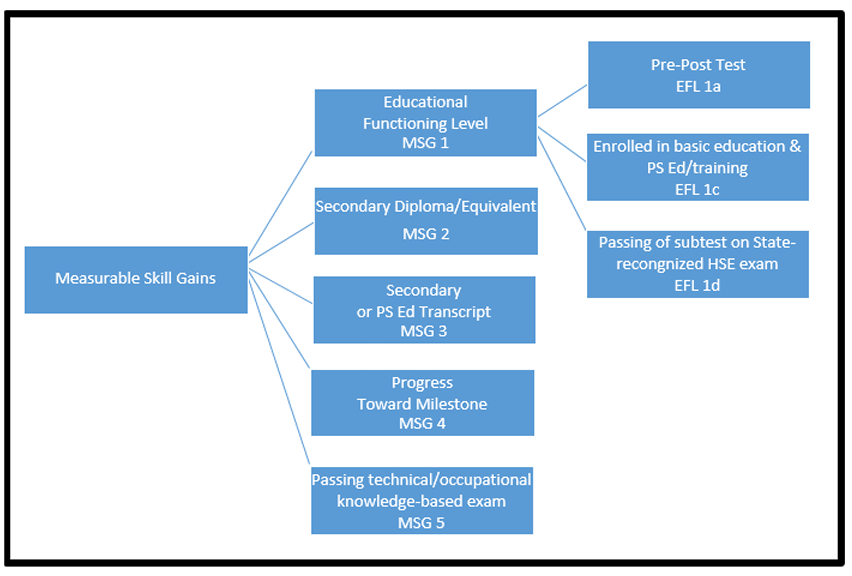
Five Types of Measurable Skill Gains under WIOA Employment related indicators
There are three WIOA indicators related to employment:
- Employment Rate – Second Quarter After Exit: The percentage of participants who are in unsubsidized employment during the second quarter after exit from program.
- Employment Rate – Fourth Quarter After Exit: The percentage of participants who are in unsubsidized employment during the fourth quarter after exit from program.
- Median Earnings – Second Quarter After Exit: The median earnings of participants who are in unsubsidized employment during the second quarter after exit from program.
Note: Employment indicators are data-matched through NSPARC for Federal Reporting purposes.
Credential Attainment Indicators
- Attainment of secondary school diploma or its equivalent
- Receipt of secondary school diploma or its recognized equivalent and employed or entered into postsecondary education within one (1) year of exit
- Attainment of postsecondary credential
- Receipt of postsecondary credential while enrolled or within one (1) year of exit
Note: For adult education participants, secondary or postsecondary transcripts, progress toward milestones, and passing technical/occupational knowledge-based exams can be used to document MSG only for participants in IET or workplace literacy programs.
Where are data reported for the MSG indicator? NRS Table 4 reports the MSG indicator.
Periods of Participation (POP)
State performance on all core outcome measures under WIOA (except median earnings) is calculated as a percentage of the number of outcomes achieved by the number of periods of participation (PoPs) of each participant. A PoP begins each time a participant (an individual with at least 12 contact hours) enrolls in adult education and then exits the program—even when multiple enrollments occur during the same program year. Subsequent enrollments and exits during a program year result in a new period of participation. Therefore, a participant may have more than one period of participation in a program year. If the participant does not exit, the PoP remains active.
The MSG indicator is not exit-based, so each participant’s program entry, or the start of a new program year (assuming the participant has contact hours greater than zero to show he/she attended in the new program year), initiates a new reporting period for MSG. The reporting periods for MSG end with either a program exit or the end of a program year.
All participants have at least one period of participation, starting with their first enrollment in the program year and ending with their program exit. Subsequent periods are counted by reentry and exit. The exit date is the last day of service for participants; importantly, this date cannot be determined until 90 days have elapsed since the person last received services, and there are no future services planned. However, if there is no exit across a program year, the PoP continues into the next program year and MSG is reported for the new program year.
*** Additional information on EFL, MSG, and PoP can be found in the Assessment Policy.The secondary diploma component of the indicator applies only to participants enrolled in a secondary education program at or above the ninth-grade level who exited the program and who did not have a secondary school diploma or its equivalent at program entry.
The postsecondary education credential component of the indicator applies only to participants who were also enrolled in a postsecondary education or training program and exited the postsecondary education or training program.
Where are data reported for the credential indicator? NRS Table 5 reports the indicator and other WIOA-required exit-based measures. Performance on this indicator cannot be measured until one year after a participant’s exit. This indicator is also included in the following tables:
- Table 5a—for participants in distance education programs
- Table 8—for participants in family literacy programs (optional)
- Table 9 – for participants in IELCE programs
- Table 10—for participants in correctional education programs
Effectiveness in Serving Employers WIOA requires the U.S. Departments of Education and Labor define the sixth performance indicator – effectiveness in serving employers – as Retention with the same employer and require it to be reported by one WIOA core program on behalf of all six WIOA core programs within each State. The final rule can be found in the Federal Register (89 FR 13814).
- Other Measures
Descriptive and Participation Measures
The NRS descriptive measures are participant demographics and status. These measures allow for a description and an understanding of the characteristics of those who attend adult education programs. The measures also allow for analyses of the performance of subgroups of participants attending adult education programs.
Demographic measures include ethnicity, age, gender, and 11 WIOA-defined barriers to employment. Program staff collect demographic information directly from participants, upon entry into the program. Participants self-report these measures, or staff may determine demographic measures through observation, when participants decline to self-identify. All demographic measures required by WIOA use the identical definitions and reporting categories as other WIOA partner programs, as described in the WIOA Participant Individual Record Layout (PIRL) in the joint information collection (OMB 1205-0526).
Barriers to Employment
WIOA requires each core program to report the performance indicators disaggregated by the following 11 barriers to employment. These barriers are presumed to affect placement of the participant in unsubsidized employment and are self-identified by the participant at entry into each PoP. Programs should report all categories to which the participant identifies. Definitions for barriers to employment can be found in the NRS Technical Assistance Guide. The 11 barriers are:
- displaced homemaker
- English language learner/low literacy level/cultural barriers ***
- exhausting Temporary Assistance for Needy Families (TANF) within 2 years
- ex-offender
- homeless or runaway youth
- long-term unemployed
- low income
- migrant and seasonal farmworker
- individual with disabilities
- single parent
- youth in foster care or who has aged out of system
***Note: For reporting purposes, all students enrolled in adult education programs must be identified as English language learner/low literacy level/cultural barriers.
Status measures include employment status, highest degree achieved or level of schooling, and whether the participant has a disability or receives public assistance. Teacher status measures include total years of experience in adult education and certifications.
Two participation measures—contact hours and program enrollment type—are collected for both descriptive and analytic purposes. These measures record the amount of instruction that participants receive and the number of participants attending in areas such as family literacy, IET and IELCE programs.
Optional Measures
There are additional optional measures that apply to participants in family literacy and Integrated English Literacy and Civics Education (IELCE) programs under WIOA, Section 243. The optional family literacy measures include increased involvement in children’s literacy activities and children’s education. For IELCE participants, the optional IELCE measures are achievement of citizenship skills, voter registration, and increased involvement in community activities.
- Exclusions
Participants in correctional education programs (WIOA, Section 225), who remain incarcerated at program exit, are excluded from all performance indicators except the Measurable Skill Gains indicator. Participants who exit the program due to the following circumstances may be excluded from the WIOA primary indicators of performance:
- The participant exits the program because he or she has become incarcerated in a correctional institution or has become a resident of an institution or facility providing 24hour support, such as a hospital or treatment center, during the course of receiving services as a participant
- The participant exits the program because of medical treatment and that treatment is expected to last longer than 90 days and precludes entry into unsubsidized employment or continued participation in the program
- The participant exits the program because the participant is a member of the National Guard or other reserve military unit of the armed forces and is called to active duty for at least 90 days
- The participant is deceased
Attachment 2 of OCTAE’s Program Memorandum 17-2 provides further information about exclusions.
- NRS Methodologies
The NRS has three main methodologies for collecting data: direct program reporting, data matching, and supplemental methods for performance reporting purposes, described in OCTAE Program Memorandum 17-6.
The MS OAE uses the direct program reporting and data matching methods. With the direct program reporting methodology, local programs collect the information directly from the participant while the participant is enrolled and receiving instruction. The information is normally obtained as part of the intake process (such as through assessment) and on an ongoing basis during the course of instruction. Data collected with this methodology are demographic, student status, program participation, and assessment results.
Data matching refers to the procedures whereby agencies serving common clients pool their data, or have linked or unified data systems, to identify achievement of outcomes. Matching is achieved using Social Security numbers or other unique identifiers and is typically done at the state level. For example, to determine whether participants obtained employment after leaving the program, the state agency responsible for adult education instruction matches the Social Security numbers and dates of attendance of participants who obtained employment in the State Unemployment Insurance (UI) database for the appropriate calendar quarter.
- Data Collection Process
The National Reporting System (NRS) produces a set of indicators and measures that describes adult education students, their participation, and the outcomes they achieve. These measures are used at the State and national levels to demonstrate whom the adult education program serves and its impact on participants’ educational and employment-related outcomes. At the local level, programs collect data and train staff according to policies and procedures set by the State for program management and improvement activities and to report on performance. This chapter describes the flow of data from the local programs through States to the U.S. Department of Education (ED). It also summarizes the roles and responsibilities of local programs and States in relation to their specific data collection processes and to the operation and maintenance of the NRS at the Federal level. For additional information on data framework and data collection policies and procedures see the NRS Technical Assistance Guide.
The MS OAE requires local programs to establish written policies and procedures for data collection that comply with State NRS requirements. Local program policies and procedures for data collection need to include the following:
- Staff Roles and Responsibilities for Data Collection
- Clear Definitions of Measures
- Standard Forms for Collecting Data
- Error-Checking and Quality Control Systems
- Ongoing Training on Data Collection
- Student-Level, Relational Database System
- Clear and Timely Data-Entry Procedures
- Timely or Direct Access to Database
- Regular Data Reviews
Without training, staff will not know or understand the policies and procedures, resulting in incomplete or haphazard data collection that can impair data reliability and validity. To ensure that the data collected are of high quality, local programs should implement ongoing staff training on NRS procedures. Staff training in data collection policies and procedures should include: content on effective professional development practices including:
- Training on WIOA and NRS Policy and Data Collection Procedures
- Continuous Professional Development on Data Collection
- Training Addresses Staff Needs
- Use of Effective Trainers and Methods
- Training Results in Learning and Improved Practice
Quality Control and Reporting
- NRS Data Quality Checklist/Improving Data Quality
OCTAE annually assesses the quality of NRS data for each state. Therefore, states complete the NRS Data Quality Checklist, which defines OCTAE’s standards for data quality, each year. The checklist describes State NRS policies and the data collection procedures that local programs within the state follow to collect NRS data. These standards clarify procedures in four areas: data foundation and structure, data collection and verification, data analysis and reporting, and staff development related to data. States are required to submit the NRS Data Quality Checklist with their annual NRS data submission, along with a signed certification as to the validity and quality of the state’s data.
At the local level, programs collect data and train staff according to policies and procedures set by the state for program management and improvement activities. Local program directors are required to annually submit the Mississippi Data Quality Checklist, along with a signed certification as to the validity and quality for the local program’s data to the state office. All programs are required to meet or exceed the Superior Quality standard or complete a Program Improvement Plan (PIP). Mississippi’s Data Quality Checklist can be found at the end of this section.
The NRS Data Quality Checklist defines data quality and provides a framework for states for improving data quality. Data quality can improve in three ways:
- training local staff
- improving local data collection
- local monitoring and data audits
- NRS Reports
States report NRS tables, the WIOA Statewide Performance Report, an annual narrative report and federal financial reports each program year (July 1 through June 30). Annual reports are due to OCTAE on October 1. NRS reports are open to the public on the National Reporting Service website.
- Data Quality Checklist
Mississippi Community College Board Office of Adult Education
Title II Grantee Data Quality Checklist
The National Reporting System (NRS) for Adult Education is an outcome-based reporting system for the state-administered, federally funded adult education program. The NRS defines state data quality standards, identifies the policies, processes, and materials that state and local programs should have in place to collect valid and reliable data for reporting. The Division of Adult Education (DAEL) within the Office of Career, Technical and Adult Education (OCTAE) developed the standards to define the characteristics of high-quality state and local data collection systems for the NRS. The standards provide an organized way for DAEL to understand the quality of NRS data collection within the states and provide guidance to states on how to improve their systems.
In order to complete the NRS State-Level Data Quality Checklist, Title II Grantees must complete the following abbreviated version, certifying the quality of local data and adherence to state policy.
Instructions for Completing the Mississippi Checklist
Local programs use the Mississippi Checklist to rate their implementation of the data quality standards in their NRS data collection procedures.
The local program director must certify the checklist and submit it with the annual end-of-year statistical tables due to the Office of Adult Education (OAE) on or before June 30th of each year.
Data Quality Improvement Plan
When local programs do not reach “Acceptable” standards in any program area, a data quality improvement plan must be completed to describe the program they have identified, along with their plan for correction. The plan will address all standards the program did not meet, describe what new policies or procedures will be put in place to meet the standards, identify barriers to compliance as well as the technical assistance needed to implement the plan. The OAE will offer technical assistance to programs to meet the goals of its data quality improvement plan.
All narrative descriptions should be brief – but sufficient to convey the information requested. No more than a few sentences are necessary.
Non-compliance is defined as a failure to meet “Acceptable” standards for any program area. For subsequent program years, non-compliance will be defined as failure to meet “Superior” standards.
- Submission and Certification
Local programs are required to submit the following checklist on the last day of the program year (June 30th)
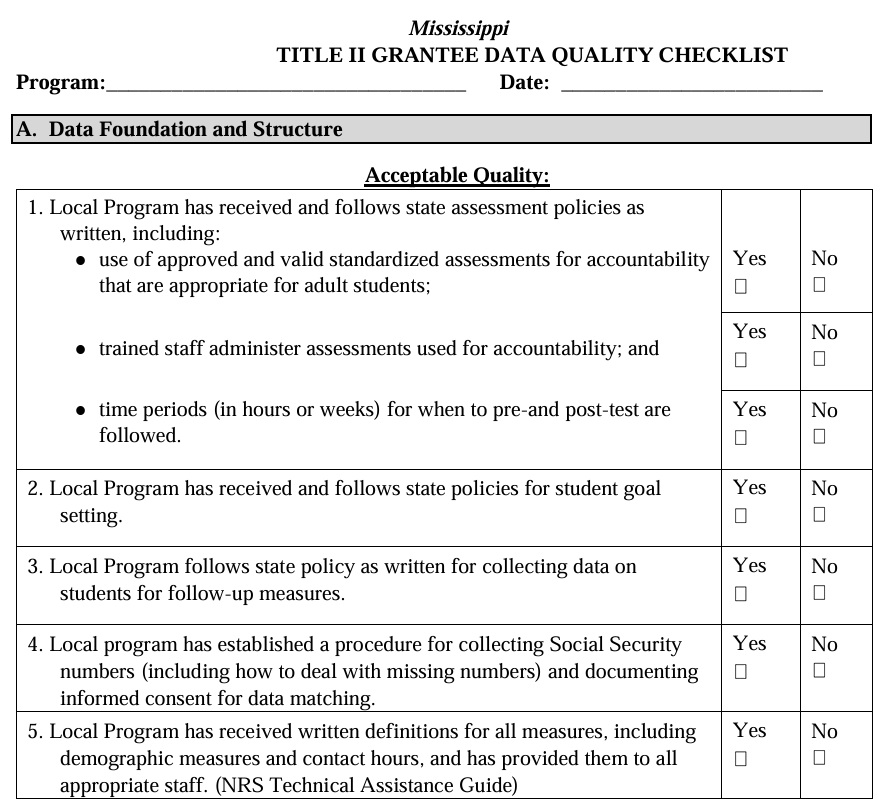
If you answered ‘No’ to any of questions 1-5, skip the rest of this section and go to Section B, Data Collection and Verification. If you answered ‘Yes’ to each of questions 1-5, continue with question 6. 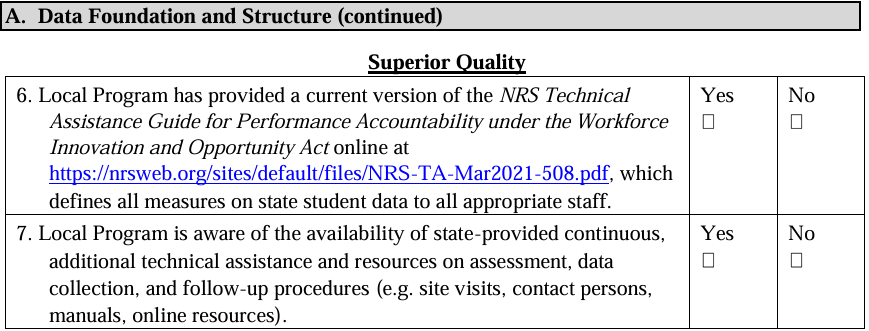
Continue with Section B below. 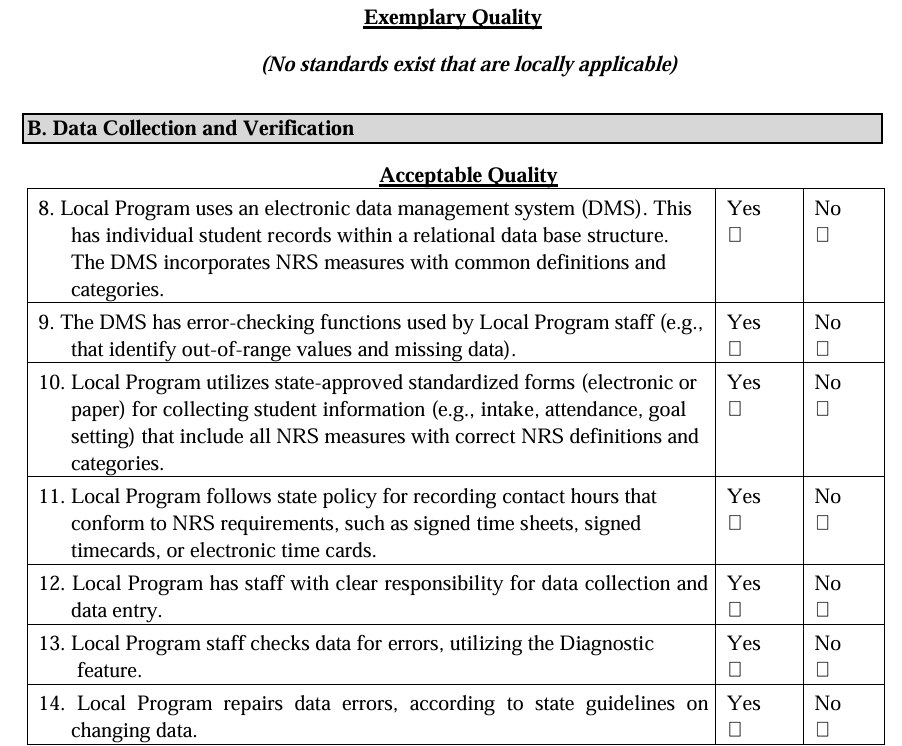
If you answered ‘No’ to any of questions 8-14, skip the rest of this section and go to Section C, Data Analysis and ReportingIf you answered ‘Yes’ to each of questions 8-14, continue with question 15. 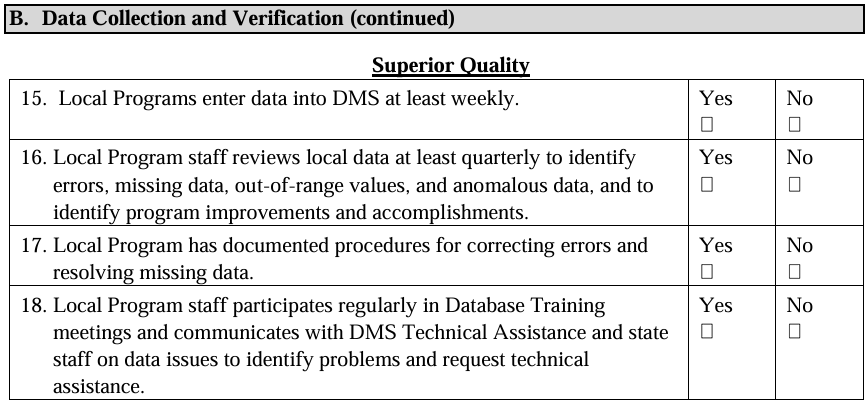
Continue with Section C below. 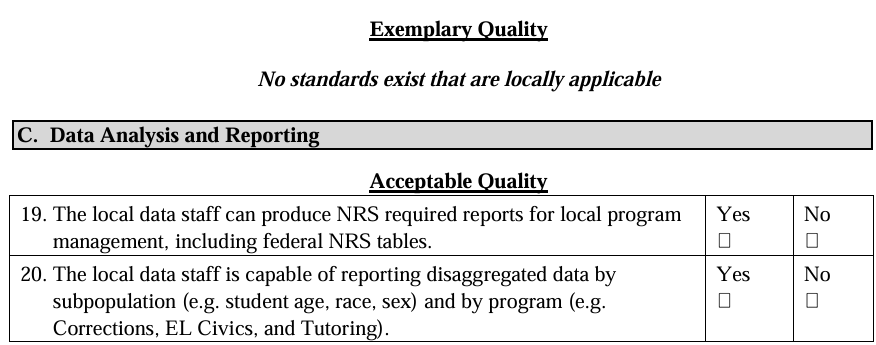
If you answered ‘No’ to either, question 19 or 20, skip the rest of this section and go to Section D, Staff Development. If you answered ‘Yes’ to both questions 19-20, continue with question 21. 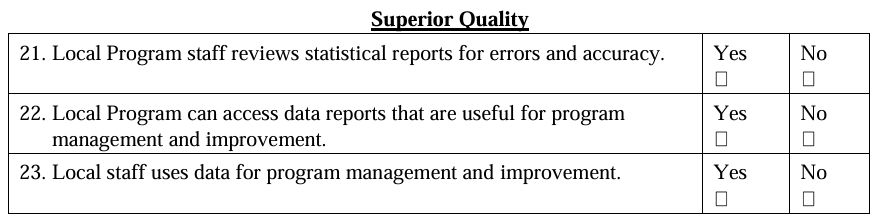
If you answered ‘No’ to any of questions 21-23, skip the rest of this section and go to Section D, Staff Development. If you answered ‘Yes’ to each of questions 21-23, continue with question 24. 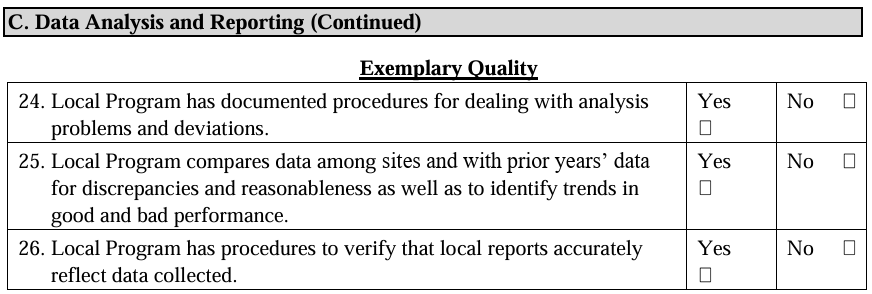
Continue with Section D. 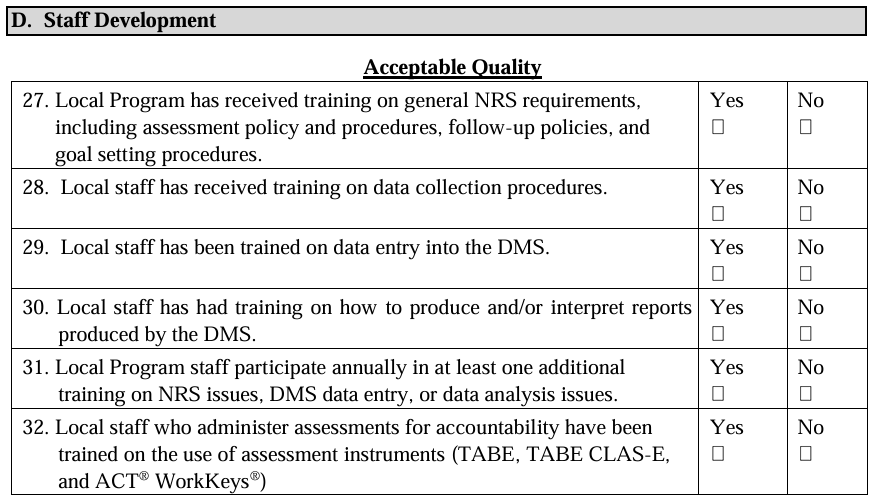
If you answered ‘No’ to any of questions 27-32, skip the rest of this section and go to Section E Data Quality Improvement Plan. If you answered ‘Yes’ to each of questions 27-32, continue with question 33. 
If you answered ‘No’ to question 33, skip the rest of this section and go to Section E. Data Quality Improvement Plan. If you answered ‘Yes’ to question 33, continue with question 33. 
Continue with Section E. 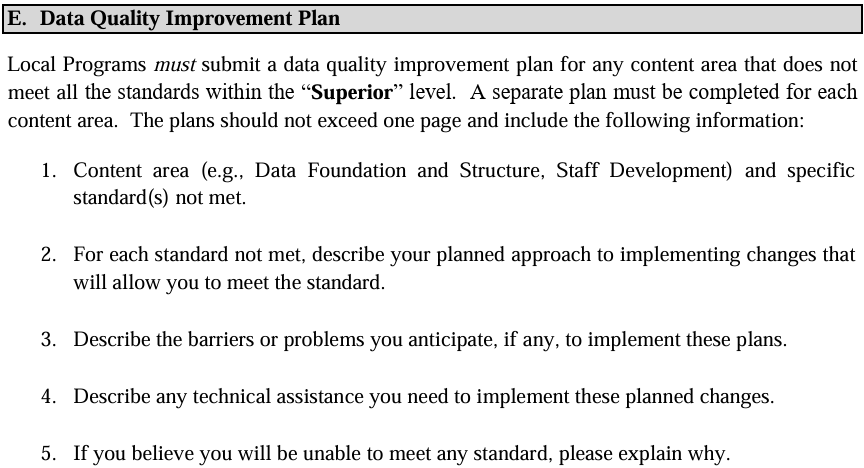
Mississippi Office of Adult Education
Title II Grantee
Data Quality Standards Checklist
The Director of the Adult Education Program must sign this certification.
Certification
I certify that to the best of my knowledge, the information contained in this document is true and correct and accurately reflects my program’s policies and procedures for collecting and reporting data to the Mississippi Community College Board, Office of Adult Education as required by the U.S. Department of Education’s National Reporting System for the Workforce Innovation and Opportunity Act, Title II Adult Education and Family Literacy.[Authorized Official Signature on Official Certification Form]
Signature
[Printed Name and Official Title]
Printed Name and Title
[Date Signed]
Date
Section 3: Program Design Elements
- Intake, Orientation, and Class Structure
The first element of an effective classroom management system involves a thorough student orientation and registration process. Adult education providers shall implement a uniform intake process which includes assessment and orientation. Assessment and orientation must occur during the first twelve (12) hours of enrollment. (This can take place remotely using fillable forms and remote testing.)
Orientation is an intake process which collects required information related to determining a student’s eligibility based on age requirements and academic functioning level as well as establishing goal-setting and other relevant activities which promote and enhance student persistence and retention in the adult education program. Programs have the flexibility to design their orientation in a manner that best meets the needs of their population. It is usually more timeefficient and effective if orientation is conducted on a Managed Intake basis with groups of potential students who come at regular appointed dates and times. Orientation can be held weekly, bi-weekly, monthly, etc.
While there is flexibility for each local program to design its own orientation, the following six elements are required:
- Intake (to include the collection of necessary forms and documents - see Student Cumulative Folder Checklist)
- Copy of state-issued photo ID (Waivers granted for ELL participants as needed)
- Assessments
- Student Success Plan
- Verification of registration in MS WORKS
- Documentation for underage students
It is NOT recommended that a full standardized pre-test be administered during the first day of orientation. Giving the student a long test at the outset can be frustrating and nerve-wracking. Instead, you may want to simply administer the locator instrument initially. This will provide you with enough information to begin the goal-setting process. Testing can be done remotely with permission from your college or school.
The Cumulative Folder Checklist lists all the items that need to be maintained for each student. Cumulative folders are reviewed by the Office of Adult Education for quality assurance and compliance. The checklist can be found at the end of this section.
Adult education programs are expected to provide structured, scheduled, and instructor-led learning opportunities resulting in successful student and program outcomes. All local programs are required to incorporate the following elements into their service delivery models:
- scheduled intake, orientation, and assessment
- regularly scheduled classes based on student availability and commitment to participation
- flexible schedules and alternative instructional options for students whose work or family obligations do not allow them to attend scheduled classes
AEFLA requires classes to be of sufficient intensity and duration to achieve substantial learning gains. Program directors should ensure services offered provide sufficient hours of instruction each week and sufficient weeks of instruction per year to make sustainable changes in the skill level of adults.
Managed Intake/Entry
Classes that utilize the Managed Intake structure offer scheduled, well-advertised registration and assessment days and times at regular intervals. New applicants are asked to come for registration only at those appointed dates/times. Program orientation, expectations, and entry assessments (locator pretests, learning styles inventories, etc.) may be offered in a small group intake setting. Individual follow-up appointments are scheduled to discuss individual learning goals, barriers to participation, and assessment results as well as to set short-term and long-term educational plans.
After participating in the intake process, a group of students start a class on the first day of the class session and attend that class for the duration of a defined class term. The program may stipulate that a student may miss no more than a prescribed number of class sessions within a term.
Open Intake/Entry
With Open Intake, students arrive while the class is in session and receive information about the program, register, begin the assessment process, and start studying immediately.
Open Intake should be utilized to build enrollment. As soon as a class is well-established, the program should switch to Managed Intake.
Certain students may be unable to come on a particular day/time because of work, transportation, or childcare conflicts. Exceptions can be made for students with specific problems. Open intake/registration should not be the normal practice for a program.
- Student Confidentiality
It is imperative adult education programs protect the privacy of students. According to the Family Educational Rights & Privacy Act (FERPA) of 1974, student information that is considered “private” may not be shared with any outside agency or individual unless designated on a release of confidential information form that has been signed by the student. This includes volunteers, case workers, other teachers, or administrators who happen to visit the classroom. Instructors cannot discuss private information about students, as it would be a breach of confidentiality.
If a student discloses any of the following types of information (verbally or in writing), legally that information is to be considered strictly confidential and therefore “private”:
- disclosure of a diagnosed learning disability
- disclosure of previous status as a "special education" student
- disclosure of any other type of diagnosed physical or mental disability
- disclosure of a diagnosed medical condition
- disclosure of use of any prescription drugs
- disclosure of history of drug/alcohol abuse and/or treatment
- disclosure of status as HIV positive or of having the AIDS virus
- official transcripts including HiSET® or GED® scores, Total Transcript or CompetencyBased Diploma
Instructors must sign the Personnel Confidentiality Agreement. This should be maintained by the administrator in the personnel file.
- Release of Information
Since the program participates in data sharing and transmits information from the Student Success Plan to other external entities, the Mississippi AE General Release of Information must be used to obtain permission for the data match. A student may refuse to sign the release, but then some achievements will not be able to be counted for the NRS report.
Intake Tip: Students must be made aware that the state may use information from the Student Success Plan to share data with other private and public entities.
Use the following procedures:
- Read aloud to students the Mississippi AE General Release of Information. This is vital because many students read at a lower level and may not be able to understand the form by reading it silently
- Ask students to sign the general release so that your program can get credit for student achievements and continue to be funded
- Update the release form each program year that the student is enrolled
Even when another agency has referred a student to the adult education program for services (e.g., MDRS, MDHS, MDES, etc.), instructors may not discuss educational record information without written permission.
- Referrals
Through MS' WIOA Combined State Plan, the primary strategy of the pathway model is integration of core providers' programs while improving efficiency in service delivery across partners. Through a referral process, resources are immediately aligned to cultivate better and more sustainable employment opportunities for Mississippians.
Combined Plan Partners perform intake procedures or collect two types of information: (1) basic registration information to determine program-specific eligibility and support WIOA reporting and (2) answers to a diagnostic instrument composed of questions submitted by each Combined Plan Partner. Next, the partner performs an agency-specific assessment of the participant's immediate needs and work the participant to complete their Student Success Plan (SSP). The SSP outlines the services, describes supportive services, and the participant's current state of work-readiness to unsubsidized employment, for example disclosed barriers. Using the questions on the SSP or the resources to follow, referrals are made to other Combined Plan Partner programs or Strategic Partner programs.
- Scheduled Classes
Scheduled classes is a process for providing a structure and sequence for adult students to enroll in adult education classes. The classes will meet the following requirements:
- must be taught by a qualified instructor who uses lesson plans aligned with College and Career Readiness Standards
- 8 hours of instruction per week for day classes and a minimum of 6 hours per week for night classes
- should employ differentiated instruction as necessary to meet the needs of students at various levels
- should incorporate technology in the classroom and utilize technology as distance learning opportunities and/or hybrid offerings
- include various instructional styles, strategies, adaptations, and resources to meet the needs of all students, including those with learning challenges
- integrate employability and digital literacy skills into academic subjects
- must maintain a sign-in sheet with students’ original signatures or electronic attendance tracking system with unique identifier that accounts for time in class
Blended: Local Program + Online
In addition to their participation in the local adult education program’s classes, students should be encouraged to participate in self-paced, online instruction assigned by the instructor. Through this blended model, students are able to access additional instruction and assistance, and local programs benefit from their students’ increased engagement in learning activities.
Structured Educational Alternatives
The OAE recognizes that classroom attendance may not be possible for some students, especially those who are employed. Also, students may need an education alternative:
- while they are waiting for a new class to start
- before they are academically prepared to join a class
- as supplemental instruction while enrolled in a class
Structured options may include, but are not limited to, the following:
- Scheduled labs: A structured lab can be designed for students who miss the start of a new class, do not want to participate in a classroom setting, or need additional assistance. Instructor-led labs allow students unable to attend scheduled classes to have an alternative learning opportunity allowing them to accomplish their educational goals without creating another barrier to their success.
- Computer labs: Computer labs for independent study may be open and available to students any time the adult education center is open.
- Distance learning: Students may begin or supplement studies using a distance learning product. Students may enroll in online learning provided by the program through a learning management system.
- Study time/study groups: Study time provides an opportunity for students to independently study and/or complete work while at the center, an opportunity especially important for students who do not have a home environment conducive to learning. Another option is providing opportunities for students to gather pre- or post-class in a facilitated or unfacilitated study group.
- Workshops: Short-term academic workshops on targeted areas allow new students, who may be waiting for a scheduled class to start, to begin their academic work in targeted areas such as multiplication tables, calculator use, ACT® WorkKeys® Curriculum, graphic information, or other topics.
- Attendance Policy
The OAE requires 8 hours of instruction per week for day classes and a minimum of 6 hours per week for night classes. This can be accomplished through a combination of face-to-face and distance learning. Direct contact hours should be entered daily, but no later than the end of the week. Hours must be entered for each individual day.
Distance learning hours can be entered in weekly totals and must be entered on a weekly basis.
For example: James Wilkinson attended face-to-face 4 hours a day on Monday, Wednesday, and Friday. His hours must be entered as 4 hours on Monday, 4 hours on Wednesday, and 4 hours on Friday. His hours can NOT be entered as a total of 12 hours for the week on Friday.
If a student stops attending class without informing program staff, the program staff should contact the student to find out if they plan to return. If a student states they have no plans to continue attending class, they may be exited. Any participant with no activity for 90 calendar days must be exited from the program and documented in the OAE Data Management System. According to the Record Retention policy in Section 4, all attendance records are required to be retained for a three-year period, and documentation should be available to the OAE upon request.
Attendance hours must be tracked, and sign-in sheets must contain the following: class name/site, class start and stop time, instructor/s name, instructor/s signatures, students’ original signatures and students’ arrival and exit time. If a student forgets to sign out, staff may enter the exit time and initial the entry. The OAE suggests students “sign-in/out,” using ink as opposed to pencil.
Calculating Student Contact Hours:
- Daily: students’ contact hours should be rounded to the nearest quarter hour daily. When rounding to the nearest quarter hour, 7 minutes is rounded down; 8 minutes is rounded up. You may NOT round daily attendance to the nearest hour or half hour
- Different hour types:
- Instruction: this includes intake, orientation, and adult education instruction
- Instruction Distance Learning: all student work completed outside the adult education center using software approved for distance learning or work in the program’s learning management systems such as Canvas or Google Classroom.
- Instruction Smart Start: this includes Smart Start instruction hours in a face-toface or hybrid setting, Canvas Smart Start hours
- Instruction MS Smart Start Online Only - this includes the entire work completed by the student is outside the adult education program
- Student Cumulative Folder Checklist
Items Required for Student Cumulative Folder
The student’s cumulative folder is a compilation of legal and confidential student education records. The folder should be kept in a locked file cabinet and only viewed by Adult Education staff and contain the following:
- Student Success Plan
- MS Works Registration verification
- Copy of state-issued picture I.D. (Waivers granted for ELL students as needed)
- Copy of TABE, TABE CLAS-E, or ACT® WorkKeys® Profile
- Work samples available upon request
- All standardized test answer sheets/scores (locator – if applicable, TABE portfolio, pretest, post-test, official practice test)
- Transcripts, including HiSET®, GED®, Total Transcript, Competency-Based Diploma, and college (MIBEST) transcripts, if applicable
- Copy of stackable credentials, i.e. Forklift, ServSafe®, CPR, OSHA, North Star (examples)
- MS OAE Smart Start Student Record
- Copy of Smart Start Credential or Certificate, if applicable
- Copy of NCRC Scores
- Documentation of accommodations, if applicable
Mississippi requires 16- & 17-year-olds to provide the following documentation:
- Age Waiver Permission Form is required for all 16 and 17-year-olds AND
- Withdrawal form signed by a school representative certifying the applicant is no longer enrolled in K-12
Note: In the event a withdrawal form is not obtainable, a “notarized” Age Waiver Permission Form is required.
According to the Mississippi Compulsory School Attendance Law, participants who turn 17 before September 1 of the calendar year are not classified as “compulsory-school-aged children.” Therefore, withdrawal documentation is not required for their enrollment in an adult education program.
Section 4: Administration of the AEFLA Program
- Eligible Providers
An “eligible provider” is defined as an organization that has demonstrated effectiveness in providing adult education and literacy activities. These organizations may include, but are not limited to (WIOA Title II Section 203(5); 34 CFR 463.23) a (an):
- local educational agency;
- community-based organization or faith-based organization;
- volunteer literacy organization;
- institution of higher education;
- public or private nonprofit agency;
- library;
- public housing authority;
- nonprofit institution not described in (a) through (g) of this section and has the ability to provide adult education and literacy activities to eligible individuals;
- consortium or coalition of the agencies, organizations, institutions, libraries, or authorities described in (a) through (h) of this section; and
- partnership between an employer and an entity described (a) through (i).
To receive funding, each agency applies for funds. Grants are awarded to successful applicants. The eligible agency must provide services related to the 13 Considerations as outlined in Adult Education and Family Literacy Act. The grant award is for a five-year period (July 1, 2020 to June 30, 2025) and must be renewed through a formal application process each fiscal year the Grantee agrees to operate classes. Awarded agencies must comply with Scope and Conditions of the grant and the specific Grant Assurances outlined in the application. Expenditures may not be made outside of this contract period.
Advisory or Inter-Agency Council
The OAE requires each eligible provider to have an advisory council or participate in a cross agency collaborative council that addresses adult education concerns. Schedule regular meetings at least twice annually to ensure consistent collaboration and oversight. Maintain comprehensive records of each meeting, including detailed agendas, attendee sign-in sheets, and well-documented minutes, securely filed for future reference and compliance.
Council members should represent local community groups:
- Postsecondary educational institutions (career-technical programs, community colleges, universities) and training programs (apprenticeships, etc.)
- Business and industry (local businesses, Chamber of Commerce, etc.)
- Human Services (Mississippi Department Human Services, Department of Housing and Urban Development, Homeless Shelters, etc.)
- Family services (Head Start, Family Resource Network)
- Disability services (Department of Rehabilitation Services, mental health facilities)
- Employment services (Workforce Investment Board, One Stop Centers, Job Services)
- Public schools and libraries
- Volunteer organizations and service clubs
- Other community-based organizations (United Way, Senior Centers, Youth Services)
- Students and instructors from the program
- Corrections
- K-12 Career Coaches
Use the advisory council to:
- facilitate collaboration, referrals, and networking among agencies serving the needs of adults with limited basic skills
- educate the community at large about the needs of this population
- assist your program with marketing, recruiting, student support services, special events (graduation and awards ceremonies), grant writing, and establishing information linkages
- provide input regarding appropriate course offerings, class locations, and schedules
Program Facilities and Services
To maximize the amount of funds available for direct instructional services, the OAE prefers adult education programs to pay minimal or no rent for space, especially those located in publicly owned buildings. State and federal funds are to be used for program services. Fiscal agents are encouraged to seek donated or in-kind space to provide maximum resources to the students.
Grantees shall ensure the following:
- All instructional facilities and services comply with the Americans with Disabilities Act of 1990
- Facilities have appropriate exterior and interior signage clearly identifying the adult education programs
- The learning environment is in good condition and properly maintained with adequate space and equipment
- There is a separate room available for student assessment and counseling purposes
- The building and surroundings are safe, sanitary, and non-hazardous
- The location is easily accessible with adequate parking
OAE classrooms should have the following provisions:
sufficient space to accommodate students (including classroom area and private counseling/tutoring area)
- adequate safety provisions (approved by fire marshal, covered by fire/liability insurance)
- accessibility for people with disabilities
- adequate heating and cooling
- adequate furniture (desks, tables, chairs) designed for adults
- available storage space
- clean restrooms
- adequate indoor and outdoor lighting
- access to telephone and Internet
- visible signs or directions to the class location
If it is determined through an OAE site visit that the facility does not meet requirements, the grantee may be asked to relocate the center to a more appropriate location or correct deficiencies.
- Financial Management
Programs must use funds for the intended purposes and must follow written policies and procedures (including all required by Uniform Administrative Requirements, Cost Principles, and Audit Requirements for Federal Awards) to ensure accurate, current, and complete disclosure of the financial results of each grant project. All awarded funds will be allocated on a costreimbursement basis. All grantees will be reimbursed for expenditures, as approved, by requesting reimbursement through the Mississippi Community College Board’s (MCCB) financial budgeting system. Requests for reimbursement should be submitted monthly. All documentation should be available upon request.
Grant recipients must maintain adequate supporting documents for expenditures (federal and nonfederal) and in-kind contributions under the grant. Costs must be shown in reports and must be supported by a source document, such as a receipt, travel voucher, invoice, bill, in-kind voucher, or similar document. Refer to the Uniform Administrative Requirements, Cost Principles, and Audit Requirements for Federal Awards for specific requirements.
Funds received under the AEFLA grant must be maintained in a separate account. The grantee must maintain all documents and other evidence pertaining to the costs and expenses of implementing this application to the extent and in such detail to accurately reflect all gross costs direct and indirect, equipment, supplies, services, and other costs and expenses. The grantee must use generally accepted accounting principles. These records and financial statements are subject to inspection, review, reproduction, and/or audit by the OAE.
Approved Budgets
At the beginning of each fiscal year, grantees are required to submit their approved budgets to the OAE.
Grant Reimbursement
Funds for the Title II grant must be claimed on a reimbursement basis. Reimbursement requests should be submitted monthly to the OAE. No payments in advance of or in anticipation of goods or services provided under this grant can be requested or paid. All charges must be reported for the current period. Grant reimbursements are contingent upon satisfactory completion and submittal of all program deliverables.
Grantees shall ensure auditable and adequate records are maintained which support the expenditure of all funds received through a contract with the MCCB, OAE. Programs will submit to periodic fiscal audits, adhere to assurances, and will submit to periodic program review, monitoring, and/or technical assistance on-site visits. Programs will respond in a timely manner to any request for information from the OAE.
Budget Modification
Expenditures shall not exceed the line-item allocations or budget total as specified in the contract. Requests for budget modification to the current fiscal year must be pre-approved by the OAE. Budget modifications must be submitted to the OAE.
Yearly Project Closeout
The OAE will provide the deadline date for the final reimbursement request at the end of the fiscal year. During this reimbursement request, it is essential all funding categories have enough funds to allow for proper reimbursement of all incurred costs for the final reporting period.
Supplement not Supplant
According to WIOA, Section 241(a), funds made available for adult education and literacy activities under Title II must supplement and not supplant other state or local public funds expended for adult education and literacy activities. “Supplement, not supplant” means the federal funds are intended to augment or increase, not replace, monies that would have been used if the federal funds had not been available.
Local Administrative Cost Limits (34 CFR, 463.26)
Administrative costs are those non-instructional costs considered reasonable, necessary, and allowable for the overall project management. Not less than 95% shall be expended for carrying out adult education and literacy activities. The remaining amount, not to exceed 5%, shall be used for planning, administration, personnel development, and interagency coordination (administrative costs).
In cases where the cost limits described are too restrictive to allow for adequate planning, administration, personnel development, and interagency coordination, the eligible provider shall negotiate with the OAE to determine an adequate level of funds for non-instructional purposes; WIOA, Section 233; 241(b); 34 CFR 463.25-.26.
An eligible provider receiving a grant or contract under this part may consider costs incurred in connection with the following activities to be administrative costs (34 CFR, 463.26):
- Planning
- Administration, including carrying out performance accountability requirements
- Professional development
- Providing adult education and literacy services in alignment with local workforce plans, including promoting co-enrollment in programs and activities under Title I, as appropriate
- Carrying out the one-stop partner responsibilities described in §678.420, including contributing to the infrastructure costs of the one-stop delivery system
Allowable and Unallowable Expenses
Expenses must be reasonable, allowable, and allocable to the benefit received and not shifted from another program or project. All expenditures submitted for reimbursement under this grant must be for proper and efficient administration of the program. Allowable costs are determined by 2 CFR 200.
Adults enrolled in adult education programs, including programs for adults with limited English proficiency, will not be charged tuition or fees.
Basic Guidelines of Allowable expenses:
To be considered allowable under a federal award, costs must meet the following general criteria:
- be necessary and reasonable for proper and efficient performance and administration of federal awards and be allocable thereto under these principles
- be authorized or not prohibited under state or local laws or regulations
- conform to any limitations or exclusions set forth in these principles, federal laws, or other governing limitations as to types or amounts of cost items
- be consistent with policies, regulations, and procedures that apply uniformly to both federally assisted and other activities of the governmental unit
- be accorded consistent treatment
Eligible Use of Funds
Eligible expenditures for actual program expenses may include wages, salaries, and fringe benefits; books, materials, and supplies; clerical services; rental of facilities that are not owned by the sponsoring program; rental of equipment not owned by the sponsoring program; training of volunteers and tutors; student support services; outreach and recruitment activities; membership dues for participation in organizations specifically focused on adult education; financing the costs of online services; and administrative costs.
Ineligible Use of Funds
Expenditures under grants from the OAE are subject to 2 CFR 200 and may not be used in, but not limited to, the following cases:
- to supplant other existing public or private funds currently used for adult basic education and/or family literacy services
- as funds commingled with other public or private funds, but may be used in conjunction with such funds
- to pay high school equivalency testing fees
- to cover the cost of instruction at the postsecondary level. Exception: the division may approve the use of federal grant funds for occupational training within a division-approved Integrated Education and Training program
Matching Requirement (state requirement)
Grantees must provide a non-federal contribution in an amount equal to 25% of the total amount of funds expended for adult education and literacy activities supportable by Title II. Non-federal contributions may be provided in cash or in kind, fairly evaluated, and must include only nonfederal funds that are used for adult education and literacy activities in a manner that is consistent with the purpose of WIOA, Section 222(b).
Personnel Costs
Timesheets records must be maintained for all employees every payroll period. Payroll records must be signed by both employee and supervisor. All employee earning records must be maintained and contain cumulative amounts by pay period for the gross salary, payroll deductions, and net pay. Documentation must support fringe benefits in the form of payroll records, payroll tax reports, insurance policies and payment schedules, and vendor’s invoices, etc.
Fringe Benefits are an allowable cost that can include the following:
- Individual’s FICA taxes paid by the employer
- Medical and Life insurance coverage
- Unemployment insurance
- Worker’s compensation
Budgeting: Employees with Hours in One or More Grants
Programs may budget an employee’s hours in one or more grants or other funding source. Documentation of employees’ hours must be available for review by OAE staff.
Time and Effort
Time and effort documentation is required when any part of the employee’s salary is charged to the federal program or used as match for a federal program. In the area of time and effort, the Education Department General Administrative Regulations (EDGAR) provides a description of the seven characteristics that must exist in your written time and effort policies and procedures (2 CFR 200.430). Be familiar with these characteristics and ensure that your current policies and procedures reflect them.
Reporting Requirements
Employees working on multiple activities or cost objectives are required to maintain time and effort documentation if the employee’s work includes any of the following:
- more than one federal award
- federal and non-federal awards
- indirect and direct cost activities
- two or more indirect activities allocated using different allocation bases
- an unallowable activity and a direct or indirect cost activity
In addition, the report must meet the following requirements:
- be prepared after the work is performed
- account for the total activity for which the employee is compensated
- be prepared at least monthly and should coincide with one or more pay periods
- agree with supporting documentation
Each local program must use the same form for all employees which must include the following elements:
- Employer’s name
- Job title/position
- Name of the federal program or cost objective under which the employee was 100% funded
- Reporting period (semiannual, at least)
- Statement that the employee worked solely on that program for the period covered by the certification
- Dated signature of the employee or of a supervisor with firsthand knowledge of the employee’s activities
In addition, the certification must meet the following requirements:
- be completed once in each six-month period
- be prepared after the work is performed
- account for total activity performed during the reporting period
Single Cost Objective
Employees whose salaries are funded under a single federal grant program are required to report their time and effort through periodic (semiannual, at least) certifications.
Multiple Cost Objectives
Employees who work on multiple activities or cost objectives are required to maintain monthly personnel activity reports to support the distribution of their salaries or wages.
If an employee spends time on adult education administrative and adult education instructional activities, that employee must track administrative time separately from instructional time.
- Travel
Allowable In-State Travel Costs
Each grantee should have written procedures for travel approval and reimbursement. All travel costs or reimbursements must adhere to the MS Department of Finance Administration (DFA) Guidelines and Regulations. Any local restrictions on travel costs also apply.
Instructors
Instructors report to work at first site of the day. Mileage may be charged for travel to second or additional sites.
Allowable Out-of-State Travel Costs
All out-of-state travel utilizing adult education funds must be pre-approved by the OAE.
Amounts authorized for maximum recovery for travel and subsistence costs against any state or federal funding source are restricted to those amounts which are approved by the State Auditor in effect for the respective funding period. Any amount over this limit must come from local funding sources.
- Equipment (Purchase, Inventory, and Disposal)
Programs must have written policies and procedures for purchasing and expenditures to support allowable activities. All equipment purchases must be consistent with the requests in the approved budget. Inventory is subject to periodic program review and monitoring. Programs must respond in a timely manner to any request for information from the OAE. All equipment purchased with adult education funds shall remain the property of the State of Mississippi and is subject to the rules and regulations of the DFA, through the life and disposition of said property. If equipment purchased with federal funds becomes unusable or no longer needed, the local entity must notify the OAE office. If the equipment is unusable, the equipment may be disposed in accord with local policies/procedures. If the equipment is no longer needed, the OAE office will locate another adult education program facility that can use the equipment. It will be the responsibility of the two local programs to complete the transfer.
An inventory list of all equipment purchased with adult education funds must be maintained. Equipment records must include:
- description of the property
- serial number or other identification number
- funding source of property
- who holds the title; if applicable
- acquisition date
- cost of the equipment
- percentage of federal participation
- location
- use and condition of the property
- any ultimate disposition data including the date of disposal and sale price of the property
Each program has a general obligation to safeguard and appropriately use inventory/property purchased with adult education funds. This obligation includes, but not limited to, the following:
- notifying the program director of any movement of inventory/property
- exercising reasonable care in use to prevent damage and maintain the good condition of the assigned property
- exercising reasonable security measures to prevent theft or misuse of the assigned property
- reporting lost, stolen, damaged, or otherwise impaired property to the program director
When property acquired with adult education funds is lost, damaged, or stolen, the program must conduct and fully document an investigation. When appropriate, law enforcement authorities should be notified, a police report should be filed and maintained for records, and if the item meets the state’s capitalization threshold, insurance provider should be notified.
Any non-consumable items purchased with adult education funds shall revert to OAE at the end of the project or at program closure. The OAE reserves the right to relocate the property or direct its disposition in accordance with regulations established by the State of Mississippi.
Leased Equipment
Equipment may be leased for educational purposes and must be designated as such. Leased equipment is a contractual expense. This equipment must be in a facility owned or operated by the local program.
Capitalized Equipment Purchases
Reimbursement for equipment purchases will be considered on an individual project basis and must be approved in advance. Any equipment purchased with federal funds for the purposes of adult education must be maintained and located in adult education facilities.
Non-Capitalized Equipment
Items less than $1,000.00 which are not on the State Auditor’s Exception List and have a useful life of more than one year are considered non-capitalized equipment. These items must be listed under educational materials.
Record Retention, 2 CFR 200.334
Financial records, supporting documents, statistical records, and all other non-Federal entity records pertinent to a Federal award must be retained for a period of three years from the date of submission of the final expenditure report or, for Federal awards that are renewed quarterly or annually, from the date of the submission of the quarterly or annual financial report, respectively, as reported to the Federal awarding agency or pass-through entity in the case of a sub-recipient.
To help clarify which programmatic information must be retained, the following guidance is provided:
- Programs are not required to keep documents such as:
- progress plan o homework o informal testing papers/results
- Programs must retain documents such as:
- Student Success Plan
- Signed non-disclosure statement
- Student Individual Education Plan (IEP) from a school district
- Diagnostic results, i.e. (TABE / ACT® WorkKeys®)
- Attendance records
- WIOA’s 13 Considerations
- The degree to which the eligible provider would be responsive to: (a) regional needs as identified in the local plan; and (b) serving individuals in the community who were identified in such plan as most in need of adult education and literacy activities, including individuals who have low levels of literacy skills or who are English language learners
- the ability of the eligible provider to serve eligible individuals with disabilities, including eligible individuals with learning disabilities
- past effectiveness of the eligible provider in improving the literacy of eligible individuals, to meet state-adjusted performance levels, especially with respect to eligible individuals who have low levels of literacy
- the extent to which the eligible provider demonstrates alignment between proposed activities and services and the strategy and goals of the local plan, as well as the activities and services of the one-stop partners
- whether the eligible provider's program: (a) is of sufficient intensity and quality, and based on the most rigorous research available so that participants achieve substantial learning gains; and (b) uses instructional practices that include essential components of reading instruction
- whether the eligible provider's activities, including whether reading, writing, speaking, mathematics, and English language acquisition instruction delivered by the eligible provider, are based on the best practices derived from the most rigorous research available and appropriate, including scientifically valid research and effective educational practice
- whether the eligible provider's activities effectively use technology services and delivery systems including distance
- whether the eligible provider’s activities provide learning in context, including through integrated education and training, so that an individual acquires the skills needed to transition to and complete postsecondary education and training programs, obtain and advance in employment leading to economic self-sufficiency, and to exercise the rights and responsibilities of citizenship
- whether the eligible provider's activities are delivered by well-trained instructors, counselors, and administrators who meet any minimum qualifications established by the State of Mississippi, where applicable, and who have access to high-quality development, including through electronic means
- whether the eligible provider's activities coordinate with other available education, training, and social service resources in the community, such as by establishing strong links with elementary schools and secondary schools, postsecondary educational institutions, institutions of higher education, local workforce investment boards, one-stop centers, jobtraining programs, and social service agencies, businesses, industries, labor organizations, community-based organizations, nonprofit organizations, and intermediaries, for the development of career pathways
- whether the eligible provider's activities offer flexible schedules and coordination with federal, state, and local support services (such as childcare, mental health services, and career-planning) that enable individuals, including individuals with disabilities or other special needs, to attend and complete programs
- whether the eligible provider maintains a high-quality information management system with the capacity to report measurable participant outcomes and monitor program performance
- whether the local areas in which the eligible provider is located have a demonstrated need for additional English language acquisition programs and civics education programs
- Grant Assurances
The Grantee accepts overall responsibility for ensuring grant funds are expended in accordance with the tenths of the Workforce Innovation and Opportunity Act (WIOA)/Adult Education and Family Literacy Act (AEFLA), the General Education Provisions Act (GEPA), and other statutes applicable to the execution of a federally funded workforce/education program.
- The Grantee agrees to manage funds prudently and maintain fiduciary control of federal and state monies in compliance with:
- Education Department General Administrative Regulations (EDGAR); and
- Uniform Administrative Requirements, Cost Principles, and Audit requirements for Federal Awards‐ 2CFR 200 (Office of Management and Budget).
- Any funds received under this grant will not be used to supplant non-federal funds normally provided for services of the same type, and the applicant will make provisions for such fiscal control and fund accounting procedures as may be necessary to assure proper disbursement and accounting for federal funds.
- The Grantee agrees that funding provided by the Agency, pursuant to this contract, is provided on a reimbursement basis. Amounts requested for reimbursement must be based upon the actual expenses within the approved budgets. The grantee assures that funds will be used only for financial obligations incurred during the grant period.
- The Grantee will only charge the grant for the proportionate share of the costs of fringe benefits for personnel whose duties are divided between this grant and other activities.
- The Grantee assures that funds will only be expended on eligible activities outlined in the Adult Education and Family Literacy Act as defined in the MS Workforce Innovation Opportunity Act (WIOA) Combined plan and in the Adult Education Program Guidelines.
- Costs associated with the HSE tests, test administration, proctoring, travel, or any other activity relating to the actual HSE test process, are not allowable and cannot be reimbursed by the federal or state grant. The only allowable costs are those associated with test preparation (e.g. instruction, materials for instruction).
- The Grantee understands that food and beverage is not an allowable expense with federal and state dollars.
- The Grantee will follow the State of Mississippi, Department of Finance regulations for all travel.
- Grantee will follow 2CFR §200.318 (Procurement Standards) through §200.326 (Contract Provisions).
- The Grantee will comply with all provisions of the Office of Adult Education Program Guidelines for Adult Education and Family Literacy Programs.
- The Grantee will appoint a full-time (30+ hours / 75% time) Program Director of adult education services for the specified Service Delivery Area. Waiver for requirement of fulltime Program Directors may be applied for under conditions outlined in EDGAR section 75.511. A decision on whether to grant the waiver will be determined by the Agency.
- The Grantee assures ALL Adult Education instructors, and the Program Administrator/Director will have a minimum of a four-year degree from an accredited college or university (state requirement).
- The Grantee will submit a budget modification request prior to any material change affecting the purpose, administration, organization, budget, or operation of an approved project.
- The Grantee agrees to maintain Time and Effort Reports or Semi-Annual Certification forms for all federal and state-funded employees. These reports must be signed by the employee and the supervisor.
- The Grantee will give the grantor agency or access to all records or documents related to the grant, including the submission of reports as may be required.
- The Grantee will comply with the requirements of the Family Educational Rights and Privacy Act of 1974.
- As a state requirement, the Grantee will provide state and/or local matching expenditures at a minimum of twenty-five percent (25%) of AEFLA federal funding per year (state requirement).
- The Grantee agrees to adhere to the Records Retention Schedule, which stipulates that records must be maintained for a period of current program year plus 3 years after the final reporting period for the grant.
- The grant award is for a five-year period (July 1, 2020 to June 30, 2025) and must be renewed through a formal application process each fiscal year the Grantee agrees to operate classes. The Grantee understands that classes may not be closed for more than two-consecutive weeks without written approval from the OAE. Request & written approval must be received at least 45 days prior to the date of closing. This includes continuation into the new fiscal year (state requirement).
- The Grantee will schedule all students a minimum of eight hours of instruction per week (state requirement).
- The Grantee will provide the Smart Start Pathway Course and assure all participants meet the requirements of the course.
- The Grantee assures that the program will:
- utilize qualified administrative personnel and instructional staff,
- provide guidance and counseling services,
- provide year-round instruction as feasible,
- develop effective recruitment and retention strategies; and provide adequate ADA and 504 accessible facilities, equipment, and materials meeting student needs.
- As a state requirement, the Grantee assures that the state-approved standards for English for Speakers of Other Languages (ESOL) and the Mississippi College and Career Readiness (CRC) standards are used throughout the duration of the grant.
- The Grantee will provide local professional development for staff and faculty and assure participation in state-provided professional development meetings as appropriate and deemed mandatory by the agency.
- The Grantee assures all program staff assigned to administer state-approved assessments obtain initial, ongoing, and/or refresher training as required and defined in the OAE policy and procedures manual for adult education.
- The Grantee assures state-required program data, including students’ social security numbers as feasible, will be entered into the OAE data management system for data matching purposes.
- The Grantee assures that National Reporting System (NRS) of Adult Education data quality standards will be met, including academic performance, HSE, and transition goals.
- The Grantee assures requests for reimbursement with supporting expenditure back-up documentation and appropriate agency signatures shall be submitted monthly to the MS Community College Board.
- The Grantee assures that receipts and expenditures of all funds associated with adult education will be documented, accounted for, and available for review as required by the Office of Adult Education.
- The Grantee agrees to implement activities to meet or exceed the Mississippi Adult Basic Education primary indicators of performance and other measures.
- The Grantee will organize an advisory committee of citizens from its defined service area with representation from each county and adhere to the guidelines as specified by the Agency (state requirement).
- The Grantee will coordinate with other WIOA partners to ensure non-duplication of service(s) and align activities to the Local Workforce Development Plan for WIOA providers, collaborate to provide supportive services, and partner to promote concurrent enrollment with Title I programs.
- The Grantee will work collaboratively with other adult education local grantees within a given Local Workforce Development Region to negotiate One-Stop infrastructure cost, and other shared costs.
- In accordance with the General Education Provisions Act (GEPA), the Grantee will implement specific measures to remove barriers to success and participation in the program’s services. Specific consideration will be given to persons who may experience a barrier based upon factors such as gender, race, national origin, color, disability, or age.
- Integrated English Literacy & Civics Education (IELCE) grantees are required to record the students’ secondary goals of “Achieve Citizenship Skills and/or Achieve U.S. Citizenship” into OAE data management system and track the completion of these goals (IELCE APPLICANTS ONLY).
- The Grantee also agrees to:
- take responsibility for performance that does not meet the standards designated by the OAE;
- write program improvement plans when designated by OAE; and
- participate in an agency evaluation/monitoring visit once every three (3) years, involving local and state staff.
- The undersigned officer understands failure to comply with the above policies and/or requirements may result in a reduction and/or termination of subsequent AEFLA funding.
- The Grantee certifies that, to the best of his/her knowledge and belief, the debarments statements are true and accurate, and that he/she fully endorses and supports the submission of this application.
- If Grantee, in Agency’s sole determination, fails or refuses for any reason to perform any of its obligations under this contract or violates the grant policies, procedures or assurances (e.g. fulltime teachers not teaching the hours required by the grant), Agency may impose sanctions as it may deem appropriate. Sanctions may include, but not limited to, placing the grantee on a Corrective Action Plan (CAP), cancellation or termination of the contract, repayment of funds to the Agency, reduction in current year funds, reduction in future funds, withholding of payments to Contractor until Contractor complies, or suspension of this contract in whole or in part, and the seeking of other remedies as may be provided by this contract law. Any cancellation, termination, or suspension of this contract, if imposed, shall become effective at the close of business on the day of Contractor’s receipt of written notice thereof from Agency.
- The Grantee agrees to manage funds prudently and maintain fiduciary control of federal and state monies in compliance with:
Section 5: Program Personnel and Professional Development Requirements
- Requirements
Adult education and family literacy programs must comply with all the requirements of the state and federal grants. Programs are required to maintain certain program staffing to ensure the quality of grant administration; supervision; data collection, entry and reporting; student support; and instruction. All staff must be properly qualified to fulfill the duties listed in their written job description through training, education, or experience and must complete required training and professional development activities.
Local professional development is an integral, required component of grant-funded adult education programs. Professional development participation is key in ensuring that federal and state policies and procedures are executed, state initiatives are implemented, and instructional best practices are learned and incorporated in the classroom. Professional development opportunities are provided to faculty and staff to ensure job preparedness and to support student needs.
To meet the professional development requirements of the grant, a local education program will:
- Develop an annual Professional Development Plan which identifies local/state professional development events that will support key program goals.
- Provide local professional development to ALL faculty (part time and full time) and program staff (leadership, administrative, data management, college and career navigator, etc.).
- Participate in OAE professional development offerings as appropriate and/or deemed mandatory by the agency.
- Track and document all professional development activities including:
- sign-in sheets
- agenda
- handouts
- PowerPoint Presentations
- Personnel: Roles and Qualifications
Director
The program director is responsible for the overall day-to-day coordination, administration, and instructional leadership of the adult and/or family literacy education program. Program directors must be full-time, salaried employees of the grantee agency spending at a minimum 75% of scheduled time in the operations and management of the adult education program. These duties include, but are not limited to, ensuring compliance with division policies; providing adequate staffing; program-specific orientation for all staff; fiscal oversight; leadership in program improvement/professional development; maintaining contact with institutions of postsecondary education and training, local businesses, and community service organizations; and coordinating adult basic education services with local workforce development system partners.
Program Directors are expected to be instructional leaders by leading and supporting in:
- ensuring the highest quality of instruction
- achieving full implementation of CCR standards-based instruction
- integrating instructional technology
- fostering instructor effectiveness through building knowledge and professionalis
- nurturing an environment of professional growth, collaborative learning, and participative decision-making
- engaging students through instruction relevant to their life experiences and empowering students to achieve next steps
- analyzing and using data to guide instructional practice
- providing constructive feedback and reinforcement to advance continuous improvement
Supervision of Adult Education Instructors/Staff Program Directors are required to:
- Evaluate instructors on an annual basis.
- Provide a minimum of at least two classroom observations per instructor (annually) and provide timely feedback to instructors/staff.
- Inform instructors of professional development opportunities and requirements.
- Encourage and support the professional development of instructors.
- Ensure all program staff meet professional development requirements.
- Ensure all instructors complete the two-assessment refresher courses every two years:
- TABE Online Refresher Course
- Back to the Basics Online Course
- Offer release time and travel reimbursement for attendance at professional development activities.
- Allow for release time for online activities as well as face-to-face training.
- Review the NRS Core Measures with staff and examine accountability reports.
- Ensure all personnel sign annual agreements maintained in personnel files listed below:
- Personnel Confidentiality Agreement
- Employee Technology Acceptable Use Policy
The Adult Education Director needs to hold a master’s degree or a four-year degree from an accredited college/university combined with one year of experience in a related field. A copy of his or her transcript(s) is required to be on file at the local director’s office. Applicants should have knowledge of and experience in adult education, program development, supervision, grants management, and fiscal program management.
Instructor (Adult Education, ESL, Smart Start)
Classroom instructor responsibilities include lesson planning, instruction, professional development, recruitment, and program improvement efforts. Instructors are also responsible for providing supplemental computer-based distance learning opportunities to interested students in their classes. Other duties include, but not limited to, periodically reviewing goals, adjusting student placement, if needed, and coordinating with the student support staff.
An instructor is required to:
- Have a bachelor’s degree (Education, Adult Education, or related field preferred).
- Provide a copy of his or her transcript(s) to the local director’s office.
- Attend the New Teacher Academy to learn basic instructional competencies, take the state competency test required for new instructors, and receive training on CCR standards.
- Take the following assessments:
- AE & ESL Instructors take the TABE 11/12 to include Locator and all subject areas. Test results need to be on file with the director.
- Smart Start Instructors take the ACT® WorkKeys® Assessments Applied Math, Graphic Literacy, and Workplace Documents. Verification of NCRC to be on file with the director.
College and Career Navigator (CCN)
The College and Career Navigator must be given sufficient time to fulfill the related responsibilities. The person must be available as needed to work with any student enrolled in the adult education program. The duties include, but not limited to, participating in program orientation, reviewing goals and analyzing assessments, coordinating with instructors and volunteer tutors, making referrals to other community resources/programs, assisting with addressing barriers to attendance, such as childcare and transportation, providing access to resources to assist with transition to workforce or postsecondary education/training, and documenting student support activities and hours.
A CCN is required to:
- Have a Bachelor’s degree, experience in education, adult education, or related field preferred.
- Provide a copy of his or her transcript(s) to the local director’s office.
- Take the ACT® WorkKeys® Assessments Applied Math, Graphic Literacy, and Workplace Documents. Verification of NCRC to be on file with the director.
Each program is to employ at least one full- or part-time College and Career Navigator except for Community Based Organizations, which are to have access to a College and Career Navigator and such services. College and Career Navigators will provide guidance and assistance for students in Adult Education programs to facilitate the achievement of career and academic goals. The College and Career Navigator will report to the Adult Education Program Director.
Mentor
The Mentor is responsible for supporting the growth and development of instructors at the local adult education program. They will guide, train, and provide technical support to ensure effective and efficient instruction in relevant subjects. Additionally, this person may provide professional development for teachers in areas, related to classroom management, such as instructional strategies, classroom management, differentiated instruction for supporting ELL students and students with special needs.
A Mentor is required to:
- Have a Bachelor’s degree, experience in education, adult education, or related field.
- Provide a copy of his or her transcript(s) to the local director’s office.
Lead Instructor
The Lead Instructor should be a staff member with current or prior adult education teaching experience. This person works with other staff to develop and implement individual professional development plans to improve program performance. Moreover, the lead instructor supports staff in implementing new skills and knowledge and works closely with the program director regarding instructional quality.
A Lead Instructor is required to:
- Have a Bachelor’s degree, experience in education, adult education, or related field.
- Provide a copy of his or her transcript(s) to the local director’s office.
- Have at least 2 years of experience in adult education.
Data Manager
Data Managers must:
- Have proficient data entry skills,
- Be knowledgeable about federal and state policies and procedures regarding the NRS,
- Have extensive experience with all assessments used by the program,
- Assist with training in the use of the OAE data management system,
- Have a complete understanding of services offered by the program to ensure accurate data entry,
- Attend the annual data training provided by the OAE,
- Assist with professional development,
- Provide guidance to instructors on how to evaluate classroom performance and provide feedback on improving student and classroom performance, and
- Serve on the OAE Data PD Team.
This position is limited to one Data Manager per program.
A Data Manager is required to meet the following requirements:
- Obtain an associate’s degree or 2 or more years of related experience
- Have at least 2 years of experience in adult education
- Have at least 2 years of experience in data management
Support Staff (Academic Assistant, Data Clerk, Intake Specialist)
Support staff must work on-site under the supervision of the program director. These positions will assist in the overall functioning of the program to ensure quality services for students. All support staff must have a minimum of a high school diploma or its equivalent.
The Academic Assistant must work under the daily supervision of a qualified instructor, assistant program director, or program director. They may provide one-on-one instruction at the discretion of the instructor or program director. They may not develop or determine curricula or provide classroom and/or group instruction.
Data Clerks are to provide support to the data manager and must have proficient data entry skills.
Intake Specialists must be proficient on the requirements of intake and orientation and verify all documentation is received and accurately completed for participants to enroll in the program. They may be required to administer the NRS approved assessments (at the discretion of the director).
Support Staff are required to meet the following requirements:
- Obtain an associate’s degree (or higher) OR
- Obtain a high school diploma or equivalent AND
- Score Silver on the NCRC
- Professional Development
The purpose of professional development (PD) is to raise the level of expertise of Mississippi’s adult educators through continuing learning opportunities. Program directors shall ensure program’s compliance with the PD requirements set by the OAE. Each year Mississippi’s Adult Education program directors and instructors are required to complete annual in-service PD. Completing the annual requirements re-qualifies the directors and instructors to serve Mississippi’s adult population.
The professional development initiative builds a systemic approach incorporating all aspects of adult education. Professional development will focus on the following:
- Instructor, program director, staff standards—define what teachers, directors, and support staff need to know and be able to do to provide quality programs.
- Content standards—define the skills and knowledge that adult learners need to know and be able to do in their roles as workers, parents, and citizens.
- Program standards—define the characteristics that exemplary local programs should demonstrate
- Professional development standards—define the essential elements of meaningful professional growth activities.
- Performance standards—define expectations for program outcomes.
- Data quality standards—ensure reliable and valid data are available to make informed decisions and guide program management.
- Required Professional Development
Mississippi’s Adult Education PD utilizes multiple media to provide PD to support the growth of local programs.
Annual Professional Development Requirements Full-Time Staff 30 hours Part-Time Staff 20 hours Support Staff 10 hours - New Instructors must attend the New Teachers Academy within 12 months of hire.
- All staff must complete the Back 2 Basics course.
- All staff who administer the TABE must have DRC TABE certification updated every two years.
- All staff who administer the TABE CLAS-E must complete the state certification every three years.
- All data managers and data clerks must attend the annual LACES training.
- Annual requirements must be met within the fiscal/program year (July to June), not the calendar year (January to December).
- Professional development should be attended throughout the year.
- New staff hired after March 1 are not subject to the annual in-service professional development requirements for the first fiscal/program year.
- Failure to meet annual professional development requirements will result in a CAP.
Evaluating Professional Development
To promote continuous improvement of professional development activities and the impact on student learning outcomes, OAE will include ongoing and systematic needs assessments and evaluation processes to not only provide information about the impact of professional development, but also provide data for refining and adjusting professional development activities.
- Participant evaluations/surveys will be collected for all professional development activities. These evaluations will reflect the response of participants to the objectives, material, presentation, and the trainer providers.
- Evaluations/surveys will be aggregated and evaluated to determine quality of training, and adjustments will be made according to the results. These results will be analyzed for areas in need of improvement, and changes will be made accordingly.
To support local programs and instructors, a Program’s Mentor/Lead Instructor will provide ongoing classroom observation, feedback, and support to ensure the objectives of professional development are effectively implemented in the classroom.
Attendance shall be documented for all local and state-level training and maintained in the OAE data management system for verification. All sign-in sheets, agendas, and resource documentation are required for all PD activities and should be available during monitoring visits.
- Program Personnel Budget
The following guidelines should be used in developing job descriptions to recruit, employ, and retain personnel. The minimum requirements for each position are mandatory. Local program fiscal agents must ensure all employees meet the minimum requirements for each position.
To ensure quality of programs and performance requirements, the OAE recommends the following minimum staff to support the adult education program:
- Adult Education Director/Administrator (1)
- College and Career Navigator (1) (based on student enrollment/need)
- Mentor/Lead Instructor (1) (based on student enrollment/need)
- Instructors: Full-time and/or part-time Instructors (10:1 student teacher ratio minimum per class)
- Data Manager (1)
- Support Staff: Academic Assistants, Data Clerks and Intake Specialist (based on student enrollment/need)
To attract and retain skilled personnel, the OAE has established an hourly rate framework with both minimum and maximum thresholds. These amounts represent the maximum amount of compensation that can be paid. If your institution allows a higher hourly rate, the difference must be supplemented by alternative funding sources. (state requirement)
Position Hourly Rate Range Director Administration costs are limited to 5% of total grant College and Career Navigator $ 18.00 – $ 24.00 Lead Instructor/Mentor $ 18.00 - $ 25.00 Must have Adult Education Teaching experience Instructors $ 18.00 - $ 24.00 Data Manager $ 16.00 - $ 20.00 Support Staff (Academic Assistant, Data Clerk, Intake Specialist) $ 11.00 - $ 18.00 Planning Time
Reasonable planning time should be made available for instructors to research and prepare for differentiated instructional strategies implemented within the content of College and Career Readiness Standards. The purpose of planning time is to give instructors the opportunity to develop activities based on different learning styles, WEBB’s Depth of Knowledge and/or Bloom’s Taxonomy. A suggested guide for an instructor teaching one or two content areas:
Instructional Time Planning Time 5 hours per week 1 hour per week 10 hours per week 2 hours per week 15 hours per week 3 hours per week 20 hours per week 4 hours per week 25 hours per week 5 hours per week *For instructors who teach in more than two content areas, reasonable additional planning time may be necessary and must be approved by the director.
Instructional Time: instructional time is defined as time spent with students, including in-take, orientation, testing, and instruction.
Non-Instructional Time: non-instructional time is defined as time spent without students, including data entry, paperwork, preparation for orientation, and assessments.
Open labs, individualized instruction, tutoring or counseling does not qualify for planning time. Classes should be scheduled on a year-round basis to include summer. When students are not in attendance, instructors are expected to use this time to plan, recruit, provide student followup, prepare for orientation, assessment, etc.
Section 6: Monitoring and Technical Assistance
- Fiscal and compliance monitoring
Fiscal and compliance monitoring is conducted throughout the year to determine compliance with federal and state requirements. During the fiscal year, all programs will be monitored in the following ways:
- Data Reviews — The OAE conducts frequent and ongoing data reviews, using the designated statewide OAE data management system. Areas of review include overall performance and outcomes, assessment data, attendance, and compliance.
- Monitoring Visits — The OAE has established a monitoring schedule for all programs. During site visits, compliance team members meet with program directors and/or staff, observe classroom instruction, tour facilities, and meet with stakeholders (optional). Areas of concern are addressed with the program director either through informal feedback, or in some cases, a formal plan.
- On-Site Program Reviews – Programs identified for review will be evaluated on the quality of instruction, adherence to policies and procedures, and the overall quality of program administration. A formal written report will be provided, and each program will be asked to respond to areas that need improvement.
- Virtual Monitoring – In the event the On-site Program Review is not conducive, the OAE will implement virtual. The components of the monitoring process remain intact; however, submission of the Monitoring Tool and documentation is done via Canvas. Program interviews, class observations, and stakeholder interviews are conducted via the Zoom web-conferencing platform. Additional technical assistance and submission deadlines are provided throughout.
One hundred percent of AEFLA funded programs will be monitored annually using desktop monitoring. The OAE monitoring program is risk-based; however, all recipients will receive an on-site monitoring visit at least once every three years.
Programs are identified for on-site monitoring through a comprehensive risk analysis based on the following factors:
- desktop monitoring
- need to verify data quality and program expenditures
- consistent low performance on National Reporting System (NRS) indicators in several categories
- noncompliance with grant requirements identified through review of programmatic and fiscal reports, or ongoing communications with the program
- unresolved audit findings
- ongoing lack of progress in resolving required actions from a prior monitoring visit
- significant staff turnover
- recent or newly establish programs
Local eligible providers are responsible to meet all programmatic goals and outcomes required in their approved Request for Application (RFA). Performance outcomes for each provider will meet or exceed the levels of performance for each of the established National Reporting System benchmarks. The OAE will assess the quality of providers of adult education and literacy activities through data reviews, monitoring visits and performance reports. If a program fails to meet performance indicators or other programmatic requirements, specific actions will be taken to improve the quality of the program. The OAE uses two plans to improve the quality of the adult education and literacy activities:
- Corrective Action Plan (CAP) - A CAP will be implemented with programs out of compliance with state and/or federal policies. The OAE will provide technical assistance throughout the corrective process, and by the end of a designated time frame , programs should be able to correct the identified issues and end their respective CAP.
- Performance Improvement Plan (PIP) – Local programs that fail to meet or exceed negotiated performance targets are subject to a program improvement plan with clearly defined goals and actions. A PIP will be required for programs which are identified as lowperforming when compared to the state performance on federal or state benchmarks. The PIP will include specific action steps, such as student retention, post-testing and assessment, data analysis, training and professional development which will be designed to improve program performance.
As a part of both plans, the OAE will provide ongoing technical assistance, professional development, and other support until the required steps of the plans are completed. The type of technical assistance, professional development, and other support will be based upon the specific area(s) of deficiency or need at an individual program.
Notification of Visit
Recipients selected for monitoring will be notified in writing 4-6 weeks prior to the scheduled visit. Each program director will receive the written notification along with the monitoring tool. The notification will provide a general timeline of the monitoring process and identify areas to be reviewed for compliance. The completed monitoring tool needs to be returned to the Assistant Director of WIOA Compliance 14 days prior to the visit.
No OAE staff member will participate in a monitoring visit for an agency or institution in which they have been previously employed. In extreme circumstances where there is no alternative, the local director will be notified in advance and have the option to allow the previously employed state staff member to participate in the monitoring visit or choose a new date for monitoring.
Pre-Visit Call
The OAE Compliance Team meets with the local director and staff to discuss logistics and other details of the visit.
Exit Interview
After the completion of the review, the compliance team will address any preliminary findings and any areas of concern with the program director.
Post-Visit Report
After the programmatic monitoring visit and exit interview have been completed, the OAE staff will issue a monitoring report within 4 weeks outlining the visit and any findings of noncompliance or recommendations.
The report will state the scope of the review and the basis of each finding or recommendation. The report will be sent to the local program director. The recipient has 60 business days, from the date of the cover letter, to provide a written response and Corrective Action Plan, if applicable, that addresses each finding. Once the recipient’s response is received and reviewed, a follow-up visit may be scheduled. If no findings are indicated, a final report will be issued within four (4) weeks of the visit.
Non-Compliance
For grantees who fail to comply with federal statutes, regulations, or the terms and conditions of a federal award, the state may impose additional conditions as described in (2 CFR 200.207) Specific Conditions (Uniform Guidance, Cost Principles, and Audit Requirements for Federal Awards). If it is determined that noncompliance cannot be remedied by imposing additional conditions, the OAE may take one or more of the following actions, as appropriate in the circumstances:
- temporarily withhold reimbursements, pending correction of the deficiency by the grantee or more severe enforcement action
- disallow (deny both use of funds and any applicable matching credit for) all or part of the cost of the activity or action not in compliance
- wholly or partly suspend or terminate the federal award
- initiate suspension or debarment proceedings as authorized under (2 CFR 180) and federal awarding agency regulations, (or in the case of a pass-through entity, recommend such a proceeding be initiated by a federal-awarding agency)
- withhold further federal awards for the project or program
- take other resolutions legally available
The MCCB, OAE reserves the right, at all reasonable times, to conduct site visits during and after the grant period to review and evaluate grantee records, accomplishments, organizational procedures, financial control systems, and performance of the program; to conduct interviews; and to provide technical assistance.
Section 7: High School Equivalency
- High School Equivalency Options
The State of Mississippi offers four (4) high school equivalency options: General Educational Development (GED®) Test, provided by the GED® Testing Service (GED® TS®), the High School Equivalency Test (HiSET®), provided by PSI Services (PSI), the Competency-Based High School Equivalency Diploma, provided by the Mississippi Community College Board, and Total Transcript, provided by Diploma Sender. These four (4) options are used as a qualifying instrument for the awarding of the Mississippi High School Equivalency Diploma (HSED). The MCCB, Office of Adult Education (OAE) coordinates administration of the four approved options in Mississippi.
Presentation of an official diploma or transcript received after passing one of these state‐authorized options is considered equivalent to a high school diploma. It may be beneficial to also show your HSE or transcript when seeking certain jobs and admittance into some postsecondary institutions.
This section outlines the policies and procedures for each option administered at testing centers approved by the state. In addition to the policies and procedures outlined in this section, all testing centers involved in the High School Equivalency (HSE) program are required to comply with the policies described in each vendor’s HSE policy manual.
- Eligibility: Enrollment, Age, Residency, and Preparation
To be eligible to take an HSE test or earn a Competency-Based Diploma, testers must not be enrolled in or have graduated from an accredited high school. HSE testing is available to individuals 16 and 17 years old if the following requirements are met:
- Age Waiver Permission Form is required for all 16 and 17-year-olds AND
- Withdrawal form signed by a school representative certifying the applicant is no longer enrolled in K-12
- provide a signed written consent form from a parent or legal guardian
Note: In the event a withdrawal form is not obtained, a “notarized” Age Waiver Permission Form is required.
*** Individuals under the age of 16 are not eligible to test under any circumstances. ***All required documentation for 16- and 17-year-olds should be kept on file.
Additional Requirements for 16-year-olds
16-year‐olds are only able to take an HSE test if they are approved for an age waiver. The age waiver requires 16‐year‐old testers to meet one of the conditions below and provide an original, typed letter on the letterhead of the requesting institution/agency, addressed to the applicant and supporting one of the conditions below. If none of the conditions in the age waiver apply, the tester cannot be approved and must wait to test until the age of 17.
Conditions allowing a 16‐year‐old applicant to take an HSE Test (must meet at least 1 condition):
- Home-School examinees: proof of registration as a home-schooled student from local school district or home school association
- An applicant with documentation verifying any one of the following conditions:
- incarcerated in a correctional institution, correctional youth center, training school for adjudicated youth, or similar institution
- confined as a patient or resident of a state-operated hospital or alcoholic rehabilitation center
- enrolled in or has completed a program of instruction provided by the Job Corps or other such agency, or an apprenticeship training program
- married with minor status removed
- a member of the United States Armed Forces
- an emancipated minor (Court order with case number)
- enrolled in an official High School Equivalency Diploma Option program as stipulated in House Bill No. 4130 from the 2024 legislative session
- extenuating or extreme personal circumstances, including, but not limited to, the following: an illness of long-range duration; sole support of family; or untenable situation at home which required the person to leave school to support themselves or family
Note: Any situation in which the local chief examiner cannot render a determination on granting a waiver will be referred to the MCCB, Office of Adult Education, for guidance.
Testers are not required to be residents of Mississippi to test in the state. Mississippi does not require testers to participate in an adult education preparation program or take an official practice test prior to testing; however, it is strongly recommended that testers prepare and study to better the content and skills that will be measured on the test.
Identification Requirements must:
- be an original document; photocopied documents are not acceptable
- show full name
- meet ID requirements for the state or jurisdiction in which applicants are testing
- Not be expired
- meet test vendor ID requirements
Additionally, the name used when creating the HSE test taker account and scheduling the appointment must exactly match what is on the ID presented on test day at the test center.
The identification must also include:
- Name
- Address
- Date of birth
- Signature
- Photograph
The following types of identification will be accepted:
- Passport
- Driver’s license
- Learner’s permit
- National/State/Country Identification Card
- Any other form of government-issued ID that meets test vendor ID requirements
Testers may be required to provide more than one form of identification to meet the requirements above. If a tester does not provide the proper ID at the testing center, the tester will not be allowed to test and will likely lose their payment.
Alternate Identification Approval
Test takers should provide a supplemental ID if the test center administrator questions the primary ID document provided.
Importantly, Supplemental ID documents may not be used to resolve last name discrepancies. The last name on applicant’s primary ID must match (excluding hyphens and accents) the name on applicant’s registration confirmation.
The following ID documents are generally acceptable as supplemental ID:
- Government‐issued ID card (including, but not limited to, Primary ID Documents on previous page
- Student ID card
The following documents are not acceptable as primary or supplemental ID under any circumstances:
- Any document that is photocopied
- International driver's license
- Draft classification card
- International student ID
- Credit/debit card of any kind
- Notary‐prepared letter or document
- Birth certificate
- Social Security card
The following information for GED® www.ged.com, and HiSET® www.hiset.org, can be found on their websites:
- Name of Assessments and Test Length
- Scoring
- Registering
- Fees and Retakes
- Retake Policy
- Accommodations
- Language Versions
- Test Center Approval
- Items Provided by Test Taker
- Items Provided by Test Center
- Competency-Based Diploma
The MS Competency-Based High School Equivalency Diploma Option is an alternate HSED. It is embedded with both academic standards and industry recognized credentials for students enrolled in the Mississippi Integrated Basic Education and Skills Training (MIBEST) program or an Integrated Education and Training (IET) Pathway. Instruction is designed to recognize the academic learning that occurs within the training programs. Essentially, the academic learning occurs through authentic, real-world problems and projects completed within the industry credential training. Mastery of content and competencies, as well as use of existing assessments for pre- and post-testing, such as TABE (Test of Adult Basic Education) and ACT® WorkKeys®, are the forms of assessment used in lieu of the GED or HiSET norm testing.
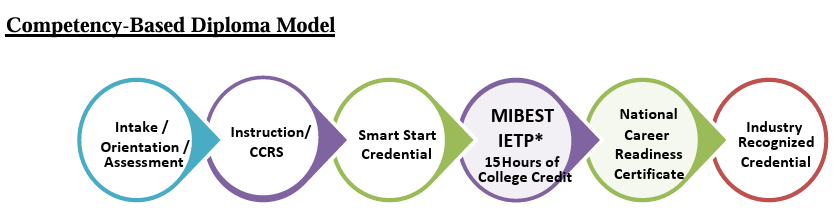
Eligibility
- must be a Mississippi resident
- not enrolled or required to be enrolled in school under the compulsory school law
- has not received a valid high school diploma or a High School Equivalency Diploma (HSED)
Enrollment in Adult Education Program
- Meet with College and Career Navigator
- Create Student Success Plan
- Student portfolio
- Register with MS WORKS
- WIOA Common Case Management Technology (Hub)
- Identify Barriers
- Referrals to core agencies, if applicable
Upon completion of the following components, participants will be awarded a Mississippi High School Equivalency Diploma (HSED) validated and issued by the State of Mississippi. All HSED’s are distributed through Diploma Sender.
Competency-Based Diploma Completion Requirements
- Obtain a minimum scale score in two subjects: Reading 563 and Total Mathematics 577 on the Test of Adult Basic Education (TABE) for Educational Functional Level 4.
- Enroll and complete a minimum of 12 hours of instruction in an Adult Education Program which includes the following:
- College & Career Readiness Standards - All students will receive instruction in reading, writing, and math aligned with the College and Career Readiness Standards required by the Office of Career, Technical and Adult Education
- https://lincs.ed.gov/professional-development/resource-collections/profile-521
- Attainment of a Smart Start Credential
- Earn 15 college credit hours through a MIBEST program or designated Integrated Education and Training Pathway
- Prior Learning Assessment/Credit by Examination college credits are allowable
- Developmental education credits are excluded
- Minimum GPA 2.0 or higher
- Earn a National Career Readiness Certificate – Silver
- Applied Math – Level 4
- Workplace Documents – Level 4
- Graphic Literacy – Level 4
- Earn an Industry Recognized Credential.
Applications for the Competency-Based Diploma should be completed and signed by the local adult education director. Complete applications should be mailed to:
Mississippi Community College Board
Office of Adult Education
3825 Ridgewood Road
Jackson, MS 39211Upon receipt and approval, the Office of Adult Education will upload documents via a secure site to Diploma Sender. Applicants will receive an email from Diploma Sender with instructions for ordering a complimentary diploma and transcript. The $25.00 application processing fee will be paid directly to Diploma Sender at the time of order.
- Total Transcript
The Total Transcript option is an alternate HSED by Diploma Sender. Total Transcript combines passing scores from the GED ® test and the HiSET ® test beginning 01/01/2014 to present to result in a credential status or HSED.
Diploma Sender uses an algorithm to create a four-point Grade Point Indicator (GPI) letter scale to determine best test scores across all publishers and to assist with credit recovery in K-12.
Total Transcript retains state testing requirements. The state testing requirements for GED® is a minimum score of 145 for each test with an overall score of 580. The HiSET® test requires testers to score a minimum of eight (8) for each test with an overall average of nine (9).
Total Transcript opportunity by reducing the impact when one or more of the publishers of HSE testing are not readily available during the lifespan of testing: and, creating a standard to analyze HSE results to satisfy K-12 credit recovery and to qualify for enrollment in post-secondary.
Applicants will receive an email from Diploma Sender with the initial diploma and transcript at no cost. There is a $20 fee for an additional copy of the diploma and transcript. The application processing fee will be paid directly to Diploma Sender at the time of order.
Testers who need additional information may contact Diploma Sender via phone at 1-855-313-5799 or chat at www.diplomasender.com.
- Establishing a High School Equivalency Testing Center
All High School Equivalency Test Centers are subject to the approval of the High School Equivalency State Administrator and the guidelines set forth by each test vendor. For specific Test Center vendor requirements, visit the websites below:
- GED Testing Service: https://ged.com/exhibit4
- PSI, HISET: https://hiset.org/test-centers-adult-ed-prep/
HSE testing centers provide standard secure testing administration to eligible candidates who wish to earn their state-issued High School Equivalency Diploma. HSE tests may be administered only at HSE testing centers or addendum sites approved by the MCCB, Office of Adult Education and High School Equivalency.
MCCB is responsible for the administration of the High School Equivalency testing program and may authorize the establishment of HSE testing centers in eligible local agencies and institutions within Mississippi. MCCB will consider HSE testing center applications based upon need for service in the local area and on the ability of the eligible agency or institution to follow MCCB and HSE assessment publishers’ mandatory policies and requirements for establishing and operating an HSE testing center.
MCCB must provide formal approval prior to HSE test administration by any prospective HSE testing center, including any required signed agreements between the test publisher or publishers, MCCB, and the HSE testing center.
HSE Program Definitions:
- Test Center – Testing site that holds an HSE test center agreement with the MCCB, Office of Adult Education and High School Equivalency and their respective HSE assessment vendors.
- Addendum Site – Site at which testing can occur, but the site does not have a separate test center agreement. Test centers are responsible for the addendum sites.
- Chief Examiner/Administrator – Individual responsible for conducting a secure and legally defensible HSE testing program. Chief Examiners must have a high school diploma or equivalent; must not receive material compensation from any HSE vendor; and must be trained as an HSE Chief Examiner and an HSE Examiner.
- Examiner – A role responsible for administering and conducting HSE testing in a secure and legally defensible manner. Examiners must have a high school diploma or equivalent; must not receive material compensation from any HSE vendor; and must be trained as an HSE Examiner and an HSE Proctor. A testing program may have several examiners.
- Proctor – A role responsible for conducting an HSE test session in a secure and legally defensible manner. Proctors must have a high school diploma or equivalent, must not receive material compensation from any HSE vendor, and must be trained as an HSE Proctor. A testing program may have several proctors.
- Candidates – Individuals who are eligible to sit for an HSE test.
MCCB will consider the establishment of HSE testing centers at the following locations:
- State and local government education entities such as colleges and school districts
- Nonprofit organizations focused on education or workforce development
- Nonprofit organizations with a community-based mission
- For-profit organizations.
- The State Administrator may consider an application from a for-profit organization only when a demonstrated need is not met by nonprofit or governmental organizations
*** The testing center must be open to the public, unless it is housed in an institutional, residential program such a correctional facility.
Requirements for Opening HSE Test Centers Testing centers must:
- Follow all MCCB and state-approved HSE test publisher policies and guidelines.
- Provide suitable physical facilities, according to the requirements outlined by stateapproved HSE test publishers.
- Provide unbiased, qualified testing program staff to administer and oversee the testing program. in accordance with state-approved HSE test publisher guidelines.
- Participate in any training required by MCCB and state-approved test publishers.
- Participate in required MCCB meetings for HSE testing centers.
- Agree to the test price schedule set by MCCB.
- Provide full HSE testing support services, which include:
- convenient testing schedules based on community need
- an emergency plan for handling testing interruptions and irregularities
- information to help candidates make informed decisions about testing, remediation, and transitioning to postsecondary education
- accessibility and availability of information on test accommodations for HSE candidates who qualify, and
- sign all appropriate agreements and memoranda of understanding.
- Assure test security by:
- complying with all security policies and procedures required by state-approved HSE test publishers
- providing secure storage, handling, and shipment of state-approved HSE testing materials
- promptly returning all restricted testing materials to state-approved HSE test publishers upon request
- conducting all required inventories, and
- cooperating with state-approved HSE test publisher in the event of a test compromise.
MCCB will review applications of prospective HSE test centers on an as-needed basis. Organizations that wish to establish a new state-approved HSE testing center must contact the MCCB High School Equivalency program at:
Mississippi Community College Board
Office of Adult Education & High School Equivalency
3825 Ridgewood Rd.
Jackson, MS 39211
601-432-6518- The proposed test center will submit a New Test Center Questionnaire form and any other documentation required by the State HSE Administrator.
- The State HSE Administrator may request addition information and may schedule a site visit by MCCB staff.
- The MCCB will review application information and make a final determination with regards to approving a prospective HSE test center.
- If the MCCB determines an additional state-approved HSE test center is not warranted, the State HSE Administrator will notify the applicant of the decision in writing.
- If the MCCB determines an additional state-approved HSE test center is warranted and the proposed test center meets the qualifications, the State HSE Administrator will contact local area test centers to inform them that another test center may be opening and contact the representative of the proposed test center to discuss expenses, the vendor application process, timeline, and related startup activities.
Establishing an Addendum Test Center
When establishing a new HSE test center is not an option, an established HSE test center may request approval from MCCB for a transportation addendum. This addendum would allow Examiners to transport testing materials to conduct testing at an approved off-site location, called an addendum testing site. The main testing center would be responsible for the location and all HSE testing occurring at the addendum site.
Eligible Addendum Site Locations
Examples of acceptable addendum sites include, but not limited to, the following:
- public libraries
- local jails and corrections camps
- workplaces that provide instruction
- nonprofit and other community organizations
- educational institutions where a low overall testing volume would not justify establishing an HSE testing center
All test administration at addendum sites must be performed by trained examiners and proctors that meet all the requirements established by the state and the respective test publishers.
Requirements to Establish an Addendum Testing Site
The Test Center Chief Examiner must provide justification in writing of the need to test at the proposed site and assurance that the addendum site is a suitable facility for HSE testing. The Chief Examiner must also ensure that only approved HSE Examiners will transport secure testing materials, and that appropriate inventory procedures will be followed for any testing materials transported to an addendum site.
When establishing an addendum site, test coordinators are expected to ensure that:
- secure materials are always transported in a locked container
- proper inventories of testing materials occur at the following intervals:
- before leaving the main testing center
- upon arrival at the addendum site
- immediately before and after administering the tests
- upon returning to the main testing site
- secure materials are never stored at an addendum site
- HSE Resources
Diploma Sender
www.diplomasender.com
Phone: 855-313-5799
Email: support@diplomasender.com
Address: PO Box 722050
Norman, OK 73069GED Testing Service
Tester Registration: www.ged.com
Educators & Administrators: www.gedtestingservice.com
Customer Service Phone: 877-392-6433,
help@gedtestingservice.com
Testing Center Service line: 1-866-389-3665
Pearson VUE Support for Testing Centers: 800-704-3613
Transcripts: https://parchmentsupport.force.com/GED/s/test-takersHISET Test Administration Services
Email: HiSETsupport@psionline.com
Website: http://hiset.org/
Address: PSI 3210 E Tropicana
Las Vegas, NV 89121NOTE: When contacting test publishers, please be prepared to provide your name, site name, site number (if known), the system in question (i.e. Online Registration System, Online Assessment System, or the Online Reporting System), and your username and password.
Please keep a record of the date, time, name of the customer service representative, and your case number (if applicable).
- Competency-Based High School Equivalency Diploma Fact Sheet
What is the Mississippi Competency-Based High School Equivalency Diploma (HSED) Option? The MS Competency-Based High School Equivalency Diploma Option is an alternate HSED. It is embedded with both academic standards and industry recognized credentials for students enrolled in the Mississippi Integrated Basic Education and Skills Training (MIBEST) program or an Integrated Education and Training (IET) Pathway. Instruction is designed to recognize the academic learning that occurs within the training programs. Essentially, the academic learning occurs through authentic, real-world problems and projects completed within the industry credential training. Mastery of content and competencies, as well as use of existing assessments for pre- and post-testing, such as TABE (Test of Adult Basic Education) and ACT WorkKeys®, is the form of assessment used in lieu of the GED or HiSET norm testing.
Why is this option important for participants? A postsecondary degree or relevant job certification is the “new minimum” needed to meet the demands of an increasing knowledge-based workforce with the means to excel in rewarding careers and growing family incomes. However, the route to postsecondary education comes to an abrupt halt if an individual does not have a high school diploma or HSED.
Who is this option for? This option is for participants looking to complete their high school equivalency through a local adult education program.
How can participants register for this option? Participants may contact any local adult education program to learn more about participating in this option.
What is the cost? $25.00 processing fee paid directly to Diploma Sender.
What instruction will students receive? All adult education instruction has been federally mandated to include College and Career Readiness Standards (CCRS). The CCRS for Adult Education report presents content most relevant to preparing adult students for success in college, technical training programs, work, and citizenship with emphasis in the areas of English language arts/literacy and mathematics.
Is this option recognized by the State of Mississippi and transferable outside of Mississippi? Yes. Mississippi Code: 37-5. Participants completing this option, will receive the Mississippi High School Equivalency Diploma (HSED).
What credit hours will be accepted? Credit hours earned in a MIBEST program or designated Integrated and Training Pathway will qualify for this completion option if it meets the definition of an IET as defined by WIOA. WIOA definition of Integrated Education and Training means a service approach that provides adult education and literacy activities concurrently and contextually with workforce preparation activities and workforce training for a specific occupation or occupational cluster for the purpose of educational and career advancement. IET represents a wide spectrum of services to build foundational, employability, and occupational skills.
What are Industry-Recognized Credentials? High-quality credentials are recognized by multiple employers across an industry. To help better identify and prioritize such credentials, the following uniform definition of “industry-recognized” is the standard definition to be used to determine if a credential meets the requirements for awarding a Competency-Based High School Diploma. The term ‘‘industry-recognized,’’ used with respect to a credential, means a credential that:
- must be awarded in "recognition of an individual's attainment of measurable technical or occupational skills necessary to gain employment or advance within an occupation” (ETA)
- is sought or accepted by employers within the industry or sector involved as a recognized, preferred, or required credential for recruitment, screening, hiring, retention, or advancement purposes
- is endorsed by a nationally recognized trade association or organization representing a significant part of the industry or sector
What are the minimum requirements for achieving a Mississippi Competency-Based HSED? Upon completion of the following components, participants will be awarded a MS High School Equivalency Diploma (HSED) validated and issued by the State of Mississippi, Mississippi Community College Board. All HSEDs are distributed through Diploma Sender.
Completion Requirements Eligibility
- Must be a Mississippi resident
- Not enrolled or required to be enrolled in school under the compulsory school law
- Has not received a valid high school diploma or a High School Equivalency Diploma (HSED)
Enrollment in Adult Education Program
- Meet with College and Career Navigator
- Create Student Success Plan
- Student portfolio
- Register with MS WORKS
- WIOA Common Case Management Technology (Hub)
- Identify Barriers
- Referrals to core agencies
Obtain a minimum scale score of 563 in Reading and 577 for Total Mathematics on the Test of Adult Basic Education (TABE) for Educational Functioning Level 4. *** Applicants are required to submit TABE Portfolio for all assessments. TABE Assessments submitted must comply with the Mississippi Adult Education Assessment Policy to be valid. Enroll and complete a minimum of 12 hours of instruction in an Adult Education Program.
College & Career Readiness Standards - All students will receive instruction in reading, writing, and math aligned with the College and Career Readiness Standards required by the Office of Career, Technical and Adult Education https://lincs.ed.gov/professional-development/resourcecollections/profile-521
Earn 15 college credit hours through a MIBEST program or designated Integrated Education and Training Pathway.
- Prior Learning Assessment/Credit by Examination college credits are allowable
- Developmental education credits excluded
- Minimum GPA: 2.0 or higher
Earn a Mississippi Smart Start Credential
- Basic Skills – National Career Readiness Certificate
- Career Exploration/Employment Preparation
- Necessary Skills – (soft skills)
Earn a National Career Readiness Certificate (NCRC) Applied Math Level 4 or higher Silver Workplace Documents Level 4 or higher Silver Graphic Literacy Level 4 or higher Silver Earn an Industry-Recognized Credential - Competency-Based High School Equivalency Diploma Option Application
Date of Application: [Date of Application]
Adult Education Program: [Program Name]
Student Name: [Full Legal Name]
SSN: [XXX-XX-XXXX]
DOB: [MM/DD/YYYY]
Address: [Street Address]
City: [City] State: MS
Zip Code: [Zip Code]
Student Email Address: [Email Address]
Student Phone Number: [Phone Number]
Applications will be processed by the Office of Adult Education. Incomplete applications will be returned.
Application and all documentation should be mailed to:
Mississippi Community College Board Office of Adult Education
3825 Ridgewood Road Jackson, MS 39211Application Requirements:
[] Copy of Driver’s License or state-issued I.D.
[] For 16- and 17-year-olds Only: Attach a copy of withdrawal form from the school district in which the student resides)
[] Copy of Student’s TABE Testing Portfolio. (Minimum scale scores: 563 for Reading and 577 for Total Mathematics for Educational Functioning Level 4)
[] Copy of college transcript verifying 15 hours of college credit earned
[] Copy of Mississippi Smart Start Credential including credential number
[] Copy of National Career Readiness Certificate: SILVER
[] Copy of Industry Recognized CredentialAdult Education Director: [Adult Education Director Name] (Print Name)
[Director Signature on Official Form] (Signature)
Date: [Date Signed]Office of Adult Education ONLY:
Date Uploaded Diploma Sender: [Upload Date] Verified by: [Office Representative Name]
HSE Director: [HSE Director Signature on Official Form]
Note: The Office of Adult Education will upload documents via a secure site to Diploma Sender. Applicants will receive an email from Diploma Sender with instructions for ordering a complimentary diploma and transcript. The $25.00 application processing fee will be paid directly to Diploma Sender at the time of order.
- Prospective Mississippi High School Equivalency Test Center Application
Official testing centers are approved by the test publisher, in consultation with the State HSE administrator when the following have been documented:
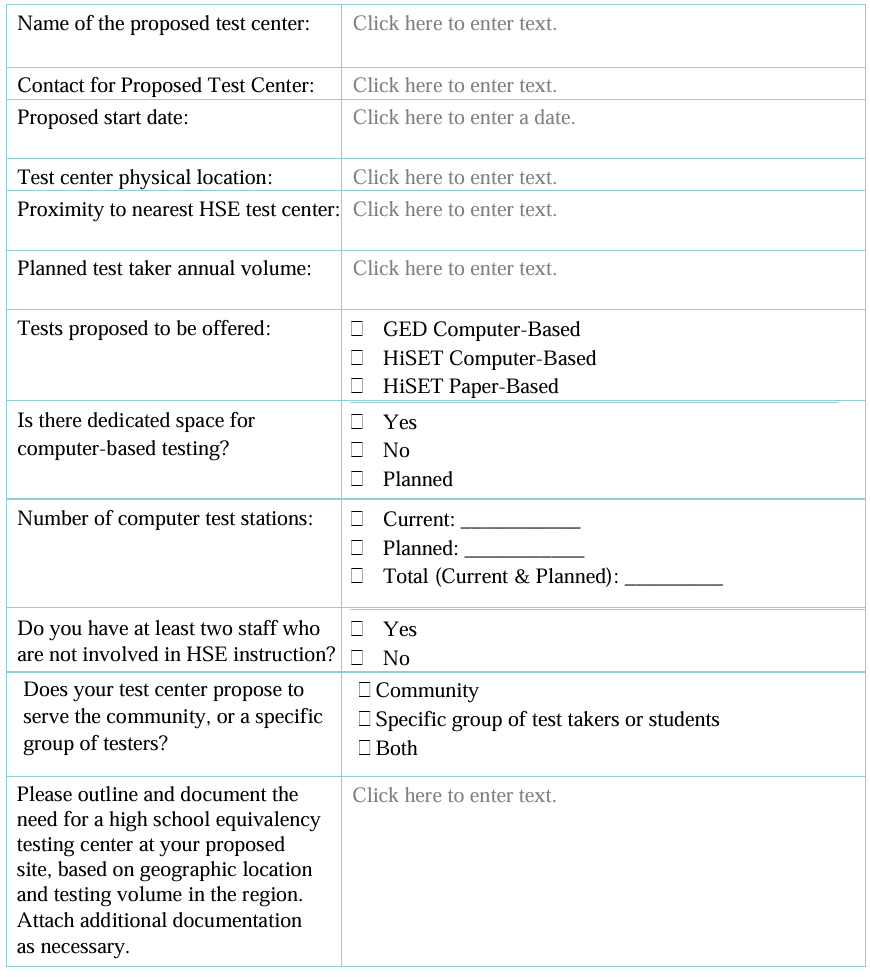
Please submit photos of your proposed testing center.
- Floor Plan
- Test Administrators Position
- Test Administration Area
- Test Delivery Area
- Reception/Check-in Area
- Neutral Background at Reception/Check-In Area (*Pearson VUE only)
- Lockable Area
- Photo-Other
- Special Accommodations Testing Area
- Building Exterior
If one video illustrates all aspects of your test center, submit one file under Video - Other.
The application is not considered complete until photos/videos have been submitted.
- Preferred photo formats: .jpg, jpeg, png, gif, pdf. Also acceptable: doc, docx, xls, xlsx.
- Acceptable video formats: mpg, flv, avi, mov, mp4.
As Test Center Administrator, I agree to fulfill all state and test vendor requirements in this application and the Memorandum of Agreement.
Test Center Administrator: [Signature on Official Agreement]
Date: [Date Signed]
State Administrator: [Signature on Official Agreement]
Date: [Date Signed]
Chief Examiner: [Signature on Official Agreement]Submit completed questionnaire and any supporting documentation by email, blittle@mccb.edu, or by postal mail to:
Mississippi Community College Board Office of Adult Education & HSE
Attn: Beth Little
3825 Ridgewood Rd.
Jackson, MS 39211Testing Area Set-Up
Photo/video checklist for HSE Test Centers
Guidance for submitting photos/videos:
- Submit either photos, videos, or a combination of both - whatever is easiest.
- If one video illustrates all aspects of the test center, submit one file under video - other.
- The application is not considered complete until photos/videos have been submitted.
- Preferred photo formats: .jpg, jpeg, png, gif, pdf.
- Also acceptable: doc, docx, xls, xlsx.
- Acceptable video formats: mpg, flv, avi, mov, mp4.
Floor Plan
Submit a floor plan (hand-sketched or digital) of test center layout, showing the location of the check-in, test administrator, lockable storage, and testing stations.
Test Administrator’s Position
This photo should indicate where the administrator will be located during delivery of the exams. The photo should also indicate the administrator's table and chair in the test room if monitoring will be done in the test room during exams.
Test Administration Area
This photo should indicate the administrator's view of the candidates. All delivery workstations, including the desktop of each workstation, should be visible. If monitoring will be done via a viewing window, the photo should be taken from the test administrator's position, showing what can be seen through the window from that position. If monitoring will be done via camera, the photo should be of the screen the test administrator sees, showing that all candidates can be continuously and simultaneously monitored. If monitoring will be done in-room, please provide photo(s) taken from the test administrator’s seated position of all testing stations.
Test Delivery Area
This photo should indicate all test PCs being requested for approval.
- Each workstation must be separated from the neighboring workstation by at least 4 feet (1.2m), or a partition.
- Partitions should be solid, permanent partitions or walls that are at least 1.5m (5’) in height and extend outward from the wall at least 1.2m (4’).
- Desktop partitions are acceptable as long as the height measured from the floor is at least
- 1.5m (5’), and the width measured outward from the wall is 1.2m (4’).
- Cardboard partitions are not acceptable.
- If there is not enough space between the workstations, you may use alternate workstations.
Reception and Check-In Area (Pearson VUE Only)
The check-in/reception area must be near, but not inside, the test room. The check-in process must be performed before allowing a candidate to go into the test room. The check-in/reception area must show that there is a desktop PC for checking in candidates. Photos should also show available seating for candidates who arrive early.
Neutral Background at Reception / Check-In Area
A neutral background is required in the check-in area to provide a background for the digital photo of the candidate (e.g., white painted wall).
Lockable Area
Provide a photo of the lockable area where candidates will secure items outside of the testing area (e.g., lockers, lockable cabinet, lockable drawer). The locking mechanism must be visible in the photo (e.g., if it's a key lock, the key must be in the lock).
Photo - Other
To be used if there are any additional photos.
Special Accommodation Testing Area
Provide a photo of the test delivery workstation that can accommodate candidates with disabilities. This photo should illustrate how the candidate will be monitored as described in the Test Administration Area above.
Building Exterior
Provide a photo of the exterior of the building showing the address, school/company signage, and the parking area. If the testing site is located in a building without individual signage, please provide a photo of the building directory, which clearly lists your company’s name.
- Requests for High School Equivalency (HSE) Transcripts & Diplomas
The Mississippi Community College Board no longer processes High School Equivalency Transcripts and Diplomas. All requests should be completed through Diploma Sender. Please follow the directions below to request copies of your documents. Note: GED requests from federal corrections and military bases require specific procedures.
Diploma Sender
All requests for official copies of HSE Diplomas and Transcripts, as well as verification of completion of an HSE Diploma, are completed through Diploma Sender at www.diplomasender.com. This includes verification for third‐party agencies such as employers and verification agencies. Adult education programs may not provide scores or verification for employers or other agencies (including schools). No HSE Diplomas or Transcripts can be provided by the Mississippi HSE office.
Note: Use your First/Last name, Date of Birth, and unique ID number assigned by the test provider to register. If you’re unsure of your ID number, see guide below for help.
Information about ID numbers:
- GED ID- 16-digit ID beginning with the year you tested. i.e. 2016xxxx-xxxx-xxxx
- HiSET ID- 8-character ID number containing letters and numbers. i.e. ABC12345
GED® - www.ged.com
HiSET® - www.hiset.orgDirections for Requests:
- Go to the following website: www.diplomasender.com
- Login or Register to Create an Account
- Select the state in which you took your test: Mississippi
- Choose Continue
- Select “No” when asked, “Did you graduate from a local or 4-year high school?”
- Select Continue
- Create a User Name and Password
- Enter your email address as your username for Diploma Sender
- Enter your phone number
- Click on the box to accept the Conditions of Use and Privacy Policy
- Select Continue
- Create a password to use for Diploma Sender
- Must be a minimum of eight (8) characters long (case sensitive)
- Provide the requested information (test date(s), identification/security questions) a. If candidate took the test before 2013, the (GEDTS, HISET, or TASC) I.D. is their social security number. If tested in 2014 or later, use the test provider’s unique ID number. (Directions will be on the screen.)
- Select Continue
- Diploma Sender will generate your documents
- Select the desired documents (diploma or transcript), include ordering details, provide consent, and make payment (see website for amount.)
Technical Support: For technical support regarding requests for transcripts and diplomas, contact ITsupport@diplomasender.com.
State Corrections and Probation Offices
Diploma Sender will process requests for all HSE transcripts and/or diplomas from state correctional facilities and probation offices. Follow the same steps listed above.
Federal Corrections
Testers who took the HiSET or TASC exam in a federal correctional facility can obtain their HSE documents through Diploma Sender. Follow the same steps listed above.
Note: Testers who took the GED exam in a federal correctional facility can obtain their GED credential through GED Testing Service. Follow the steps listed below.
Directions for Requests through GED Testing Service:
- Go to www.GED.com
- Click on the top tool bar, “Grads and Transcripts”
- On the page, “Request Your Transcript,” select the appropriate option:
- If you earned your GED credential in 2014 or later, login to request your transcripts
- If you earned your GED credential before 2014, enter your location in the drop-down to request your transcript. Importantly, select “Federal Bureau of Prisons”
- Once logged in, select which documents (diploma or transcript) you want, including ordering details, giving consent, and making payment (see website for amount.)
Military
Testers who took the GED test at military testing centers can obtain their HSE documents through DANTES (Defense Activity for Non‐Traditional Education Support).