Introduction
On May 19, 2023, The Mississippi Community College Board unanimously voted to approve the Postsecondary Career and Technical Education Program Guidelines . When approved, the document will then follow the SOS review process.
On April 25, 2023, The Mississippi Association of Community Colleges (The President’s Association) unanimously voted to approve the Postsecondary Career and Technical Education Program Guidelines 2022-23. The guidelines will be presented to the MS Community College Board (MCCB) at the next available meeting. If approved, the document will then follow the SOS review process. Once approved, the document will be in effect and will be updated yearly or as needed.
- Administrators
The CTE Administrator’s retreat was held October 25-26, 2022, Natchez, MS. The CCTO Chair, Dr. Addie Boone, presented the revised Postsecondary Career and Technical Education Program Guidelines 2022-23, to the CTE Administrators. The following administrators unanimously approved the guidelines.
- Jason Mattox, Northeast
- Larry Webster, Coahoma
- Brent Duguid, Copiah Lincoln-Brent was absent. Dr. Magee voted for Co-Lin
- Michael Busby, East MS
- Sherry Franklin-Bellmon, Hinds-Sherry was absent. Dr. Hudson voted for Hinds
- Amy Whittington, Holmes
- Barry Emison, ICC
- Rod Tolbert, Jones
- Suzanne Thompson, MS Delta
- Joseph Knight, Meridian
- John Poelma, MS Gulf Coast
- Dwayne Casey, Northwest
- Amy Townsend, Pearl River
- Addie Boone, Southwest
- Cody, Spence, East Central
The CCTO Chair will present the guidelines to Chair of the Mississippi Community College President’s Association for the President’s to review and approve. If the President’s approve, the document will then be presented to the MCCB for approval and follow SOS review process. Once approved, the document will be in effect and will be updated yearly or as needed.
- Guidelines Review
Several meetings were held in the fall of 2021 and spring of 2022, to review the Guidelines document, the articulation document and the qualifications document. The members of the meeting (Vetting committee) were selected from the chair of the CTOA. Vetting Committee- (Barry Emison, Itawamba Community College; Rod Tolbert, Jones College, Addie Boone, Southwest Community College, James Collum, Pearl River Community College, Suzanne Thompson, MDCC and Sherry Bellmon, Hinds CC) Amy Whittington, Holmes Community College, Brent Duguid, Copiah Lincoln Community College and Scott Kolle, Director of Curriculum, Instruction and Assessment from MCCB) The Vetting committee will review and suggest changes. The MCCB staff will review and suggest changes. After approval of both groups, the document will be reviewed and voted on by the CTOA administrators for each college. If approved, each CTE administrator will review the document with his or her college President. Once approved by both CTE administrators and the Presidents, the document will be presented to the MCCB for approval and follow SOS review process. Once approved, the document will be in effect and will be updated yearly or as needed.
When this document is approved by all parties and completed the APA process, this document will supersede, the MCCB Articulation agreement document 2014 and previous versions, the MCCB Qualifications document 2017 and National Certifications Standards and Procedure Manual for Career Technical Education and Workforce Training Mississippi Community College Board Division of Workforce and Economic Development 2017 and the MCCB CTE Guidelines document 2020.
Section 1
- Career and Technical Programs
Career and Technical Education (CTE) provides students with the academic and technical skills, knowledge, and training necessary to succeed in careers and to become lifelong learners. CTE prepares learners for the world of work by introducing them to workplace competencies and making academic content accessible to students by providing it in a hands-on context. Funding is provided through both federal and state sources.
Career and Technical Stackable Options All CTE curriculum is designed in a stackable credential format with multiple exit points. The stackable credentials will be designed into a 15 semester hour work ready certificate, 30 semester hour career certificate, 45 semester hour technical certificate, and 60 semester hour Associates of Applied Science Degree.
Work Ready Certificate (is called “Accelerated” in current docs) 15 credits in a program of study. This option can use MI BEST. 8 hours must be in a prefix, rest can be electives. Must be tied to a CIP. Career Certificate 30 credits minimum Technical Certificate Career Certificate Coursework + 15 credits minimum (minimum of 45 credits) General Education Core Courses 15 academic general education credits minimum (minimum of 60 credits) Total Semester Credit Hours for the Associate of Applied Science Degree 60 credits minimum hours earned as a compilation of Career, Technical, and Academic credit hours Note: Professional accreditation may require additional hours. Programs of study will align and prepare students all professional accreditation standards.
- Entry Requirements
Each college establishes its own entry requirements for postsecondary CTE Programs. - Process for Requesting New Postsecondary CTE Programs
There are two categories of New CTE Program Applications:- Proposal to add Unique CTE Program: A proposal to implement a program that is not currently being offered under an existing approved or statewide curriculum.
- Proposal to add an Existing CTE Program (not currently approved for the college). A proposal to implement a program that is not currently approved for the requesting institution that has an existing approved or statewide curriculum.
Colleges may request to add a New CTE Program by submitting a letter of request accompanied by a completed “New Program Application.”
- Process For Adding A Unique New CTE Program:
- Complete Employment Needs Data, including state and district employment and wage projections (average annual salary projections and 10 year employment projections).
- Complete student interest data form.
- Obtain recommendations from the advisory committee.
- Obtain professional association endorsement (if needed).
- Develop the curriculum following the 30/45/60 (include 15 hours if applicable) course sequencing format.
- The curriculum should list each course planned in the 30/45/60 course sequencing format including the course number, title, and credit hour as an attachment.
- List the course description of each core course (not including general education course) in the curriculum.
- Submit the Curriculum as “Attachment I”.
- Obtain local approval.
- Submit the new program application, along with all the requested supporting documentation to the Director of Career and Technical Education.
- Applications must be submitted by the monthly deadline published by the Career Technical Officers Association (CTOA) “Events Schedule” (available on the MCCB website).
- Upon approval, proposal is presented to MCCB Board.
- Once approved:
- MCCB notifies college of approval.
- MCCB notifies Mississippi Department of Education and the Research and Curriculum Unit.
- Each College works with the MCCB to develop a statewide curriculum framework and technical skills assessment, if required.
- Each college is responsible for adhering to local community college processes/SACSCOC and other accrediting boards.
- Process For Adding A New Program With An Existing Curriculum Framework (The program is already approved for another college)
- Complete Employment Needs Data, including state and district employment and wage projections (average annual salary projections and 10 year employment projections).
- Complete student interest data form.
- Obtain recommendations from the advisory committee.
- Obtain professional association endorsement (if needed).
- Submit the Curriculum as “Attachment I”.
- If a statewide curriculum exists, provide a copy of the 30/45/60 (include 15 hours if applicable) course sequence from the curriculum.
- If a curriculum does not exist, list each course planned in the 30/45/60 course sequencing format including the course number, title, and credit hour as an attachment.
- List the course description of each core course (not including general education courses) in the curriculum.
- Obtain local approval.
- Submit the new program application, along with all the requested supporting documentation to the Director of Career and Technical Education.
- Applications must be submitted by the monthly deadline published by the Career Technical Officers Association (CTOA) “Events Schedule” (available on the MCCB website).
- Upon approval, proposal is presented to MCCB Board of Directors.
- Once approved:
- MCCB notifies college of approval.
- MCCB notifies Mississippi Department of Education and the Research and Curriculum Unit.
- College works with the MCCB to develop a statewide curriculum framework and technical skills assessment, if required.
- Each college is responsible for adhering to local community college processes/SACSCOC and other accrediting boards.
Process For Requesting New Program Option/Concentration Or Location New options or concentrations are defined as any option (degree or certificate) listed within a statewide curriculum framework of any program currently listed in the Statewide CIP table for requesting institution.
Colleges may request to add new options, concentrations, or locations under existing programs by submitting a completed “New Option Application” (available on the MCCB website). Requests, along with all the requested supporting documentation to the Director of Career and Technical Education. Applications must be submitted by the monthly deadline published by the Career Technical Officers Association (CTOA) “Events Schedule” (available on the MCCB website).
The request must justify the need for the new option, concentration, or location and must address the items outlined in the “New Option Application” including but not limited to the following:
- Program, option, or concentration name and CIP code.
- Location(s) where the program, new option or concentration will be offered.
- State and district employment and wage projections (average annual salary projections and 10 year employment projections).
- Projected enrollment for the new option or concentration or at the new program location.
- Identified technical skills assessment.
- Attach copy of current curriculum (cover and course outline is acceptable). g. If the current curriculum is sequenced in the 30/45/60 SCH stackable credentials format, provide a copy of the course sequence from the curriculum.
- If the curriculum has the 30/45/60 Course Sequencing format and show as an attachment).
- Projected additional costs for facilities, equipment, and faculty.
- Semester of proposed implementation.
- Once approved:
- MCCB notifies college of approval.
- MCCB notifies Mississippi Department of Education and the Research and Curriculum Unit.
- College works with the MCCB to develop a statewide curriculum framework and technical skills assessment, if required.
- Each college is responsible for adhering to local community college processes/SACSCOC and other accrediting boards.
- Process For Terminating Programs, Options, Locations, Or Concentrations Colleges may terminate programs, options, or concentrations at any location through a letter of notification to the MCCB, Director of Career and Technical Education. Applications must be submitted by the monthly deadline published by the Career Technical Officers Association (CTOA) “Events Schedule” (available on the MCCB website). Applications should also include the following:
- Program, option, or concentration name and CIP code
- Location(s) of the terminated program, option, or concentration
- Reason for the termination
- Effective date of termination
- Confirmation of closed programs will be emailed to the college president, the RCU, and MDE.
- Each college is responsible for adhering to local community college processes/SACSCOC and other accrediting boards.
Section 2
- Qualifications for Post Secondary Personnel
It is the college’s responsibility to justify and document the qualifications of its faculty, in compliance with SACSCOC and other accrediting boards.
Section 3
- Professional Development
Administrators at each college will work collaboratively with MCCB to provide:
- The Institute for Teaching and Learning
- The Administrator Retreat
- The Leadership Academy
- The Summer Conference
- others as needed
Section 4
- Guidelines on Statewide Articulated Credit
- Statewide Articulation with High Schools: Statewide articulation agreement ended June 30, 2022.
- Local Articulation agreements: Local high schools should contact their local community college to inquire about establishing a local agreement.
- Dual Enrollment: Refer to the Procedures Manual for the State of MS Dual Enrollment Accelerated Programs.
Section 5
- Postsecondary Career and Technical Education Funding
Formula-History
10/10/2022 Update
This section was reviewed by the Mississippi Community College Board’s Deputy Executive Director for Finance and Administration (Jason Carter). The only update was this statement in A. (see below) “Beginning in FY 2013 the divisor of 30 was used to determine an FTE for funding purposes. The MACJC voted on the change at its June 2011 meeting” and adding the Appendix H (High Cost Programs by level. Questions concerning this section should be directed to the Business Manager/ Finance Administrator at the local community college. This person will contact the Mississippi Community College Board’s Deputy Executive Director for Finance and Administration for more information.
A Career Technical Formula Study Committee was appointed by Dr. Wayne Stonecypher, Executive Director of the SBCJC, in January of 2005 to satisfy conditions set forth in the Memorandum of Agreement between the Mississippi Board of Education (MBE), the Mississippi Department of Education (MDE) and the State Board for Community and Junior Colleges (SBCJC). More importantly, the charge to the Committee was to provide recommendations for funding CTE at the community and junior college level in a way that is most equitable to the fifteen colleges and which encourages colleges to provide programs and services to constituents at the greatest level of quality and efficiency. Finally, although it was not a part of the original charge, the Committee accepted the challenge to develop a formula which would raise the standards and expectations of Career Technical programs to a higher level of respect in the eyes of the public.
The Career Technical Formula Study Committee was composed of a cross section of individuals representing Presidents, Chief Academic Officers, Career Technical Deans, Business Managers and SBCJC Staff members. The Committee was challenged by Dr. Stonecypher and the Chairman to make decisions on the basis of what was in the best interest of the community college system. It was very evident that committee members met this challenge throughout the process. The Committee met six times and spent many hours examining the impact of various formulas upon the system. In addition, many emails were exchanged whereby various information and opinions were shared. They took their task seriously and made decisions with the welfare of the community college system in mind.
The Committee presented their recommendations to the MACJC and the SBCJC as a representation of its work. Realizing that the final formula may be changed by either of those two groups, the report represented a sound product that is equitable for all fifteen institutions and which encourages colleges to provide programs and services at the highest level of quality and efficiency.
The Committee developed a survey to gather information from members of the five constituent groups. This survey asked respondents to rant factors in priority in accordance with the weight that should be given in determining funding for Career Technical Education. It also provided an opportunity for respondents to list elements which should be included in any funding formula.
There were fifty-three surveys completed and returned. Respondents rated “equity” as a very high priority, buy many of the respondents indicated they felt equity was a “given” and did not rank it. The results indicated that the highest single priority by respondents was the formula should be based on FTE, the second highest priority was “high cost” programs, with ninety-six percent (96%) indicating that a special weight should be assigned for high cost programs. “High Demand” programs were ranked as important as well, and “Performance Based” factors were also listed as important to the respondents.
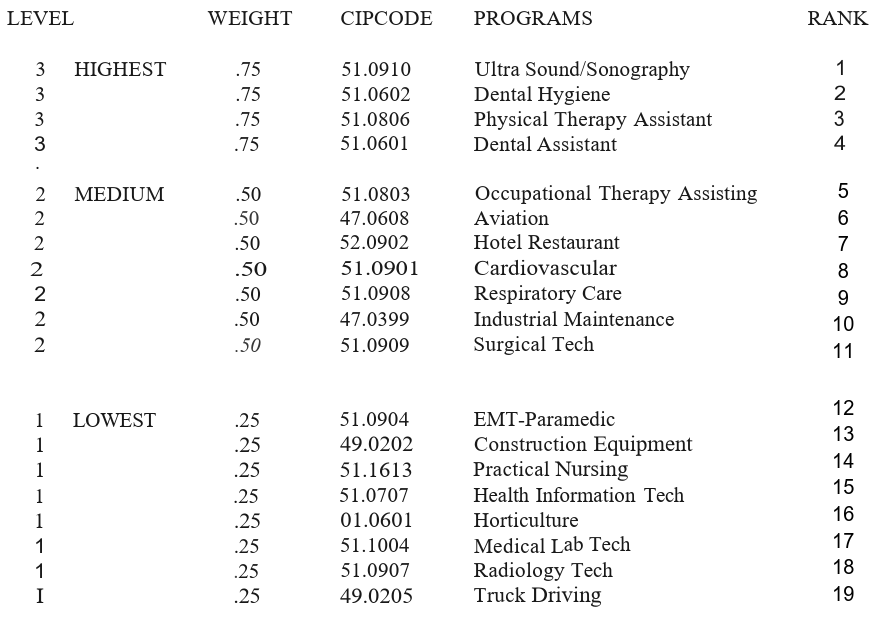
A sub-committee was selected by the Chair and the Director of the Career Technical Division at the SBCJC to advise the Committee on what programs should be listed as “High Cost” and at which level. Members of that sub-committee developed a survey to gather information from Career Technical Deans, which would substantiate a listing of program costs. The Committee has asked for the top eight “high cost” programs, but the subcommittee expanded that list to nineteen, with a rank order, and recommended that all nineteen programs be considered high cost.
As indicated on survey returns, it was agreed that high cost programs should be funded at a higher level than those programs which were not high cost. Several formulas were analyzed to determine a means to increase funding in an equitable manner for those programs which cost more to operate.
Formulas were developed, using the following weights: Level 1 Level 2 Level 3 Formula #1 (add weight) .2 .3 .4 Formula #2 (add weight) 1.2 1.3 1.4 Formula #3 (add weight) .5 1.0 1.5 Formula #4 (add weight) .25 .50 .75 Formula #5 (add weight) .25 .75 1.25 In analyzing the impact of these weights for high cost programs, it was determined that formula #1 added much too little to make a difference in funding and that Formula #2 added much too much to each level. It was also determined that the weight added to the three levels in Formula #1 and #2 was much too small to make a difference between the three levels.
Formula #3 and #5 were much better than the first two formulas, but still provided too much additional funding, particularly at level 3. Level #4 seemed to provide the needed additional funds, but did not over compensate for the program costs.
Based upon the results of the surveys, the programs were listed in rank order by the subcommittee, with the program that had the highest cost ranked number one and the program with the lowest as number nineteen. The sub-committee then divided the programs into three levels for funding.
- Full-Time Equivalents (FTE) Based Funding
Full Time Equivalents (FTE) is the first and most prominent component for funding CTE programs. One FTE is awarded for each 24 semester credit hour (SCH) earned over a 12 month period of time (summer, fall, and spring). No academic or AND credit hours are to be included in this formula. Beginning in FY 2013 the divisor of 30 was used to determine an FTE for funding purposes. The MACJC voted on the change at its June 2011 meeting. - Base/Site
A base (site) amount of the Career Technical appropriation is to be set aside to be divided equally among the 15 college districts. It was recommended that 7.5% of the prior year Career Technical appropriation be used as the base (site) amount each year. - Phase-In
FTE based funding was phased in over a period of 3 years, beginning with FY 2007 as the FIRST YEAR and continuing through FY08 and FY09, when the new funding mechanism was fully implemented.
NOTE: the “Hold Harmless” provision was the only component of this formula that was phased in over the three year period. The intent of hold harmless was that no institution would suffer extraordinary loss of funding because of the formula changes. - High Cost Programs
High cost programs receive a higher level of funding to help cover the additional cost to those institutions offering such programs. There are three levels of additional funding for semester credit hours taken by those students enrolled in High Cost programs: for Level One programs the institution should receive an additional weight of .25 per FTE; for Level Two programs the institution should receive an additional weight of .50 per FTE and for Level Three programs the institution should receive an additional weight of .75 per FTE.
- Full-Time Equivalents (FTE) Based Funding
- Appendix H
IDGH Cost Programs By Level
- Mississippi Community and Junior Colleges Funding Formula Weights and Per Student Funding FY 2022
CJC Support Funding Formula $187,216,351 Categories Weight $ Per FTE per college Base 15.00% 1,872,163.51 Academic 1.00 2,916.76 Technical 1.00 2,916.76 Career 1.00 2,916.76 Associate Degree Nursing 1.19 3,470.94 Associate Degree Allied Health 1.19 3,470.94 MSVCC Host 0.75 2,187.57 MSVCC Provider 0.25 729.19 High Cost Programs Level 1 N/A N/A High Cost Programs Level 2 N/A N/A High Cost Programs Level 3 N/A N/A Career & Technical Funding Formula $26,655,473 Categories Weight $ Per FTE Base 7.50% 133,277.00 per college Academic N/A N/A Technical 1.00 1,725.34 Career 1.00 1,725.34 High Cost Programs Level 1 0.25 431.33 High Cost Programs Level 2 0.50 862.67 High Cost Programs Level 3 0.75 1,294.00 Questions concerning the Funding Formula Weights and Per Student Funding should be directed to the Business Manager/ Finance Administrator at the local community college. This person will contact the Mississippi Community College Board’s Deputy Executive Director for Finance and Administration for more information. This chart should get updated every year.
Section 6
- Types of Equipment Funds, Uses and Restrictions
Perkins V (Federal)
Each community college will receive a separate allocation of Perkins funds, which may be used in the approved areas. Training on Perkins rules and regulations will be provided to the appropriate college staff.
Section 7
- Curriculum and Instruction
The Mississippi Community College Board, Office of Curriculum and Instruction (C&I) is funded through a partnership with the Mississippi Department of Education (MDE), who serves as Mississippi’s fiscal agent for state and federal Career and Technical Education (CTE) funds. The office is tasked with developing statewide CTE curriculum, programming, and professional development designed to meet the local and statewide economic demand.
Our mission is to develop an innovative curriculum and professional training system that facilitates seamless educational delivery by well-trained professionals who are focused on preparing skilled workers in the 21st century economy. To support development and delivery of curriculum, the Office of Curriculum and Instruction established the following goals:
- Produce industry based, high-quality curricula for MS Community Colleges where all programs are aligned to industry needs and national certifications.
- Provide professional development teaching, learning, and leadership strategies to facilitate instructor, staff, and administrator effectiveness.
Support the implementation of groundbreaking career pathways; innovative instructional design and delivery (i.e. online instruction, stackable credentials (Work ready, Career, and Technical), block scheduling, hybrid courses); and infusion of technology in the classroom. Curriculum will be developed to meet the needs of Mississippi’s current and emerging economy. The purpose for beginning the curriculum development process with an industry-based design is to document the need for the CTE or Workforce programs as well as define and design technical, academic, and workplace skill/student outcomes consistent with national trends.
- Curriculum Development
Curriculum Development Logistics
Meeting Facilitation- Participants
- Faculty: Each college that offers the program is invited and encouraged to participate. Any college considering offering the program in the future can participate at the colleges’ expense.
- Administrators: It is preferred that at least one administrator participate on each curriculum revision team.
- Industry Representatives: It is to the advantage of the colleges participating in this curriculum development or rewrite to include the industry representatives that hire their graduates. Industry representatives may participate throughout the development process. Each college will request the program who participates in the revision process will have at least one industry representative validate the curriculum content.
- The curriculum calendar will be posted on the MCCB website, MCCB will notify college admin about the calendar. It is the college administrator’s responsibility to notify their instructors. It is the colleges responsibility to contact industry representatives. The meetings can be held online or face to face, pending need.
- Pre-Writing Team Meeting
Instructors, administrators, and industry members are invited and encouraged to participate. During this meeting, the team members will:- Review and finalize the industry-based component.
- Discuss industry-recognized credentials, certifications, and national standards.
- Discuss and draft the courses within the program of study for the work ready certificate, career certificate, technical certificate, and AAS degree options.
- Curriculum Components
The following curriculum components will be explained in detail during the “Forward” section of the Curriculum Document.- Curriculum Identification Information
- Curriculum Title: The title will be retrieved from the Statewide CIP Table.
- Program CIP: The CIP code will be the same CIP code from the state-wide CIP Table. If the program is a new program, the CIP code will be retrieved from the college’s new program approval letter.
- Curriculum Board Approval Date: The month and year of MCCB Board Approval will Be Identified (Example: Month, year).
Curriculum Contact Information
The following Information will be included:Direct Inquiries to: https://www.mccb.edu/offices/
CIA Director Name
Director of Curriculum and Instruction
Phone: 601-432-6155
Email: Director’s email addressCurriculum Specialist’s Name
Curriculum Specialists
Phone Number: insert phone number
Email: insert email address
Published by:
Mississippi Community College Board
Division of Workforce, Career, Technical Education and Adult Education
3825 Ridgewood Road, Jackson, MS 39211- Acknowledgements
Curriculum is driven by instructors at each local community college and based on input from local and state-wide business and industry members. The following list of acknowledgements will be listed in the curriculum:- Faculty Writing Team Members: Name, College, and Campus Location.
- Administrative Writing Team Members: Name, College, and Campus Location.
- Business and Industry Writing Team Members: Name, Company, and Location.
- Modularization
The curriculum will be designed in a stackable credential (Work ready, Career, and Technical) format and credit courses will be divided and aligned into non-credit modules (when appropriate).- Stackable Credentials: Each curriculum will be designed into a Work ready certificate (15 hours), career certificate (30 semester hours), technical certificate (45 semester hours), and an Associate of Applied Science Degree (60 semester hours) as applicable.
- Articulation
The curriculum will include the following articulation elements:- Statewide Articulation with High Schools: Statewide articulation agreement ended June 30, 2022.
- Local Articulation agreements: Local high schools should contact their local community college to inquire about establishing a local agreement.
- Dual Enrollment: Refer to the Procedures Manual for the State of MS Dual Enrollment Accelerated Programs.
- Southern Association of Colleges and Schools (SACS) General Education Core Courses. To receive the Associate of Applied Science Degree, a student must complete all of the required coursework found in the Career Certificate option, Technical Certificate option and a minimum of 15 semester hours of General Education Core.
- Curriculum Identification Information
Each community college will specify the actual courses that are required to meet the General Education Core Requirements for the Associate of Applied Science Degree at their college. The Southern Association of Colleges and Schools (SACS) Commission on Colleges Standard 2.7.3 from the Principles of Accreditation: Foundations for Quality Enhancement 1 describes the general education core.
Section 2.7.3 in each undergraduate degree program, the institution requires the successful completion of a general education component at the collegiate level that:
- is substantial component of each undergraduate degree,
- ensures breadth of knowledge, and
- is based on a coherent rationale.
For degree completion in associate programs, the component constitutes a minimum of 15 semester hours or the equivalent. These credit hours are to be drawn from and include at least one course from the following areas: humanities/fine arts, social/behavioral sciences, and natural science/mathematics. The courses do not narrowly focus on those skills, techniques, and procedures specific to a particular occupation or profession.
All CTE curriculum is designed in a stackable credential format with multiple exit points. The stackable credentials will be designed into a 15 semester hour work ready certificate, 30 semester hour career certificate, 45 semester hour technical certificate, and 60 semester hour Associates of Applied Science Degree.
Work Ready Certificate (is called “Accelerated” in current docs) 15 credits in a program of study. This option can use MI BEST. 8 hours must be in a prefix, rest can be electives. Must be tied to a CIP. Career Certificate 30 credits minimum Technical Certificate Career Certificate Coursework + 15 credits minimum (minimum of 45 credits) General Education Core Courses 15 academic general education credits minimum (minimum of 60 credits) Total Semester Credit Hours for the Associate of Applied Science Degree 60 credits minimum hours earned as a compilation of Career, Technical, and Academic credit hours Note: Professional accreditation may require additional hours. Programs of study will align and prepare students all professional accreditation standards.
In the event of significant revisions to a framework, curriculum update training may be offered to all instructors who will be teaching the revised curriculum. At this training, instructors will have the opportunity to learn how to integrate the common course template into their instruction.
- Course Information
The following information will be included in each course:- Course Name
- Course Number
- Course Description
- Lab, Lecture, Clinical, and Contact Hours defined
- Pre-requisite and/or Co-requisites, Determined by colleges o Student Learning Outcomes Suggested Instructional Materials (Textbooks, websites/web resources)
- Suggested Equipment List
Uniform Course Numbering
The system of identifying courses in all CTE curricula was adopted in 2005 to become implemented in the fifteen public community college districts during the 2006-2007 school years. The leadership and efforts provided by the Mississippi Community and Junior College Chief Career Technical Officers and Deans made this course numbering system possible.New courses are constantly reviewed by a screening committee of the Career Technical Officers Association (CTOA) referred to as the Uniform Course numbering (UCN) Committee.
When a new course is added or an existing course revised, the name of the course, a complete course description, the course number, and the SCH breakdown is provided and the Uniform Course Numbering (UCN) database updated.
Course Identifiers And Numbers
Each course in the numbering system has a three-letter prefix that identifies the subject field to which the course belongs. Examples: BOT identifies a Business Office Technology course; DDT identifies a Drafting and Design Technology course, etc.- First number designates year.
- Example: 1000 level courses indicate first year's work 2000 level courses indicate second year's work
- Second number designates grouping.
- Grouping are consistent for each year but not from year one to year two
- Third number designates sequence in a group.
- Fourth number designates course credit hours.
Colleges have the flexibility to adjust the semester credit hours of a course up 1 hour or down 1 hour (after informing the Mississippi Community College Board [MCCB] of the change). Thus, credit may vary from course credit shown by varying this number up or down 1 credit hour.
Example: DDT 1213 and DDT 1214 with the same letter prefix indicate the same basic course, but with different credit due to more lecture or laboratory time.
Developing New Courses
Courses developed as part of the statewide curriculum development/revision process will automatically be included in the Electronic Audit Reporting System (eARS) database.All other career and technical education courses must be approved for inclusion and course reimbursement purposes. When a college wants to add a new course outside of the curriculum revision meetings, the following process should occur:
- The requesting college obtains necessary institutional approval(s).
- The requesting college completes a new course request form, available from the MCCB website.
- The requesting college submits the completed course request form to the Director of Curriculum and Instruction at the MCCB.
- The director will forward the form to the chair of the Career Technical Officers Association (CTOA) uniform course numbering committee for committee consideration.
- The committee chair shall notify the Director Curriculum and Instruction of the committee’s action on the request.
- Once approved, the director will update the eARS database and the UCC document for reimbursement purposes the course will be added to the curriculum framework when the document is revised.
Curriculum Percentages
The content of the courses in this section reflects approximately 75% of the time allocated to each course. The remaining 25% of each course should be developed at the local district level and may reflect:- Additional competencies and objectives within the course related to topics not found in the State curriculum framework, including activities related to specific needs of industries in the community college district.
- Activities that develop a higher level of mastery on the existing competencies and suggested objectives.
- Activities and instruction related to new technologies and concepts that were not prevalent at the time the current framework was developed/revised.
- Activities which implement components of the including integration of academic and CTE skills and coursework, school-to-work transition activities, and articulation of secondary and postsecondary CTE programs.
- Individualized learning activities, including worksite learning activities, to better prepare individuals in the courses for their chosen occupational area.
Semester Credit Hour Definition
MS Community College Board policy indicates:A semester credit hour is defined as a minimum student-teacher contact of 750 minutes for lecture and 1500 minutes for laboratory. (This does not include time for passing between classes, registration, nor final examinations.)
Semester credit hour(s) will align with United States Department of Education regulatory policy with regard to financial aid. This information can be found in the Federal Student Aid Handbook, chapter on School Eligibility and Operations, at www.ifap.ed.gov.
Courses can be developed using lecture, laboratory, clinical, or contact hours. When developing curriculum content, use the following conversion table:
Semester Credit Hour (SCH) SCH Breakdown Equivalency Contact Hours Lecture Hour 1 1 15 Laboratory Hours 1 2 30 Clinical Hours 1 3 45 When determining contact hours, use the following formula:
Step 1: Breakdown of lab/lecture/clinical hours x 15
Step 2: Add hours from lab/lecture/clinical together for total contact hours
Example: Step 1: 3 semester credit hours (2 lecture, 2 lab)
2 (lecture) x 15 = 30
2 (lab) x 15 = 30
Step 2: 30 + 30 = 60 total contact hoursCurriculum Implementation Flexibility and Customization
Approved Career–Technical elective courses have been included to allow community colleges and students to customize programs to meet the needs of industries and employers in their area. In order to provide flexibility within the colleges, individual courses within a framework may be customized by doing the following:- adding new student learning outcomes and suggested objectives to complement the existing student learning outcomes and suggested objectives in the program framework
- revising or extending the suggested objectives for individual student learning outcomes
- adjusting the semester credit hours of a course to be up 1 hour or down 1 hour (after informing the MCCB of the change) Community colleges can submit the “Request to change semester credit hours form” found on the MCCB website.
Once approved, this form will be returned to the community college. Community colleges may need to file these forms for future SACCOC accrediting visits, accrediting visits by state or national boards or other accrediting meetings.
In addition, the curriculum framework as a whole may be customized by doing the following:
- sequencing courses within the suggested course sequence to reflect the new assessment format.
- developing and adding a new course that meets specific needs of industries and other clients in the community or junior college district (with MCCB approval).
- adding courses listed in the “Approved Career and Technical Electives List” as local certificate and degree completion requirements to meet specific needs of industries and other clients in the community (“Approved Career and Technical Electives” are currently approved in the eARS database; therefore, MCCB approval is not required).
Curriculum Development for New Programs and New Program Options
Colleges will follow the procedure for requesting a new program or new program option through the Director of Career and Technical Education’s office by completing the proper application form.Once the MCCB Board approves the new program or program option, college will implement program locally. During the first 2 years of implementation, the MCCB Office of Curriculum and Instruction will work with the college to develop a statewide curriculum framework. The following timeline is suggested.
Year 1, Fall Semester
- Identify steering committee of business/industry, education, and government personnel. This may be the same committee that colleges identified on the new program application.
- Conduct research to learn about other programs, certifications, standards, etc. iii. Identify the writing team (faculty from college applying for the program and those with related programs, if applicable). Conduct a writing team meeting with writing team, administrators, and business/industry steering committee to draft curriculum for the Work Ready, Career , Technical Certificate and the A.A.S. degree option.
Year 2, Spring Semester
- Hold a writing team meeting to review and finalize the Work Ready, Career, Technical Certificate and the A.A.S. degree option.
- Begin MCCB Board Approval process that includes validation, presentation to members, APA, and final vote of approval. iii. Upload curriculum framework to the MCCB Curriculum Download Website and include program into the regular curriculum revision cycle.
- Curriculum Resources
Curriculum resources will be prepared as a companion piece for each curriculum framework. Faculty members will be asked to provide resources such as textbooks, software, websites, and equipment they currently use or believe will be useful with revised curriculum. - Instructional Practices - The Institute for Teaching and Learning will offer a module on effective instructional practices and learning styles.
- Participants
- Curriculum Development
Each newly developed or revised curriculum framework will be validated by college faculty/trainers, college administration, and business and industry prior to presenting the curriculum to the MS Community College Board for approval.
- College & Industry Validation
Deans, Directors, Faculty, Trainers, and Industry Members will be asked to review the curriculum and validate the document. The following will take place:
- College & Industry Validation
- MCCB Board Approval Process
Curricula will be presented to the MCCB Board after validation. The following will be included in the board packet:
- Curricula CIP and name
- Summary of major changes
- Validation
Upon approval, the curricula will be made public for comments via the Secretary of State Office for 30 days. After the public comment period, the curricula will be presented to the board for final approval or, if comments warrant, go back into the revision process.
Upon final approval, the eARS database and the UNC document will be updated where needed.
- Community College Implementation of Curricula
Once curricula has final board approval, the community colleges offering programs specified under a curricula framework have until the term of the following calendar year to implement.